
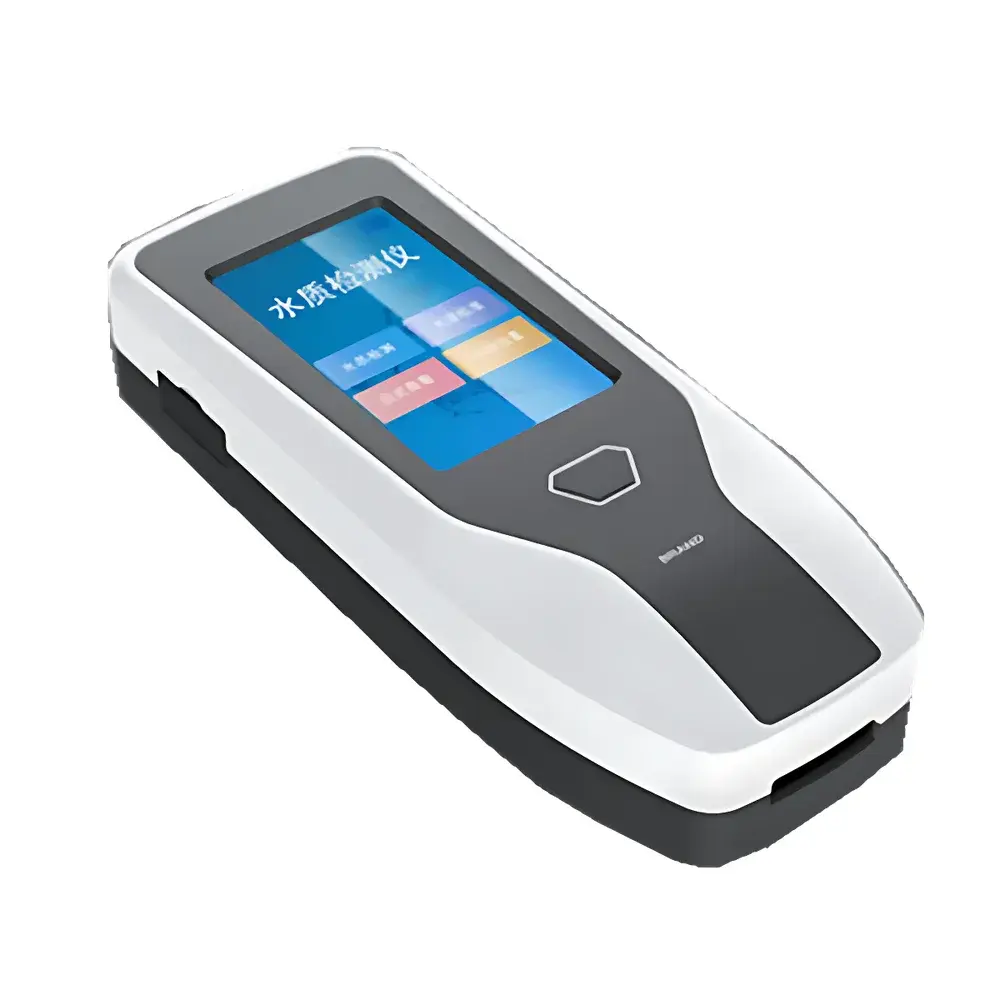
Portable Colloidal Gold Immunoassay Analyzer JT-DB10B by Ruixin
| Brand | Ruixin |
|---|---|
| Origin | Shanghai, China |
| Model | JT-DB10B |
| Detection Method | Colloidal Gold Immunochromatography |
| Measurement Range | 0.00–1000 ppb |
| Detection Limit (LOD) | 0.01 ppm |
| Accuracy | ±5% |
| Channel Count | 1 |
| Measurement Speed | <2 s per test |
| Display | 5-inch capacitive touchscreen (Android OS) |
| Power Supply | Built-in rechargeable lithium battery |
| Data Output | C/T line intensity, CT ratio, colorimetric quantification |
| Connectivity | Wi-Fi, Bluetooth, USB 2.0 |
| Compliance | Aligns with MOA Notice No. 102 (2022), “Three-Year Action Plan for Residue Control in Edible Agricultural Products”, and Technical Guidance for Cowpea, Leek & Celery Quality Safety Management |
Overview
The Ruixin JT-DB10B Portable Colloidal Gold Immunoassay Analyzer is a field-deployable optical quantification instrument engineered for rapid, objective interpretation of lateral flow immunoassay (LFIA) strips based on colloidal gold labeling technology. Unlike subjective visual assessment, the JT-DB10B employs a high-resolution CCD imaging sensor coupled with embedded AI-driven image analysis algorithms to convert qualitative test strip results into quantitative concentration values (ppb). It operates on the principle of reflectance photometry—measuring optical density differences between control (C) and test (T) lines—and calculating normalized CT ratios to determine analyte concentration against pre-calibrated standard curves. Designed specifically for food safety laboratories, agricultural extension stations, and on-site regulatory inspection teams, the device supports standardized detection of pesticide residues (e.g., organophosphates, carbamates), mycotoxins (e.g., aflatoxin B1), veterinary drug residues (e.g., chloramphenicol, sulfonamides), and pathogen antigens in complex matrices including leafy vegetables, fruits, aquatic products, poultry eggs, and cereal grains.
Key Features
- High-fidelity CCD imaging system with auto-focus and uniform LED illumination ensures consistent capture of lateral flow strip morphology under variable ambient lighting conditions.
- Real-time AI-based strip classification: automatically identifies valid vs. invalid assays (e.g., insufficient sample volume, capillary flow failure, or non-specific binding) prior to quantification.
- One-touch operation via intuitive Android-based UI; no software installation or PC dependency required.
- On-device data management: stores ≥10,000 test records with timestamp, operator ID, sample ID, and raw image metadata; supports export via USB or cloud sync.
- Integrated wireless modules (Wi-Fi 802.11 b/g/n, Bluetooth 4.2) enable secure transmission to LIMS, cloud platforms (e.g., Ruixin Cloud), or third-party regulatory databases.
- Field-ready power architecture: 7,800 mAh lithium-ion battery provides >8 hours continuous operation; charging via micro-USB or optional vehicle adapter.
- Open platform design includes built-in instructional video library and firmware upgradability via OTA or local APK deployment.
Sample Compatibility & Compliance
The JT-DB10B is validated for use with commercially available colloidal gold-based rapid test kits compliant with Chinese Ministry of Agriculture and Rural Affairs (MARA) technical specifications. It supports all standard LFIA formats—including single-analyte and multi-analyte cards—with nitrocellulose membrane widths of 3.0–4.5 mm and typical assay durations of 5–15 minutes. Instrument performance meets the metrological requirements outlined in MARA Notice No. 102 (2022) for routine pesticide residue screening and aligns with the analytical validation criteria specified in GB/T 27404–2008 (Laboratory Quality Control Guidelines for Food Microbiology Testing) and GB/T 27403–2008 (Guidelines for Laboratory Quality Control in Food Chemical Analysis). While not certified under ISO/IEC 17025, the system supports GLP-aligned workflows through audit-trail-enabled data logging, user authentication, and electronic signature capability (via optional configuration).
Software & Data Management
The embedded Android 9.0 OS hosts Ruixin’s proprietary QuantScan™ software suite, which implements ISO/IEC 17025-aligned data integrity controls—including immutable timestamps, operator login credentials, and version-stamped calibration profiles. Each test record contains full-resolution strip images, CT ratio plots, concentration interpolations, and pass/fail flags based on user-defined thresholds. Data export options include CSV (for Excel or statistical packages), PDF reports (with QR-code-linked cloud verification), and direct API integration with Ruixin Cloud for centralized dashboard visualization, trend analytics, and automated alerting (e.g., exceedance notifications). All communications comply with TLS 1.2 encryption standards; local storage utilizes AES-256 encryption for sensitive records.
Applications
- Routine surveillance of organophosphate and carbamate residues in fresh produce (e.g., leek, celery, cowpea) per MARA Technical Guidance documents.
- On-farm screening of aflatoxin M1 in dairy products and aflatoxin B1 in maize, rice, and peanut samples.
- Verification testing at slaughterhouses and aquaculture facilities for chloramphenicol, nitrofurans, and malachite green.
- Emergency response deployments during foodborne outbreak investigations requiring rapid triage of suspected contamination sources.
- Training and capacity building for grassroots inspectors via integrated video tutorials and simulated test mode.
FAQ
Does the JT-DB10B require external calibration standards for each test kit?
No—calibration curves are pre-loaded per manufacturer-specified kit lot numbers; users only need to select the corresponding kit profile from the internal database.
Can the instrument store custom calibration curves?
Yes, advanced users may import validated curve parameters (four-parameter logistic or linear regression models) via USB for proprietary or research-grade assays.
Is the device compatible with non-Ruixin branded colloidal gold test strips?
It supports any lateral flow strip with standard C/T line geometry and visible colloidal gold signal; however, quantitative accuracy depends on kit-specific validation and curve alignment.
What cybersecurity measures protect data during cloud upload?
All transmissions use TLS 1.2 with certificate pinning; locally stored data is encrypted at rest using hardware-accelerated AES-256.
How is traceability maintained across field and lab environments?
Each test generates a unique digital fingerprint (SHA-256 hash) linked to GPS coordinates (if enabled), operator ID, and device serial number—enabling full chain-of-custody reconstruction during audits.





