
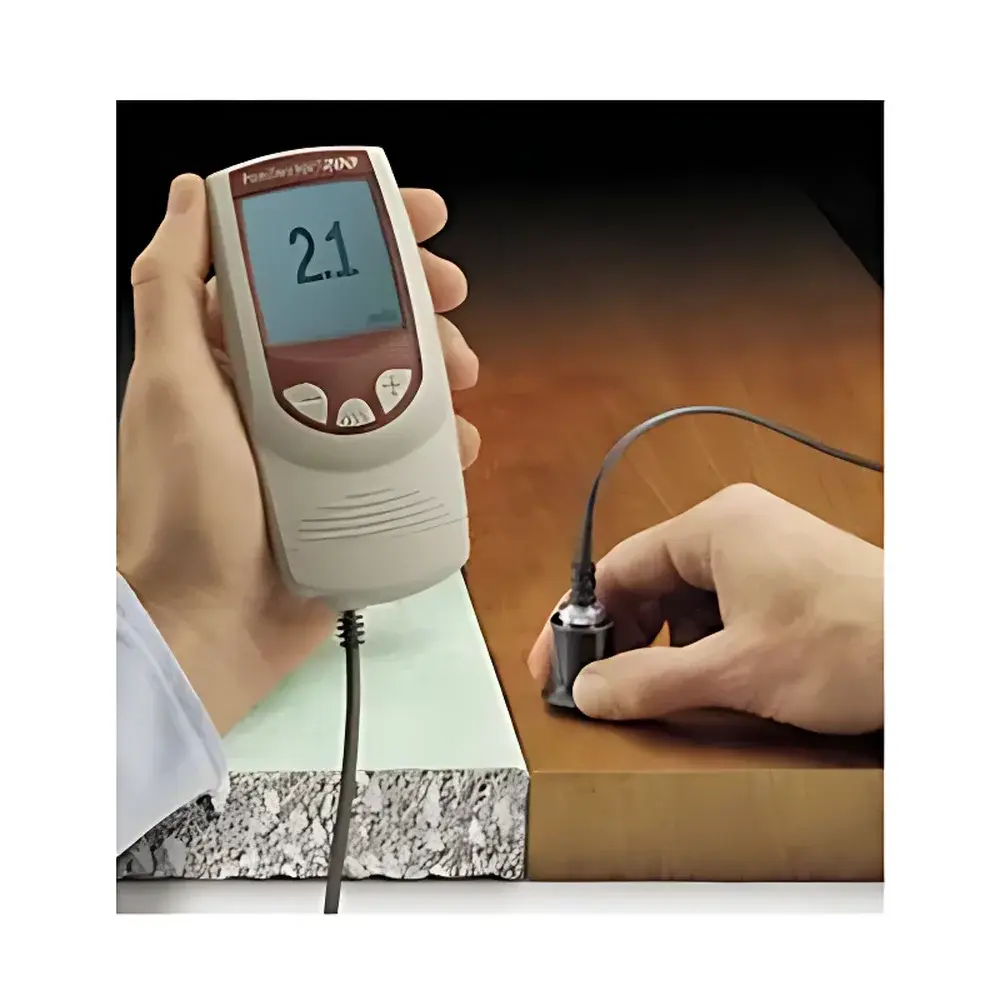
PosiTector 200 Non-Metallic Digital Coating Thickness Gauge
| Origin | Shanghai, China |
|---|---|
| Manufacturer Type | Authorized Distributor |
| Origin Category | Domestic (China) |
| Model | GW |
| Pricing | Available Upon Request |
| Measurement Principle | Ultrasonic Pulse-Echo |
| Standards Compliance | ASTM D6132, ISO 2808 |
| Measurement Range | 13–1000 µm |
| Accuracy | ±(2 µm + 3% of reading) |
| Measurement Speed | Up to 45 readings/minute |
| Data Storage | 10,000 readings (up to 1,000 batches) |
| Display | Backlit LCD with dual-color status LED |
| Environmental Rating | IP5X (dust-protected, water-splashing resistant) |
| Interface | USB, RS-232, and infrared |
| Power | Two AA batteries (typical life: 100+ hours) |
| Dimensions & Weight | 146 × 64 × 31 mm / 105 g |
| Units | Metric (µm) and Imperial (mils), switchable |
| Language Support | English, Spanish, French, German, Chinese, Japanese |
| Calibration | NIST-traceable certificate included |
| Warranty | 2 years (instrument and probe) |
Overview
The PosiTector 200 Non-Metallic Digital Coating Thickness Gauge is an ultrasonic pulse-echo based instrument engineered for precise, non-destructive measurement of coating thickness on non-conductive, low-density substrates—including wood, concrete, plastic, fiberglass, and gypsum board. Unlike magnetic induction or eddy current gauges—designed exclusively for metallic substrates—the PosiTector 200 employs time-of-flight analysis of high-frequency ultrasonic waves reflected at the coating-substrate interface. This principle enables reliable quantification without mechanical penetration, surface abrasion, or chemical dissolution, eliminating the need for destructive cross-sectioning per ASTM D7091 Annex A1 or ISO 2808 Clause 8. The device complies fully with ASTM D6132 “Standard Test Method for Nondestructive Measurement of Dry Film Thickness of Nonmetallic Protective Coatings Applied to Concrete Using an Ultrasonic Gauge” and ISO 2808:2019 “Paints and varnishes — Determination of film thickness”, ensuring methodological validity in quality control, commissioning inspections, and third-party verification workflows.
Key Features
- True non-destructive operation: No substrate damage, no sample preparation, no consumables required
- Intuitive menu-driven interface with tactile navigation buttons and dual-color LED status indicator (green = ready, red = error/warning)
- Ruggedized housing with overmolded rubber armor, meeting IP5X environmental protection standards for dust resistance and incidental water exposure
- Scratch- and solvent-resistant display window compatible with industrial solvents, oils, and alkaline cleaning agents
- High-speed acquisition engine delivering up to 45 stable readings per minute with real-time statistical feedback (mean, standard deviation, count)
- Factory-calibrated transducer with NIST-traceable calibration certificate; zero-point reset function restores default configuration instantly
- Extended battery life: >100 hours continuous use on two standard AA alkaline cells
Sample Compatibility & Compliance
The PosiTector 200 is validated for use on low-acoustic-impedance substrates where conventional electromagnetic methods fail. It reliably measures coatings—including epoxies, polyurethanes, acrylics, elastomeric membranes, intumescent fireproofing, and cementitious renders—on wood (solid, laminated, OSB), cast-in-place and precast concrete (cured ≥7 days, compressive strength ≥20 MPa), PVC and ABS plastics, fiber-reinforced polymer (FRP) panels, and drywall. All measurements adhere to the procedural rigor defined in ASTM D6132 Section 7 (probe placement, surface flatness, temperature limits) and ISO 2808 Clause 6.2 (environmental conditioning requirements). The gauge supports GLP-compliant data integrity through timestamped storage, audit-ready batch grouping, and user-configurable pass/fail thresholds aligned with project specifications or SSPC-PA 2 acceptance criteria.
Software & Data Management
Built-in memory retains up to 10,000 individual thickness values across 1,000 user-defined batches, each tagged with date, time, operator ID, and location metadata. Data export is supported via USB 2.0 (mass storage mode), RS-232 serial (DB9), and infrared (IrDA v1.1) interfaces—enabling seamless integration with laboratory information management systems (LIMS), QA databases, and reporting tools such as PosiSoft Desktop (Windows-compatible) or industry-standard CSV/Excel import pipelines. All stored records include full traceability: measurement sequence, probe model serial number, calibration date, and firmware revision. Audit trails comply with FDA 21 CFR Part 11 requirements when used with validated software configurations and electronic signature protocols.
Applications
- Quality assurance of architectural coatings on timber cladding and structural glulam beams
- Verification of waterproofing membrane thickness on bridge decks and parking structures
- In-service inspection of protective linings in wastewater treatment plants (concrete tanks, channels)
- Commissioning checks for fire-resistive coatings on structural steel encasements (applied over concrete or gypsum lagging)
- Field validation of floor topping thickness in commercial concrete slab installations
- R&D screening of novel composite coatings on FRP substrates in aerospace and marine manufacturing
FAQ
Can the PosiTector 200 measure coatings on carbon fiber or aluminum substrates?
No. It is specifically designed for non-metallic, low-density substrates. Metallic or highly conductive surfaces require magnetic induction (e.g., PosiTector 6000 F-series) or eddy current (e.g., PosiTector 6000 C-series) gauges.
Is surface roughness compensation available?
The instrument does not perform automatic roughness correction. For optimal accuracy, substrate surface profile should comply with ASTM D4417 Method C (maximum peak-to-valley height ≤25% of coating thickness) prior to measurement.
What is the minimum substrate thickness required for valid measurement?
Concrete and wood substrates must be ≥25 mm thick to prevent back-wall interference effects; thinner sections may yield erroneous high readings due to signal coupling into the support structure.
Does the gauge require periodic recalibration?
Annual recalibration is recommended per ISO/IEC 17025 guidelines. Field verification using certified thickness standards (e.g., PosiTest SH-100 series) should be performed before each work shift or after probe replacement.
Can multiple operators share one device with individual logins?
Yes. User profiles can be assigned via PosiSoft Desktop; operator IDs are embedded in all exported data files and batch headers for accountability in regulated environments.



