
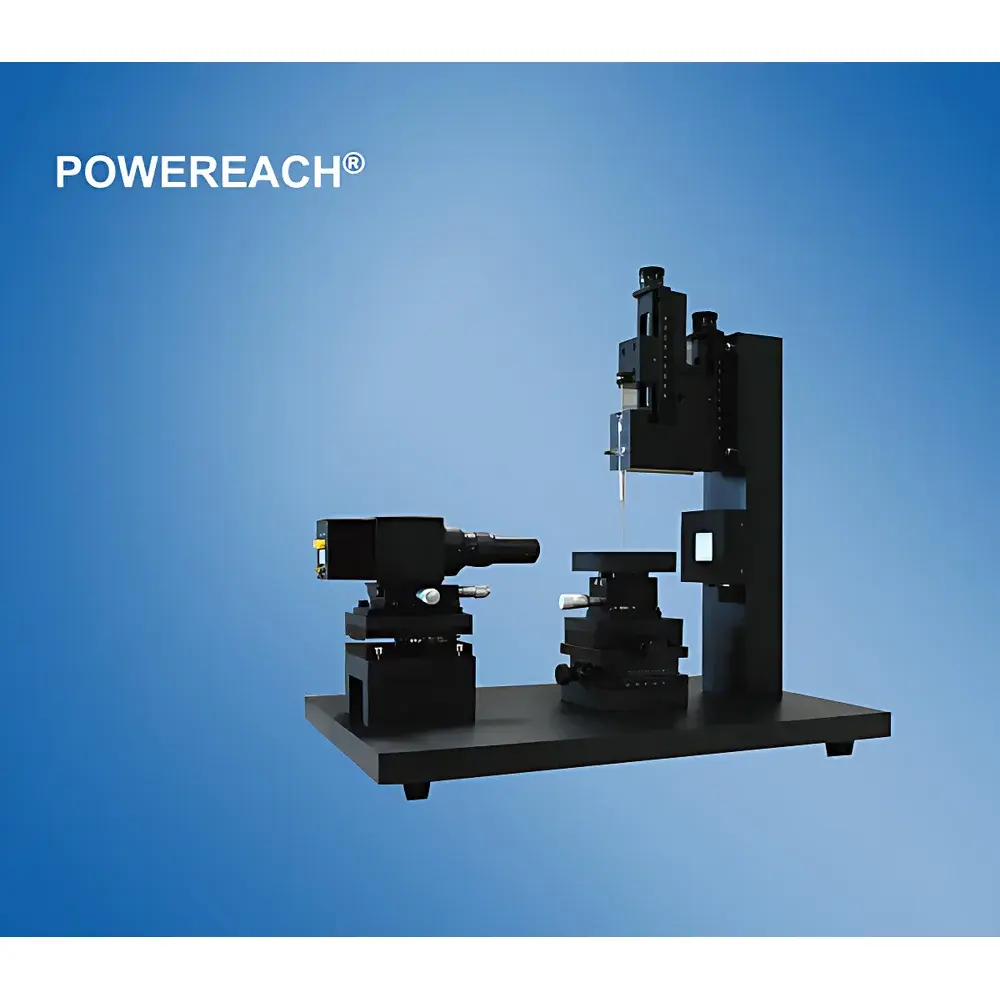
POWEREACH JC2000C1 Advanced Contact Angle Goniometer & Interfacial Tension Analyzer
| Brand | POWEREACH (Shanghai Zhongchen Digital Technology Equipment Co., Ltd.) |
|---|---|
| Origin | Shanghai, China |
| Model | JC2000C1 |
| Instrument Type | Benchtop Laboratory Goniometer |
| Contact Angle Measurement Range | 0–180° |
| Contact Angle Resolution | 0.01° |
| Contact Angle Accuracy | ±0.1° or ±0.5° (selectable via tangent method) |
| Sample Stage Dimensions | 70 mm × 100 mm (fixed) |
| Maximum Sample Size (L×W×H) | ≤100 mm × ∞ × 25 mm |
| Maximum Sample Thickness | 25 mm |
| Image Magnification | 50–318 pixels/mm |
| Surface/Interfacial Tension Range (Pendant Drop Method) | 0.01–2000 mN/m |
| Surface/Interfacial Tension Accuracy | ±0.01 mN/m |
| Measurement Modes | Static contact angle, advancing/receding angle (via syringe infusion/withdrawal), dynamic contact angle, sessile drop, pendant drop, captive bubble |
| Software Analysis Methods | Tangent (3-/4-/5-point), circle/ellipse fitting, Young–Laplace curve fitting, Owens–Wendt two-liquid surface energy model |
| Imaging Capture Modes | Single-frame freeze, time-lapse (1–3600 s interval), high-speed video (30 fps) |
| Mechanical Adjustments | 4-axis manual stage (X/Y/Z + tilt) |
Overview
The POWEREACH JC2000C1 is a precision benchtop goniometer engineered for quantitative analysis of solid–liquid–gas interfacial behavior. It operates on the fundamental principle of optical drop shape analysis—capturing high-resolution images of sessile, pendant, or captive liquid droplets on solid substrates and applying geometric or physical models to extract contact angle and interfacial tension values. The system integrates a USB digital CCD camera with a continuously variable zoom optical path, enabling accurate pixel-scale calibration across magnifications from 50 to 318 pixels/mm. Designed for rigorous academic and industrial R&D environments, the JC2000C1 supports static, dynamic, and hysteresis-based wetting characterization—including advancing and receding angles—critical for evaluating surface heterogeneity, chemical modification efficacy, and coating uniformity. Its architecture adheres to core metrological principles: traceable image acquisition, deterministic edge detection algorithms, and model-based fitting (e.g., Young–Laplace equation for pendant drop interfacial tension), ensuring measurement reproducibility compliant with ASTM D7334 (Standard Practice for Surface Wettability of Coated Surfaces) and ISO 19403-2 (Paints and varnishes — Contact angle measurements — Part 2: Determination of the contact angle).
Key Features
- Four-axis manual mechanical stage (X/Y/Z translation + tilt) with calibrated micrometer drives for precise sample positioning and orientation control
- Dual-resolution contact angle measurement: selectable ±0.1° or ±0.5° accuracy in tangent-based analysis, optimized for routine QC or high-fidelity research
- Comprehensive imaging flexibility: single-frame freeze capture, programmable time-lapse acquisition (1–3600 s intervals), and real-time 30 fps high-speed video for dynamic wetting kinetics
- Multi-method analytical engine: supports tangent (3-, 4-, and 5-point), circle/ellipse, and Young–Laplace curve fitting—eliminating subjective operator bias in baseline and tangent line definition
- Integrated pendant drop module for surface/interfacial tension quantification (0.01–2000 mN/m) with ±0.01 mN/m resolution, validated against standard surfactant solutions per ISO 6883
- Surface free energy calculation using the Owens–Wendt two-liquid method and other established models (e.g., Wu harmonic mean, Fowkes)
- Modular hardware design: detachable syringe pump interface, interchangeable lenses, and standardized USB 2.0 connectivity for broad compatibility with modern computing platforms
Sample Compatibility & Compliance
The JC2000C1 accommodates diverse material geometries without requiring vacuum or environmental chamber integration. Flat, curved, porous, fibrous, or particulate samples—including pressed powders, textiles, membranes, thin films, and bulk polymers—are compatible within its 100 mm × ∞ × 25 mm dimensional envelope. The 70 mm × 100 mm fixed stage and 25 mm maximum sample thickness enable stable mounting of irregular or oversized specimens. All measurement protocols align with internationally recognized standards governing interfacial characterization: ASTM D5725 (Standard Test Method for Surface Wettability of Paper and Paperboard), ISO 19403-4 (Contact angle determination via sessile drop), and USP (Analytical Instrument Qualification) guidelines for instrument performance verification. Data integrity is maintained through timestamped image metadata, audit-trail-enabled software logging, and export-ready CSV/PNG outputs suitable for GLP/GMP documentation workflows.
Software & Data Management
The proprietary JC2000 Series Analysis Software provides a unified platform for image acquisition, real-time processing, and quantitative reporting. It features non-destructive image annotation, batch processing of multi-condition experiments, and automated report generation with customizable templates (PDF/Excel). All raw images and processed parameters—including contact angle, droplet volume, base diameter, curvature radius, and surface energy components—are stored with full metadata (timestamp, operator ID, instrument configuration, calibration status). The software architecture supports 21 CFR Part 11–compliant user access controls when deployed on validated Windows systems, including role-based permissions, electronic signatures, and immutable audit trails for regulatory submissions. Firmware and application updates are provided free of charge for the lifetime of the instrument, ensuring long-term compatibility with evolving OS environments and analytical requirements.
Applications
The JC2000C1 serves as a foundational tool across materials science, pharmaceutical development, and industrial quality assurance. In nanomaterials research, it quantifies changes in hydrophobicity/hydrophilicity following plasma treatment, silanization, or atomic layer deposition. In battery R&D, it characterizes electrolyte wettability on separator membranes and anode/cathode coatings—directly correlating with ion transport efficiency. For biomedical device manufacturers, it validates surface functionalization of implants, catheters, and microfluidic chips per ISO 10993-4 biocompatibility testing protocols. In coatings and adhesives, advancing/receding angle hysteresis data inform bond strength prediction and failure mode analysis. Additional use cases include CMC determination for surfactants, inkjet printability assessment, textile moisture management evaluation, and geological core sample wettability profiling in enhanced oil recovery studies.
FAQ
What computer specifications are required to operate the JC2000C1?
A Windows PC (7/10/11) with one available USB 2.0 port, minimum 4 GB RAM, and 500 MB free disk space is sufficient. Laptops, desktops, and all-in-ones are supported.
Is the instrument capable of measuring contact angles on rough or heterogeneous surfaces?
Yes—the 5-point curve fitting and Young–Laplace methods accommodate topographical variation; advancing/receding angle protocols further resolve local energy heterogeneity.
Can the system perform interfacial tension measurements between two immiscible liquids?
Yes—using the pendant drop method with appropriate density-matched liquid pairs, the JC2000C1 measures interfacial tension across the full 0.01–2000 mN/m range.
Does the software support Good Manufacturing Practice (GMP) compliance?
When installed on a validated Windows system with controlled user accounts, the software’s audit trail, electronic signature, and data export functions meet key elements of FDA 21 CFR Part 11 and EU Annex 11 requirements.
What maintenance is required for long-term calibration stability?
Annual verification using certified reference standards (e.g., NIST-traceable contact angle calibration slides and surfactant solutions) is recommended; no consumables or routine recalibration are required between verifications.



