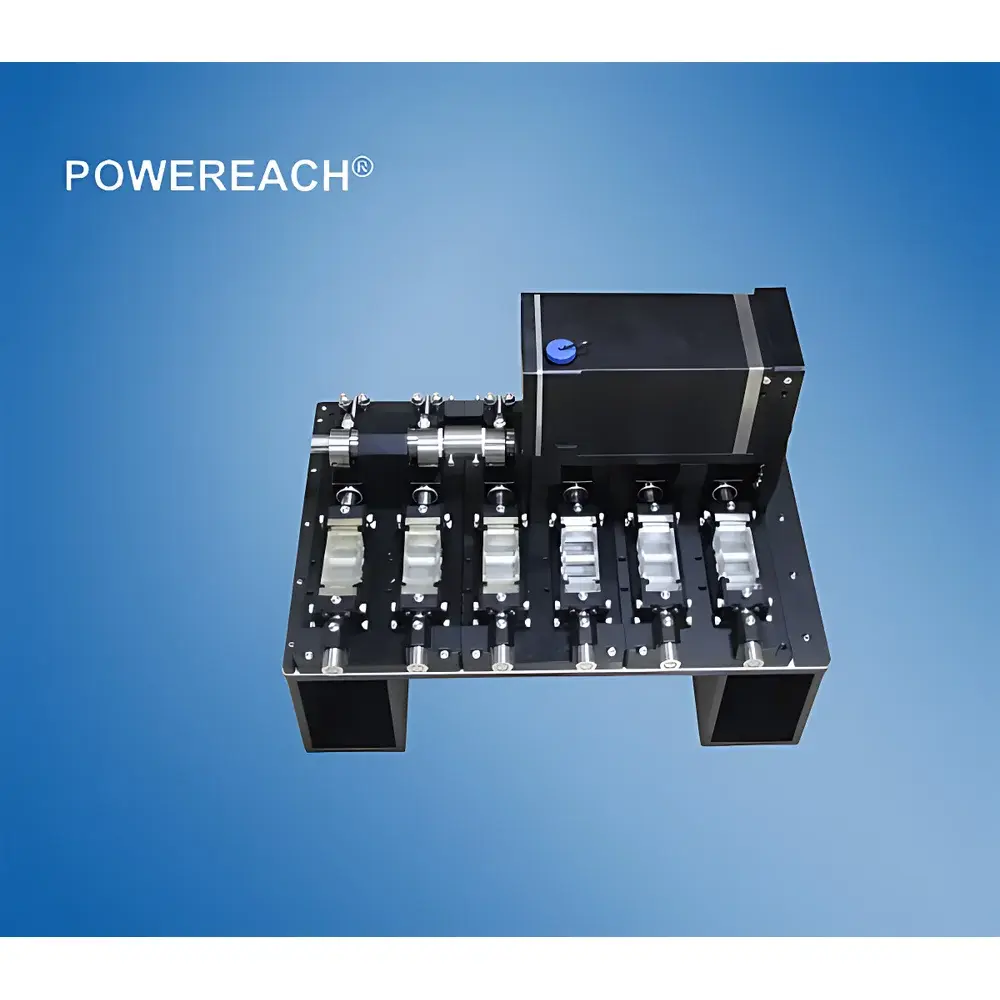
POWEREACH JLS14 Cellular Stretching Instrument
| Brand | POWEREACH (Shanghai Zhongchen) |
|---|---|
| Origin | Shanghai, China |
| Manufacturer Type | Authorized Distributor |
| Country of Origin | China |
| Model | JLS14 |
| Pricing | Upon Request |
| Software Included | Yes (JLS-Control Suite v3.x) |
| Delivery & Installation | Door-to-door in Mainland China with on-site commissioning and operator training |
| Warranty | 12 months parts and labor |
| PC Requirement | Windows 7/10 (32-bit), 1× USB 2.0 port, 1× RS-232 serial port (DB9) |
| Optional OEM PC | +USD 560 (incl. 3-year onsite warranty) |
Overview
The POWEREACH JLS14 Cellular Stretching Instrument is an engineered biomechanical stimulation platform designed for quantitative, time-resolved investigation of cellular mechanotransduction under controlled uniaxial or biaxial tensile strain. It operates on the principle of motor-driven, programmable substrate deformation—where flexible silicone or PDMS culture membranes are cyclically stretched via precision linear actuators synchronized with real-time optical monitoring. The system enables reproducible application of physiological or pathological strain magnitudes (0.5–20% elongation), frequencies (0.01–5 Hz), and waveforms (sinusoidal, square, ramp, or custom-defined profiles), facilitating studies of cytoskeletal reorganization, nuclear deformation, focal adhesion dynamics, and gene expression modulation in response to mechanical cues. As a non-invasive, in vitro tool, it integrates seamlessly into standard cell culture workflows and supports live-cell imaging compatibility when used with inverted microscopes.
Key Features
- Programmable strain control: Adjustable amplitude (0.5–20%), frequency (0.01–5 Hz), duty cycle, and waveform shape via intuitive GUI
- Dual-mode actuation: Supports both uniaxial and biaxial stretching configurations using interchangeable loading frames
- Real-time synchronization: TTL-triggered output for coordination with high-speed cameras, fluorescence microscopes, or electrophysiology rigs
- Temperature- and CO2-compatible chamber: Optional environmental enclosure maintains 37 °C and 5% CO2 during extended experiments (up to 72 h)
- Calibrated force feedback: Integrated load cell (±0.05 mN resolution) validates applied stress across membrane geometries
- Modular design: Interchangeable culture substrates (35 mm, 60 mm, and custom-cut PDMS membranes) with standardized mounting fixtures
- GLP-compliant operation log: Timestamped parameter records, user authentication, and audit trail export (CSV/Excel)
Sample Compatibility & Compliance
The JLS14 accommodates adherent mammalian cell lines (e.g., NIH/3T3, C2C12, HUVECs, A549), primary cells (cardiomyocytes, fibroblasts, osteoblasts), and co-cultures grown on compliant elastomeric substrates. Membrane thickness (25–100 µm) and stiffness (10–200 kPa) are configurable to mimic tissue-specific mechanical microenvironments. All hardware components meet IEC 61000-6-2 (EMC immunity) and IEC 61000-6-4 (EMC emission) standards. Software complies with FDA 21 CFR Part 11 requirements for electronic records and signatures when configured with user role management and digital signature modules. Device validation documentation (IQ/OQ protocols) is available upon request for GMP/GLP-regulated laboratories.
Software & Data Management
The JLS-Control Suite v3.x provides full instrument orchestration—including protocol definition, real-time strain visualization, event logging, and automated data export. Experimental parameters are stored in encrypted project files (.jlsproj) with embedded metadata (user ID, timestamp, calibration ID). Raw strain/time datasets export as ASCII-compatible .csv files compatible with MATLAB, Python (NumPy/Pandas), GraphPad Prism, and MATLAB-based analysis pipelines. Audit trails record all parameter changes, software updates, and user login/logout events. Remote monitoring via secure LAN connection is supported; cloud backup integration requires on-premise IT approval per institutional cybersecurity policy.
Applications
- Mechanobiology research: Quantifying YAP/TAZ nuclear translocation kinetics under dynamic stretch
- Cardiovascular modeling: Simulating cyclic strain on vascular smooth muscle cells to assess ECM remodeling
- Tissue engineering: Optimizing scaffold preconditioning protocols prior to implantation
- Drug screening: Evaluating compound effects on stretch-induced calcium signaling or inflammatory cytokine release
- Developmental biology: Probing embryonic cell sheet migration under directional mechanical cues
- Neuroscience: Investigating axon growth cone responses to substrate strain gradients
FAQ
Is the JLS14 compatible with live-cell fluorescence microscopy?
Yes—optical path clearance (≥45 mm working distance) and low-vibration actuation allow concurrent use with inverted epifluorescence and confocal systems.
Can strain profiles be imported from external sources (e.g., MATLAB)?
Yes—custom waveforms can be loaded via .csv-formatted time-series files with column headers “Time_s” and “Strain_percent”.
Does the system support multi-well or high-throughput configurations?
Not natively; the JLS14 is optimized for single-substrate, high-fidelity mechanostimulation. Parallelization requires multiple units or custom rack-mount integration.
What calibration certificates are provided?
Each unit ships with NIST-traceable load cell calibration certificate and strain accuracy verification report (±0.3% FS at 10% strain, 1 Hz).
Is remote software support available outside mainland China?
Yes—technical assistance is provided via TeamViewer-assisted diagnostics and firmware updates; English-language documentation and video tutorials are included.
Related Products