
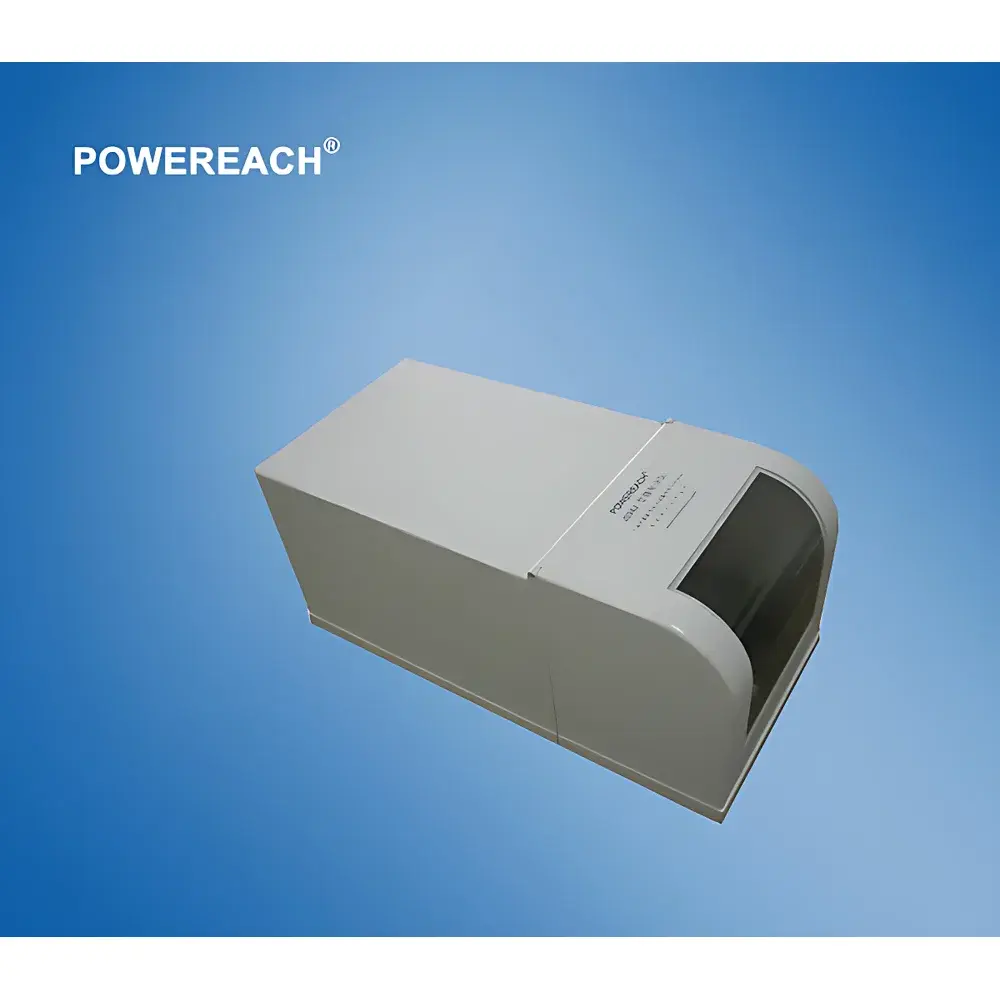
POWEREACH JS94J2-1K20X Microelectrophoresis Analyzer (Zeta Potential Analyzer)
| Brand | POWEREACH |
|---|---|
| Origin | Shanghai, China |
| Manufacturer Type | Authorized Distributor |
| Country of Origin | China |
| Model | JS94J2-1K20X |
| Zeta Potential Range | ±200 mV (typical, per GB/T 32668-2016 calibration protocol) |
| pH Range | 1.6–13.0 (standard operation: 2.0–12.0) |
| Operating Temperature | 20–35 °C |
| Temperature Resolution | 0.1 °C |
| Optical Resolution | 12 pixel/μm |
| Microscope System | WDK Japan high-magnification optical module, working distance 7 mm |
| System Accuracy | ≤5% relative error (per ISO 13099-2:2012 validation methodology) |
| Particle Size Applicability | 0.1–10 μm (aqueous & organic dispersions) |
| Power Consumption | <150 W, 220 V / 50 Hz |
Overview
The POWEREACH JS94J2-1K20X Microelectrophoresis Analyzer is a precision instrument engineered for direct measurement of electrophoretic mobility and subsequent calculation of zeta potential (ζ) in colloidal dispersions and emulsions. It implements the microscopic electrophoresis method—defined as the reference technique in GB/T 32668-2016, China’s national standard “General Rules for Zeta Potential Analysis of Colloidal Particles by Electrophoresis”—and aligns with the fundamental principles outlined in ISO 13099-2:2012 (Colloidal systems — Methods for determining zeta-potential — Part 2: Optical methods). Unlike light-scattering-based electrophoretic analyzers, this system enables real-time visual observation of individual particle motion under controlled electric fields, eliminating ensemble averaging artifacts and providing unambiguous validation of particle behavior. The instrument determines ζ via Smoluchowski approximation (applicable to aqueous systems with κa > 100), incorporating automatic temperature compensation, dynamic voltage polarity reversal, and frame-synchronized image capture at 1200× optical magnification. Its design prioritizes metrological traceability, repeatability, and compatibility with GLP-compliant laboratory workflows.
Key Features
- Optically validated microelectrophoresis platform compliant with GB/T 32668-2016 and referenced in ISO 13099-2:2012 Annex A
- WDK Japan high-resolution microscope optics (12 pixel/μm resolution, 7 mm working distance) with dual-wavelength (blue/green) semiconductor illumination (<50 μW output) to minimize thermal perturbation and enhance contrast for sub-micron particles
- Integrated open-cell electrophoresis chamber: 0.5 mm-thick borosilicate glass cuvette with embedded Ag, Pt, and POM electrodes; sample volume requirement only 0.5 mL per measurement
- Programmable low-frequency DC voltage source: polarity reversal interval adjustable from 0.30 s to 1.20 s; field strength independently tunable to avoid electrode polarization and ensure stable current density
- Real-time environmental monitoring: built-in thermistor probe continuously feeds temperature data to analysis software for automatic ζ correction using Henry’s function and dielectric constant interpolation
- Standardized imaging protocol: synchronized acquisition of four grayscale frames (two forward, two reverse direction) at user-defined exposure intervals (3–10 s total), processed via centroid-tracking algorithm
- Unified firmware architecture: single software suite supports full JS94 series configuration variants without retraining or license migration
Sample Compatibility & Compliance
The JS94J2-1K20X accommodates both aqueous and organic dispersions across a broad physicochemical spectrum. Validated applications include silica, titania, polystyrene latex, liposomes, protein aggregates, clay suspensions, and pigment dispersions within the 0.1–10 μm size range. Its operational pH window spans 1.6–13.0, enabling studies of acid-stable oxides (e.g., alumina in HCl media) and alkali-tolerant polymers (e.g., carboxymethyl cellulose above pH 12). All measurements adhere to the reporting conventions of ASTM D7824–18 (Standard Guide for Zeta Potential Measurement) and support audit-ready documentation required under FDA 21 CFR Part 11 when deployed with configured electronic signatures and change control logs. The instrument meets IEC 61000-4 electromagnetic compatibility standards and operates safely on vibration-isolated optical tables per ISO 10816-1 mechanical stability guidelines.
Software & Data Management
The included Windows-based application provides full acquisition, processing, and reporting functionality. It implements automated calibration routines using NIST-traceable latex standards (e.g., Duke Scientific 3000A), stores raw image sequences with metadata (timestamp, voltage, temperature, pH), and exports ζ distributions as CSV or PDF reports compliant with ISO/IEC 17025 documentation requirements. Audit trail features log all parameter modifications, user actions, and software updates. Data integrity is enforced through checksum verification and optional AES-256 encryption for exported datasets. Software updates are delivered free-of-charge for the instrument’s lifetime and maintain backward compatibility with legacy JS94-series data files. No cloud dependency: all computation occurs locally, satisfying data sovereignty requirements for regulated industries including pharmaceutical manufacturing (ICH Q5C) and medical device development (ISO 10993-12).
Applications
This analyzer serves critical roles in formulation science and interfacial characterization. In cosmetics R&D, it quantifies charge stabilization of nanoemulsions and solid lipid nanoparticles under varying surfactant concentrations. In mineral processing, it maps pH-dependent ζ shifts during froth flotation optimization for copper sulfide ores. For pharmaceutical colloids, it validates surface charge reversal during polymer coating of PLGA microparticles—a key indicator of batch consistency per USP . In battery materials research, it assesses zeta potential trends of cathode slurries (e.g., NMC622 in NMP) to predict dispersion stability and electrode homogeneity. Academic labs use it to teach electrokinetic theory, isoelectric point determination, and Stern layer modeling—supported by its transparent optical path and real-time particle tracking capability.
FAQ
What regulatory standards does the JS94J2-1K20X comply with?
It conforms to GB/T 32668-2016 (China National Standard), ISO 13099-2:2012, ASTM D7824–18, and supports compliance with FDA 21 CFR Part 11, ISO/IEC 17025, and ICH Q5C through configurable software audit trails.
Can it measure zeta potential in non-aqueous solvents?
Yes—validated for common organic media including ethanol, isopropanol, ethyl acetate, and N-methyl-2-pyrrolidone (NMP), provided conductivity remains within 1–500 μS/cm and viscosity does not exceed 20 cP.
How is temperature controlled during measurement?
The system uses passive thermal equilibrium on an anti-vibration table; active cooling/heating is not integrated, but ambient lab temperature must be stabilized between 20–35 °C per ISO 291 environmental conditioning requirements.
Is calibration traceable to international standards?
Yes—calibration employs NIST-certified monodisperse polystyrene standards (e.g., Duke 3000A) and certified pH buffers; full calibration certificates are generated within the software.
What computing hardware is required?
A dedicated Dell OEM workstation (included) with Intel Core i5-8500, 16 GB RAM, 512 GB SSD, and Windows 10 Pro 64-bit is preconfigured and validated for real-time image capture and analysis.



