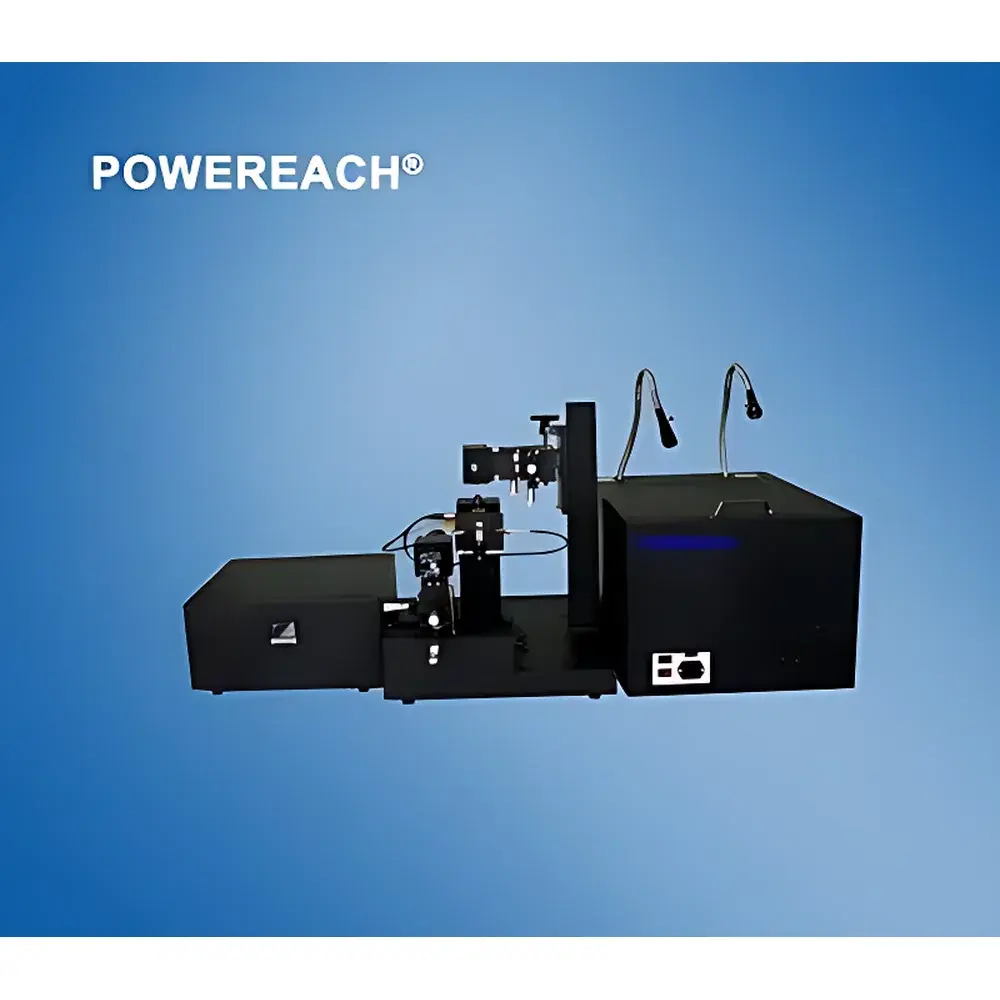
POWEREACH JWQ06 Single-Fiber Bending Fatigue Tester
| Brand | POWEREACH |
|---|---|
| Model | JWQ06 |
| Application | Textile Fiber Mechanical Testing |
| Measurement Principle | Controlled Oscillatory Bending under Tension |
| Sample Type | Individual Filaments (Aramid, Carbon, Glass, UHMWPE) |
| Adjustable Bend Radius | Yes |
| Environmental Operation | Ambient to Elevated/Low Temperatures |
| Tension Monitoring | Real-time Dynamic Tension Measurement during Bending Cycles |
| Control Interface | PC-based Software with RS232/USB Connectivity |
| Compliance Context | ASTM D3822, ISO 5079, GB/T 14337, ISO 1973 (adapted for bending fatigue extension) |
| Software Features | Cycle Counting, Load-Time Curve Logging, Pre-tension Calibration, Angle & Frequency Parameterization |
Overview
The POWEREACH JWQ06 Single-Fiber Bending Fatigue Tester is an engineered instrument designed for quantitative evaluation of flexural durability in high-performance monofilaments. It operates on the principle of controlled oscillatory bending—subjecting a single fiber segment, clamped at fixed endpoints, to repeated angular deflection about a programmable pivot radius while maintaining precise pre-tension. This replicates service-induced cyclic flexure encountered in technical textiles, composite reinforcement preforms, and protective apparel. Unlike tensile fatigue systems, the JWQ06 isolates bending-dominated failure mechanisms—including surface microcracking, interfacial debonding in coated fibers, and progressive kink-band formation—enabling structure–property correlation for advanced fiber development and quality assurance. Its architecture supports standardized test protocols adapted from ASTM D3822 (tensile properties of single textile fibers) and ISO 5079 (determination of breaking force and elongation of single fibers), extended to bending fatigue via defined angular amplitude, frequency, and environmental conditioning.
Key Features
- Programmable oscillation parameters: bend angle (±5° to ±45°), frequency (0.1–5 Hz), and cycle count (up to 106 cycles) are digitally adjustable via intuitive PC software.
- Real-time dynamic tension monitoring throughout each bending cycle using integrated load cell feedback—critical for detecting early-stage stiffness degradation or hysteresis growth.
- Adjustable bending radius (2–20 mm) accommodates fibers ranging from 5 µm (e.g., ultrafine glass) to 100 µm (e.g., industrial aramid filaments), ensuring geometric consistency across material classes.
- Digital optical observation system (5 MP CMOS camera, 10×–50× magnification) synchronized with motion control enables frame-locked imaging of fiber deformation, surface fracture initiation, and localized buckling during fatigue progression.
- Thermostatically compatible design allows integration with environmental chambers (−20°C to +80°C) for temperature-dependent bending fatigue assessment per ISO 1973 Annex B guidelines.
- Modular夹具 (clamping) interface supports pneumatic, v-groove, and micro-screw fixtures—optimized for brittle carbon fibers, slippery UHMWPE, and high-modulus aramids without slippage or end damage.
Sample Compatibility & Compliance
The JWQ06 is validated for testing individual filaments ≤150 µm in diameter and ≥10 mm in gauge length, including but not limited to para-aramid (Kevlar®, Twaron®), polyacrylonitrile-based carbon precursors, E-glass and S-glass filaments, and ultra-high-molecular-weight polyethylene (Dyneema®, Spectra®). It meets functional requirements for method validation under GLP-compliant laboratories when paired with audit-trail-enabled software (optional FDA 21 CFR Part 11 module available). Test data output conforms to ISO/IEC 17025 documentation standards, supporting traceability of calibration certificates (load cell, encoder, thermal sensor), uncertainty budgets, and raw time-series datasets. The system satisfies clause 6.2 of GB/T 14337–2016 (Chinese national standard for single-fiber tensile testing) when adapted for bending fatigue through documented method equivalence protocols.
Software & Data Management
The proprietary POWEREACH FiberFatigue™ software provides deterministic control, real-time visualization, and structured data export. Each test session generates timestamped CSV files containing cycle number, instantaneous angle, measured tension, elapsed time, and camera trigger markers. Statistical analysis modules compute median cycles-to-failure (Nf50), Weibull modulus (m), and stiffness decay rate (dE/dN). All user actions—including parameter changes, calibration events, and manual intervention flags—are logged with operator ID and system timestamp. Raw video sequences (AVI/H.264) are stored with metadata linking frames to corresponding mechanical data points. Export formats include ASTM E1958-compliant XML reports and Excel-ready templates aligned with textile industry QA workflows.
Applications
- Accelerated lifetime prediction of high-strength fibers used in ballistic fabrics, where bending fatigue governs delamination resistance in multi-layer assemblies.
- Comparative screening of surface treatments (e.g., plasma etching, sizing agents) on carbon fiber flexural endurance—quantifying improvement in interfacial shear transfer efficiency.
- Validation of filament winding process parameters by correlating mandrel radius-induced bending strain with post-cure matrix cracking thresholds.
- Research into fatigue crack nucleation in bio-based fibers (e.g., lyocell, PTT) under cyclic flexure mimicking garment wear conditions.
- Supporting ISO/TC 38/WG 22 efforts to standardize bending fatigue test methods for next-generation technical fibers.
FAQ
What sample preparation is required prior to testing?
Fibers must be cut to 30–50 mm lengths, cleaned ultrasonically in isopropanol, and mounted taut between clamps with no visible twist or slack. Gauge length is set to 10–20 mm depending on bending radius.
Is the system compatible with third-party environmental chambers?
Yes—standardized flange interfaces and RS232/USB passthrough enable seamless integration with commercially available thermal chambers meeting IEC 60068-2-1/-2 specifications.
Can bending radius be changed mid-test?
No—radius is fixed per test run to ensure mechanical boundary condition consistency; however, rapid reconfiguration (<5 min) between tests is supported via calibrated radius inserts.
Does the software support automated pass/fail decision logic?
Yes—users define acceptance criteria (e.g., “fail if tension drop >15% within first 10,000 cycles”) and generate binary compliance reports per batch.
What maintenance intervals are recommended?
Load cell recalibration annually; optical path cleaning weekly; pivot bearing lubrication every 6 months; full system verification against NIST-traceable reference fibers biannually.