
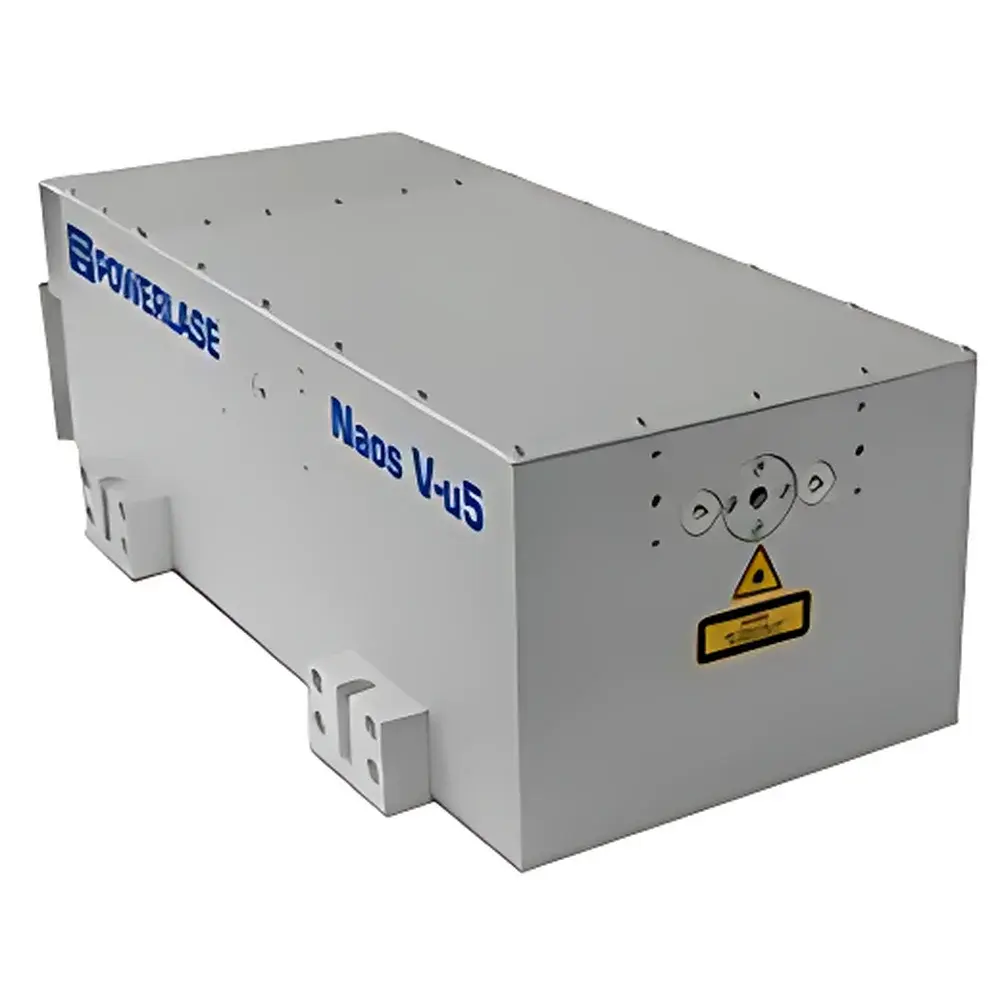
Powerlase Naos V-Series Diode-Pumped Solid-State (DPSS) Nanosecond Lasers
| Origin | UK |
|---|---|
| Manufacturer Type | Authorized Distributor |
| Origin Category | Imported |
| Model | Naos V-Series |
| Price Range | USD 13,500 – 40,500 (FOB) |
| Core Technology | Diode-pumped solid-state (DPSS) Q-switched laser systems |
| Wavelength Options | 1064 nm, 532 nm, 355 nm |
| Max Avg. Power | 20 W |
| Repetition Rate | 20–100 kHz |
| Pulse Width | <15–25 ns |
| Beam Quality | TEM₀₀, M² < 1.3 |
| Polarization | Linear or Vertical, >100:1 |
| Cooling | Air-cooled |
| Compliance | CE, RoHS, IEC 60825-1:2014 Class 4 Laser Product |
Overview
The Powerlase Naos V-Series represents a family of industrial-grade, diode-pumped solid-state (DPSS) nanosecond lasers engineered for high-reliability pulsed operation in demanding manufacturing and scientific environments. Based on master oscillator power amplifier (MOPA) architecture with intracavity harmonic generation, these lasers deliver stable, diffraction-limited output across three fundamental harmonics: 1064 nm (fundamental), 532 nm (second harmonic), and 355 nm (third harmonic). Designed for precision material processing—including thin-film ablation, semiconductor scribing, micromachining, and laser-induced breakdown spectroscopy (LIBS)—the Naos V-Series combines high pulse energy (>400 µJ at 20 kHz), excellent temporal stability (<3.0% RMS energy fluctuation), and sub-25 ns pulse widths with air-cooled thermal management. All models comply with IEC 60825-1:2014 as Class 4 laser products and are CE-marked for integration into OEM equipment and automated production lines.
Key Features
- High average power output up to 20 W at 1064 nm, scalable across harmonics with optimized conversion efficiency
- Flexible repetition rate tuning from 20 kHz to 100 kHz, enabling process optimization for throughput vs. thermal load trade-offs
- TEM₀₀ beam profile with M² < 1.3 and divergence < 3 mrad—ensuring tight focusability and consistent spot size over working distances
- Air-cooled design eliminates dependency on external chillers, reducing system footprint and operational complexity
- Integrated digital control interface (RS-232 / USB) supporting remote parameter adjustment, status monitoring, and interlock management
- Robust mechanical architecture with vibration-damped optical mounts and hermetically sealed laser heads rated for continuous operation in ambient temperatures from 10 °C to 40 °C
- Low power consumption (< 4.2 kW total system draw), optimized for integration into energy-sensitive cleanroom or lab environments
Sample Compatibility & Compliance
The Naos V-Series is compatible with a broad range of optically transparent and absorbing materials, including silicon wafers, glass substrates, polymer films, ceramics, and metal alloys. Its nanosecond pulse regime enables non-thermal ablation mechanisms critical for high-resolution patterning without collateral thermal damage. All units meet international safety and electromagnetic compatibility standards: CE marking per Directive 2014/30/EU (EMC) and 2014/35/EU (LVD); compliance with IEC 60825-1:2014 for laser safety classification; and RoHS 2011/65/EU for hazardous substance restriction. The laser system supports full traceability in regulated environments through optional TTL-compatible shutter control, analog power monitoring outputs, and hardware interlocks aligned with ISO 13849-1 PL e functional safety requirements.
Software & Data Management
Powerlase provides the Naos Control Suite—a Windows-based configuration and diagnostics application enabling real-time monitoring of laser parameters including pulse energy, repetition rate, internal temperature, and diode current. The software logs timestamped operational data with configurable sampling intervals, supporting GLP-compliant audit trails when deployed in QC laboratories. For integration into automated platforms, the Naos V-Series offers native support for Modbus RTU and ASCII command protocols over RS-232 or USB virtual COM port. All firmware updates are delivered via signed binary packages with SHA-256 checksum verification, ensuring integrity during field deployment. Optional SDKs (C/C++, .NET, Python) facilitate custom integration with machine vision systems, motion controllers, and MES/SCADA infrastructure under FDA 21 CFR Part 11-aligned electronic record workflows.
Applications
- Semiconductor manufacturing: Wafer dicing, via drilling, and thin-film removal on Si, GaAs, and OLED substrates
- Microelectronics: PCB depaneling, flex circuit trimming, and solder mask ablation with minimal HAZ
- Medical device fabrication: Precision cutting of nitinol stents and polymer catheter components
- Scientific instrumentation: Pump source for OPOs, LIBS excitation, time-resolved fluorescence lifetime measurements
- Display manufacturing: LTPS annealing, touch sensor patterning, and micro-LED lift-off processes
- Automotive sensors: Lidar calibration targets, MEMS mirror actuation testing, and coating adhesion assessment
FAQ
What is the maximum pulse energy achievable at 355 nm?
The Naos V-u5 model delivers >160 µJ at 30 kHz, while the V-u2 provides >60 µJ at the same repetition rate—both optimized for UV-sensitive applications requiring minimal thermal loading.
Is external water cooling required?
No. All Naos V-Series lasers are fully air-cooled and designed for plug-and-play operation without auxiliary chillers or plumbing infrastructure.
Can the laser be synchronized with external motion stages or cameras?
Yes. Standard TTL-compatible trigger inputs and outputs enable precise synchronization with motion controllers, galvanometers, and high-speed imaging systems with jitter < 10 ns.
What is the typical lifetime of the laser diode pump source?
Rated for >20,000 hours of continuous operation under specified thermal and drive conditions, with gradual degradation managed via built-in diode current compensation algorithms.
Are OEM integration kits available?
Yes. Powerlase offers mechanical mounting adapters, beam delivery collimators, fiber coupling options (for 1064 nm variants), and EMI-shielded power supply enclosures tailored to system-level integration requirements.





