
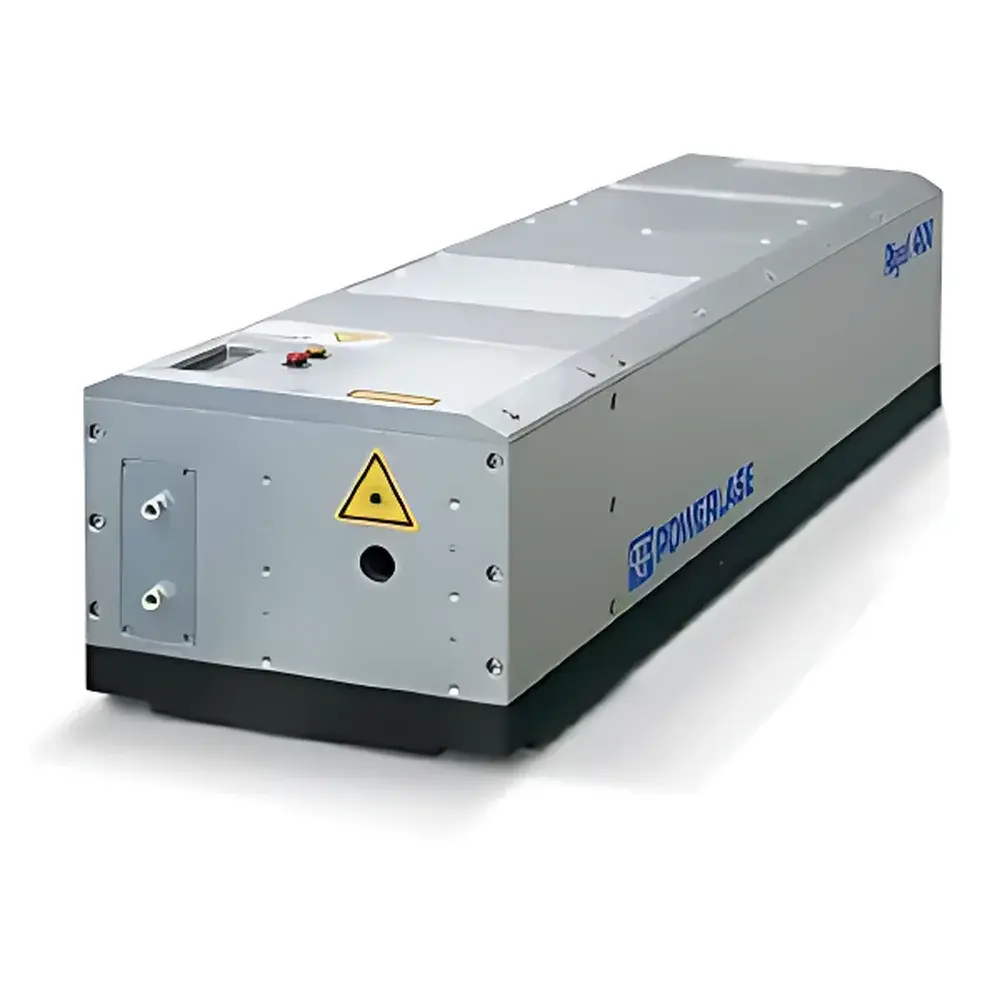
Powerlase Rigel Series High-Power, High-Repetition-Rate Diode-Pumped Solid-State (DPSS) Laser
| Brand | Powerlase |
|---|---|
| Origin | United Kingdom |
| Manufacturer Type | Authorized Distributor |
| Origin Category | Imported |
| Model Series | Rigel |
| Core Technology | Diode-Pumped Solid-State (DPSS) Laser System |
| Repetition Rate | 3–50 kHz |
| Beam Quality (M²) | <1.3 |
| Pulse Energy | Up to 2.5 mJ (model-dependent) |
| Average Output Power | Up to 125 W (model-dependent) |
| Wavelength Options | 1064 nm (fundamental), 532 nm (SHG), 355 nm (THG), 266 nm (FHG) |
| Cooling | Water-cooled |
| Control Interface | RS-232, USB, Ethernet (TCP/IP) |
| Compliance | CE, RoHS, IEC 60825-1:2014 Class 4 Laser Product |
Overview
The Powerlase Rigel Series is a family of industrial-grade, diode-pumped solid-state (DPSS) lasers engineered for demanding applications requiring simultaneous high average power, high pulse energy, and precise temporal control. Operating on the fundamental Nd:YAG wavelength at 1064 nm—with harmonic generation options extending to 532 nm (second harmonic), 355 nm (third harmonic), and 266 nm (fourth harmonic)—the Rigel platform leverages advanced thermal management, monolithic cavity design, and optimized pump diode architecture to deliver exceptional stability and beam fidelity. Its core operating principle relies on end-pumped, Q-switched DPSS technology, where high-brightness laser diodes excite a neodymium-doped crystal (typically Nd:YVO₄ or Nd:YAG), followed by active or passive Q-switching to generate nanosecond-duration pulses with sub-10 ns rise times. This architecture enables robust performance across both laboratory research and 24/7 production environments—particularly where reproducible ablation thresholds, minimal thermal load, and consistent photon flux are critical.
Key Features
- High Repetition Rate & Scalable Pulse Energy: Adjustable repetition rate from 3 kHz to 50 kHz, enabling flexible duty-cycle optimization; pulse energy scalable up to 2.5 mJ at lower repetition rates while maintaining >95% pulse-to-pulse energy stability (standard deviation ≤0.8%) over 8-hour operation.
- Diffraction-Limited Beam Quality: M² < 1.3 across all harmonics ensures tight focusability (<25 µm focal spot diameter with standard f-theta lenses), essential for high-resolution micromachining and nonlinear frequency conversion efficiency.
- Integrated Real-Time Monitoring: Onboard photodiodes, temperature sensors, and voltage/current monitors feed into an embedded microcontroller, providing live diagnostics via front-panel display or remote interface—including warning thresholds for coolant flow, cavity temperature drift (>±0.5 °C), and output power deviation (>±2%).
- Modular Output Configuration: Standard free-space output with optional fiber-coupling (SMF-28 or HI1060, NA 0.12–0.15) and motorized variable attenuators (OD 0–6, resolution 0.1 OD) for seamless integration into automated processing lines or multi-stage optical setups.
- Industrial-Grade Thermal Architecture: Dual-stage thermoelectric cooling combined with precision-regulated water cooling (flow rate: 4–6 L/min, ΔT < 0.3 °C) maintains cavity alignment and gain medium homogeneity under sustained high-power operation.
Sample Compatibility & Compliance
The Rigel Series is compatible with a broad range of optically transparent and opaque materials—including fused silica, sapphire, silicon wafers, copper, stainless steel, polyimide, and ITO-coated glass—without requiring pre-ablation surface treatment. Its ns-pulse regime enables controlled material removal with minimal heat-affected zone (HAZ < 1 µm in Si), making it suitable for precision thin-film patterning, selective layer removal, and EUV source seeding. The system complies with IEC 60825-1:2014 (Class 4 laser product), CE marking per 2014/35/EU (Low Voltage Directive) and 2014/30/EU (EMC Directive), and RoHS 2011/65/EU. Optional safety interlock modules support integration into ISO 13857-compliant enclosures and meet requirements for GLP/GMP-aligned laser process validation documentation.
Software & Data Management
Control is facilitated through Powerlase’s proprietary Rigel Control Suite, a Windows-based application supporting real-time parameter adjustment (repetition rate, pulse energy, Q-switch delay), waveform logging (pulse train capture at 100 MS/s), and automated sequence scripting. All operational parameters—including timestamped power readings, thermal sensor outputs, and interlock status—are logged in CSV and HDF5 formats with configurable sampling intervals (100 ms–10 s). Audit trails comply with FDA 21 CFR Part 11 requirements when used with network-authenticated user accounts and digital signature-enabled report export. Remote monitoring via TCP/IP allows integration into MES/SCADA platforms using Modbus TCP or custom RESTful API endpoints.
Applications
- Photovoltaic Manufacturing: Selective emitter formation, laser doping, and edge isolation on PERC and TOPCon solar cells—achieving <±2 µm placement accuracy and <0.5% sheet resistance variation across 156 mm × 156 mm wafers.
- Thin-Film Processing: Ablation of dielectric stacks (SiO₂/TiO₂), transparent conductive oxides (ITO, AZO), and organic layers (PEDOT:PSS) with sub-micron lateral resolution and no substrate delamination.
- Ultrafast Laser Pumping: As a stable, high-repetition-rate pump source for optical parametric amplifiers (OPAs) and Ti:sapphire regenerative amplifiers targeting attosecond science and HHG-driven EUV generation.
- Roll-to-Roll Micromachining: Integration into web-handling systems for high-speed patterning of flexible electronics substrates at line speeds exceeding 20 m/min.
- Medical Device Marking: Permanent UDI-compliant marking on stainless-steel surgical tools and polymer-based implants, validated per ISO 13485 and ASTM F2847.
FAQ
What harmonic wavelengths are available as standard configurations?
Standard harmonic options include 1064 nm (fundamental), 532 nm (SHG), 355 nm (THG), and 266 nm (FHG); custom UV/VIS combinations are available upon request with spectral purity >99.5%.
Is the Rigel Series compatible with third-party motion control systems?
Yes—RS-232, USB CDC, and Ethernet (TCP/IP) interfaces support direct synchronization with Galvo scanners, linear stages, and PLCs using industry-standard protocols including ASCII command sets and Modbus TCP.
Does the system support external triggering and burst-mode operation?
All Rigel models feature TTL-compatible external trigger input (5 V, negative edge) and programmable burst mode (1–256 pulses per burst, inter-burst delay ≥100 µs).
What maintenance schedule is recommended for continuous operation?
Coolant replacement every 12 months (or per conductivity threshold >5 µS/cm), optical cavity inspection every 6,000 operating hours, and annual calibration traceable to NPL (UK) standards.
Can the laser be integrated into a cleanroom environment (ISO Class 5)?
Yes—the sealed optical head and low-outgassing enclosure materials meet ISO 14644-1 requirements; optional HEPA-filtered purge gas inlet supports nitrogen or dry air purging.




