
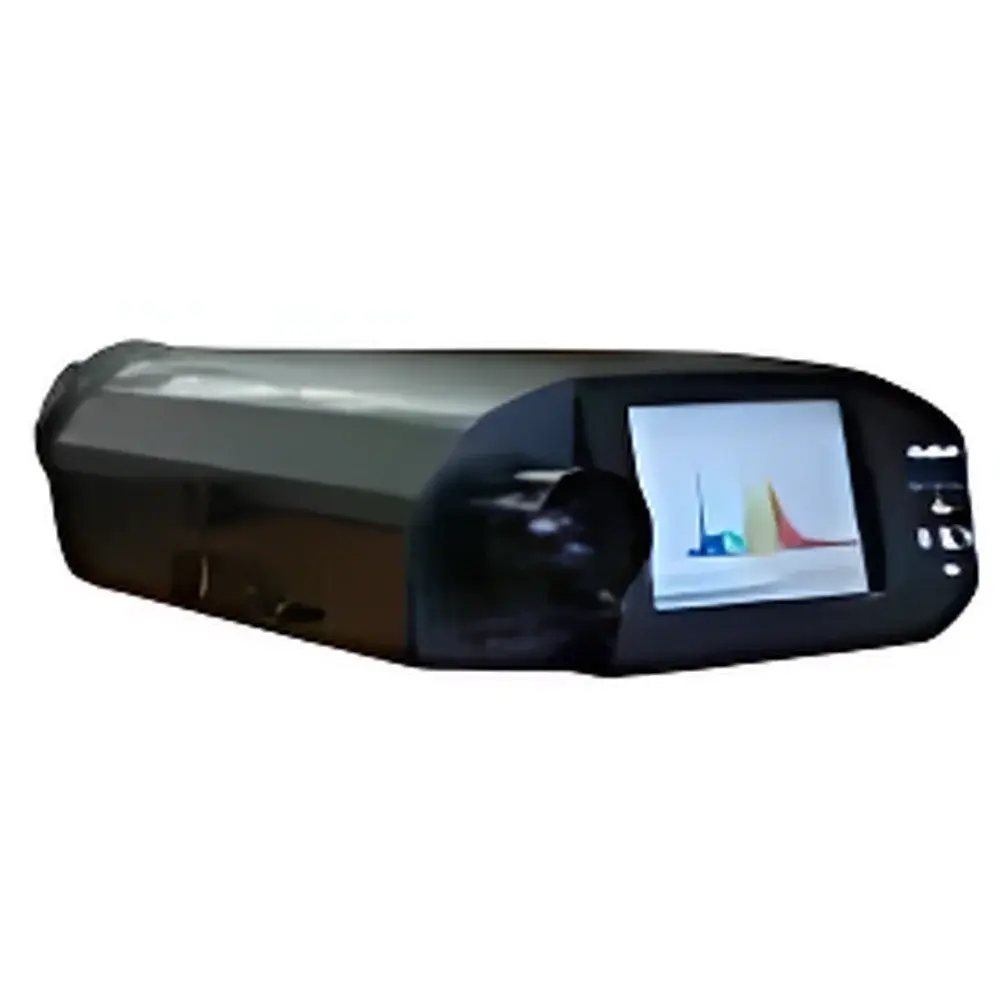
PR-670 Spectroradiometer / Colorimeter / Photometer
| Brand | Photo Research |
|---|---|
| Origin | USA |
| Model | PR-670 |
| Spectral Resolution | 1.56 nm/pixel |
| Detector Array | 256-element CCD |
| Field-of-View Options | 1°, 0.5°, 0.25°, 0.125° (motorized aperture selection) |
| Luminance Sensitivity | 0.01 fL (3.4 × 10⁻⁵ cd/m²) |
| Battery Life | Up to 12 hours (rechargeable Li-ion) |
| Control Interface | Local keypad and remote TTL/RS-232/Ethernet |
| Compliance | NIST-traceable calibration, supports CIE 1931 XYZ, CIE 1976 u’v’, and CIE 2015 photobiological safety weighting functions |
Overview
The PR-670 Spectroradiometer / Colorimeter / Photometer is a high-precision, field-deployable spectral measurement instrument engineered for absolute radiometric, photometric, and colorimetric characterization of light sources, displays, and luminous surfaces. Based on a 256-element linear CCD detector array and a fixed-grating monochromator architecture, the PR-670 operates on the principle of sequential spectral scanning with high optical throughput and minimal stray light. Its spectral sampling interval of 1.56 nm per pixel delivers sufficient resolution to resolve narrowband LED emissions, OLED spectral peaks, and phosphor-based white-light spectra—enabling accurate calculation of CIE tristimulus values (X, Y, Z), chromaticity coordinates (x, y; u′, v′), correlated color temperature (CCT), color rendering indices (CRI, TM-30 Rf/Rg), and photobiologically weighted irradiance (e.g., blue-light hazard per IEC 62471). Designed for metrology-grade applications in display manufacturing, lighting R&D, automotive HUD validation, and regulatory compliance testing, the PR-670 meets the foundational requirements of CIE Publication 127, ISO/CIE 11664, and ANSI C78.377 for spectral measurement fidelity.
Key Features
- Motorized multi-aperture system offering four discrete field-of-view options: 1°, 0.5°, 0.25°, and 0.125°—enabling precise spatial sampling from extended sources or small-area emitters without manual lens swaps.
- Integrated rechargeable lithium-ion battery supporting continuous operation for up to 12 hours, facilitating portable use in production floors, outdoor signage verification, and on-site display calibration.
- Sub-femtowatt radiometric sensitivity: capable of measuring luminance down to 0.01 foot-Lambert (3.4 × 10⁻⁵ cd/m²), suitable for low-brightness OLEDs, night-mode interfaces, and dark-state contrast evaluation.
- Full remote control via TTL trigger, RS-232 serial interface, or Ethernet (TCP/IP), enabling seamless integration into automated test stations and programmable logic controller (PLC)-driven QA workflows.
- NIST-traceable factory calibration with optional annual recalibration services; spectral responsivity and photopic V(λ) correction are stored onboard and applied in real time during acquisition.
- Internal shutter mechanism synchronized with integration time to eliminate ambient light contamination during dark-current and reference measurements.
Sample Compatibility & Compliance
The PR-670 is compatible with planar and curved emissive surfaces including LCD, OLED, microLED, and projection systems—as well as reflective standards, architectural lighting fixtures, and automotive interior lighting. It does not require external integrating spheres or auxiliary optics for standard luminance and chromaticity measurements. All spectral data output conforms to CIE S 014-2/E:2022 (colorimetric computation standards) and supports export in industry-standard formats (ASCII CSV, CIE 15:2018-compliant .cie, and XML-based CIE 184-2010). The instrument’s firmware and data logging architecture comply with GLP/GMP documentation requirements, including timestamped metadata, operator ID tagging, and audit-ready measurement history logs—facilitating FDA 21 CFR Part 11–aligned validation when paired with secure networked data management software.
Software & Data Management
The PR-670 operates with Photo Research’s proprietary SpectraWin™ software (Windows 10/11 compatible), which provides real-time spectral visualization, multi-parameter reporting, batch measurement scripting, and customizable pass/fail tolerance mapping. Data files include embedded calibration certificates, spectral irradiance/luminance traces, CIE chromaticity diagrams with MacAdam ellipse overlays, and spectral power distribution (SPD) metadata compliant with IEC 61228 Annex B. Raw spectral data can be exported for third-party analysis in MATLAB, Python (via NumPy/Pandas), or specialized lighting simulation platforms such as AGi32 and Dialux evo. Optional SpectraWin™ Enterprise Edition adds role-based user access control, electronic signature support, and centralized database synchronization across distributed lab environments.
Applications
- Display manufacturing: pixel-level uniformity mapping, gamut verification against DCI-P3/BT.2020, and temporal stability assessment under variable drive conditions.
- Lighting product development: spectral binning of LEDs, flicker index (IEEE 1789) and percent flicker computation, and photobiological safety classification per IEC/TR 62778.
- Automotive electronics: HUD luminance and chromaticity validation under varying ambient temperatures and viewing angles, per SAE J1711 and ISO 15008.
- Regulatory testing: conformance verification for ENERGY STAR, DesignLights Consortium (DLC), and EU Ecodesign Regulation (EU) 2019/2020 spectral requirements.
- Research laboratories: spectral reflectance/transmittance derivation using calibrated reference standards, and spectral modeling of human cone fundamentals for vision science studies.
FAQ
Does the PR-670 require periodic recalibration? Why?
Yes. While factory calibration is NIST-traceable, drift in CCD quantum efficiency and grating alignment may occur over time and with thermal cycling. Annual recalibration is recommended for applications requiring traceable uncertainty budgets below ±0.5% in luminance or ±0.002 in CIE x,y coordinates.
Can the PR-670 measure pulsed or modulated light sources accurately?
Yes—when configured in external trigger mode with adjustable integration gate timing, it captures single pulses or synchronizes to PWM frequencies up to 10 kHz, supporting flicker and temporal light modulation analysis per IEEE 1789.
Is the PR-670 compatible with integrating spheres?
The PR-670 itself is not an integrating sphere spectrometer; however, it can be coupled to external spheres (e.g., Labsphere UV-Vis or SphereOptics models) via fiber optic input for total flux or spectral radiant intensity measurements.
What spectral range does the PR-670 cover?
The standard configuration covers 380–780 nm (visible spectrum) with optional UV extension to 350 nm or NIR extension to 1000 nm, depending on grating and detector coating configuration.
How is measurement repeatability quantified for this instrument?
Repeatability is specified per CIE 127:2007 as ≤0.5% (k=2) for luminance and ≤0.0015 Δuv for chromaticity under controlled thermal and electrical conditions—verified using stabilized tungsten-halogen and LED reference sources.




