
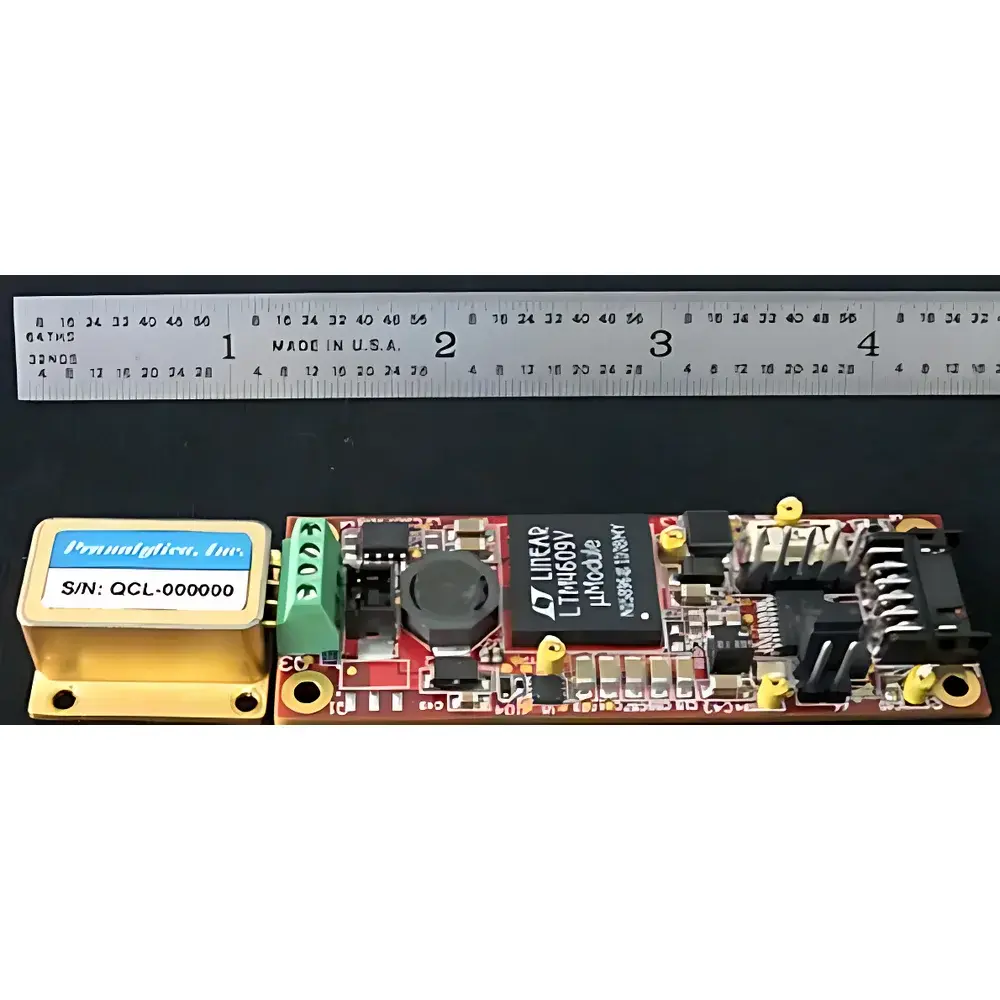
Pranalytica 1101-XX-QCW-YYYY-UC-PF OEM High-Average-Power Pulsed Quantum Cascade Laser System
| Brand | Pranalytica |
|---|---|
| Origin | USA |
| Manufacturer Type | Authorized Distributor |
| Product Category | Imported |
| Model | 1101-XX-QCW-YYYY-UC-PF |
| Configuration | Solid-State Laser System with Integrated Driver and Collimated Output |
| Cooling | Passive (Conduction-Cooled) |
| Operating Mode | Quasi-CW Pulsed |
| Wavelength Range | 3.8–12.0 µm |
| Avg. Power | >2 W @ 4.6 µm, >1 W @ 4.0 µm |
| Package | Hermetically Sealed Butterfly Housing with On-Board Pulse Shaping Electronics |
| Compliance | MIL-STD-810G (Shock/Vibration), RoHS, CE |
Overview
The Pranalytica 1101-XX-QCW-YYYY-UC-PF is a high-average-power, passively cooled, quasi-continuous-wave (QCW) quantum cascade laser (QCL) system engineered for integration into OEM platforms requiring robust, maintenance-free mid-infrared illumination. Unlike conventional interband semiconductor lasers, QCLs operate on intersubband transitions within a repeated stack of precisely engineered quantum wells—typically exceeding 500 periods—enabling photon emission without electron-hole recombination. This unipolar architecture supports wavelength design across the atmospheric transmission windows (3–5 µm and 8–12 µm), with precise tailoring via bandstructure engineering in InGaAs/InAlAs heterostructures grown by molecular beam epitaxy (MBE). The 1101 series leverages Pranalytica’s proprietary thermal management and monolithic driver integration to deliver >2 W average power at 4.6 µm and >1 W at 4.0 µm under standard operating conditions (25 °C ambient, 100–500 Hz repetition rate, 100–500 ns pulse width), with full spectral coverage from 3.8 µm to beyond 12 µm. Its conduction-cooled, hermetically sealed butterfly package eliminates active cooling subsystems—reducing size, weight, power (SWaP), and failure modes—while maintaining long-term wavelength stability and beam collimation (<1.5 mrad divergence) without optical alignment.
Key Features
- High average power output: >2 W @ 4.6 µm, >1 W @ 4.0 µm, scalable across 3.8–12.0 µm via custom epitaxial design
- Passive thermal management: Conduction-cooled architecture compliant with MIL-STD-810G mechanical shock and vibration requirements
- OEM-optimized form factor: Compact hermetic butterfly housing with integrated PCB-mounted pulse shaping electronics (rise/fall time <50 ns, jitter <1 ns)
- Turnkey operation: Single +12 V or +24 V DC input; no external controllers, water chillers, or realignment required
- Wavelength stability: <±0.1 cm⁻¹ over 8-hour continuous operation at constant ambient temperature (20–30 °C)
- Beam quality: Collimated free-space output (M² < 1.3), polarization-maintained, TEM₀₀ dominant mode
- Modular scalability: Supports single-wavelength, dual-wavelength, or multi-element array configurations for spectral multiplexing
Sample Compatibility & Compliance
The 1101-XX-QCW-YYYY-UC-PF is designed for direct integration into gas sensing, standoff detection, and industrial process monitoring platforms where regulatory traceability and environmental resilience are critical. Its passive thermal architecture meets MIL-STD-810G for operational durability in mobile and field-deployable systems. All electrical interfaces comply with IEC 61000-4 electromagnetic compatibility standards. Optical output adheres to ANSI Z136.1–2022 Class 4 laser safety requirements, with integrated interlock circuitry compatible with IEC 60825-1:2014. The device supports GLP/GMP-aligned usage when paired with validated data acquisition firmware—enabling audit-ready timestamped pulse logs, thermal telemetry, and duty-cycle tracking per FDA 21 CFR Part 11 Annex 11 principles. No hazardous substances are used in packaging per RoHS Directive 2011/65/EU and REACH Regulation (EC) No. 1907/2006.
Software & Data Management
While the 1101 system operates autonomously via fixed-function hardware, Pranalytica provides optional SDKs (C/C++, Python, LabVIEW) for host-level synchronization with spectrometers, photodetectors, or lock-in amplifiers. Pulse timing signals (TTL-sync out), analog monitor photodiode outputs, and internal thermistor telemetry are accessible via a standardized 15-pin D-sub interface. Firmware updates—delivered as signed binary images—support secure field upgrades without physical access to the laser die. All operational metadata (pulse count, cumulative runtime, peak junction temperature history, voltage/current rail diagnostics) is stored in non-volatile memory with write-cycle endurance >10⁶ cycles. Data export follows HDF5 v1.12 format with embedded SI-unit metadata, ensuring interoperability with MATLAB, Python (h5py), and commercial spectroscopic analysis suites such as GRAMS/AI and OPUS.
Applications
- Defense & Security: Infrared countermeasure (IRCM) source for directed-energy testbeds; remote explosive vapor detection (e.g., TNT, RDX); container and vehicle screening via photoacoustic or absorption spectroscopy
- Medical Diagnostics: Non-invasive breath analysis for ammonia (liver/kidney function), acetone (diabetes), isoprene (cholesterol metabolism), and sevoflurane (anesthetic monitoring)
- Environmental Monitoring: Open-path and extractive monitoring of CH₄, CO, NO, N₂O, SO₂, H₂S, and VOCs across urban air networks, marine emissions, landfill sites, and agricultural biogas facilities
- Industrial Process Control: Real-time natural gas composition analysis (C₁–C₅ hydrocarbons), refinery flare gas monitoring, pharmaceutical solvent residue detection (e.g., dichloromethane, ethanol), and semiconductor fab ambient gas purity verification (NH₃, HF, SiH₄)
- Research Infrastructure: Pump source for difference-frequency generation (DFG) in THz spectroscopy; local oscillator in heterodyne receivers; calibration reference for FTIR and cavity ring-down spectrometers
FAQ
Is this laser system compatible with existing gas absorption databases (e.g., HITRAN, GEISA)?
Yes—the 1101 series emits narrow-linewidth radiation (<0.005 cm⁻¹ FWHM in DFB variants; <0.1 cm⁻¹ in FP variants) fully resolvable by standard high-resolution spectroscopic models. Wavelength calibration certificates traceable to NIST SRM-2034 are provided with each unit.
What is the expected lifetime under continuous QCW operation?
Accelerated life testing per Telcordia GR-468-CORE indicates >20,000 hours MTTF at 25 °C case temperature and 10% duty cycle. Lifetime scales inversely with junction temperature; derating curves are supplied in the reliability report.
Can the system be operated in true CW mode?
No—this is a QCW-optimized platform. True CW operation requires active cooling and is available in Pranalytica’s 1200-series systems. The 1101 architecture prioritizes SWaP reduction over CW capability.
Does the butterfly package include collimating optics?
Yes—a monolithic aspheric lens is permanently aligned and epoxy-bonded inside the hermetic package, delivering a collimated output beam with divergence <1.5 mrad (full angle) and pointing stability <5 µrad/°C.
Is spectral tuning possible with this model?
Standard 1101 units are fixed-wavelength. Tunable versions (external cavity or multi-section DFB) are available under the 1101-TC and 1101-MD product lines—contact technical sales for wavelength agility specifications and control interface options.




