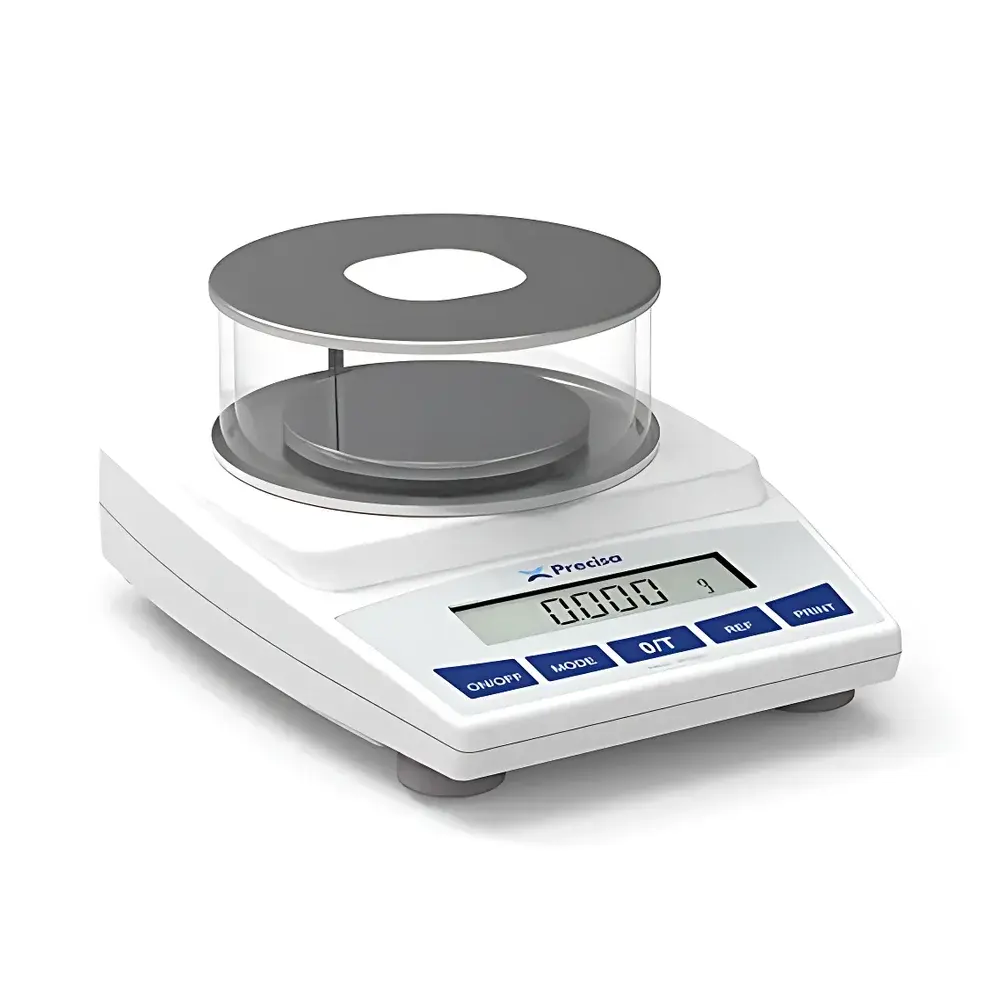
Precisa 165BJ Portable Precision Balance
| Brand | Precisa |
|---|---|
| Origin | Switzerland |
| Model | 165BJ |
| Instrument Type | Precision Balance |
| Maximum Capacity | 102 g |
| Readability | 1 mg |
| Repeatability | 1 mg |
| Calibration Method | Intelligent Calibration Mode (ICM) |
| Power Supply | AC/DC adapter & rechargeable battery (up to 12 h operation) |
| Interface | RS232 |
| Compliance | GxP-ready with real-time clock, audit trail-capable configuration, multi-level password protection |
| Dimensions | Compact portable design |
| Display | Backlit LCD with large readout area |
| Additional Functions | Below-balance weighing, unit conversion, counting, percentage weighing, animal weighing, statistics, formulation, density determination (optional) |
Overview
The Precisa 165BJ Portable Precision Balance is a compact, high-reliability laboratory balance engineered for accuracy-critical tasks in field laboratories, quality control stations, educational settings, and regulated manufacturing environments. Based on electromagnetic force compensation (EMFC) technology, it delivers stable, drift-resistant measurements under variable ambient conditions—including temperature fluctuations and minor mechanical vibrations—common in mobile or non-dedicated lab spaces. With a maximum capacity of 102 g and readability of 1 mg (0.001 g), the 165BJ meets ISO/IEC 17025 calibration traceability requirements when used with certified reference weights and conforms to ASTM E898–22 for precision balance performance verification. Its integrated real-time clock (RTC) supports time-stamped data logging, a prerequisite for GLP and GMP documentation workflows.
Key Features
- Intelligent Calibration Mode (ICM): Enables user-defined calibration points (e.g., 10 g, 50 g, 100 g) without requiring full-range calibration—reducing downtime and improving operational flexibility.
- Multi-Level Security Architecture: Combines mechanical anti-theft lock, 4-digit access password, and hierarchical menu protection to restrict access to calibration, configuration, and system settings per user role—fully aligned with FDA 21 CFR Part 11 electronic record integrity requirements.
- Extended Battery Operation: Integrated rechargeable Li-ion battery provides up to 12 hours of continuous use on a single charge; automatic low-power warning and graceful shutdown prevent data loss during power transitions.
- GxP-Compliant Data Handling: Built-in RTC stamps all weight records with date/time metadata; RS232 interface supports direct transmission to LIMS or Excel via standard ASCII protocol—enabling raw data export without proprietary software dependency.
- Ergonomic Human-Machine Interface: Five-key membrane panel minimizes operator error; backlit LCD ensures legibility in low-light conditions; oversized weighing pan (120 mm diameter) accommodates irregular or bulky samples without compromising stability.
Sample Compatibility & Compliance
The 165BJ accommodates diverse sample types—including powders, granules, small components, biological specimens, and pre-weighed vials—thanks to its robust draft shield compatibility (optional accessory) and zero-drift stabilization algorithm. It complies with international metrological standards including OIML R76-1 (2021) for non-automatic weighing instruments and satisfies key clauses of ISO 9001:2015 clause 7.1.5 (monitoring and measuring resources). All internal firmware updates are delivered via RS232 and digitally signed to maintain integrity—critical for audit readiness in pharmaceutical QC labs operating under EU Annex 11 or USP guidelines.
Software & Data Management
No proprietary software installation is required for basic data capture: the balance transmits weight values, timestamps, and unit identifiers as plain-text ASCII strings over RS232. For advanced integration, third-party applications (e.g., LabWare LIMS, Thermo Fisher SampleManager) can parse these streams using configurable delimiters. User Menu Memory (UMM) allows storage of up to 10 customized weighing configurations—including tare offsets, unit preferences, and statistical averaging parameters—each retrievable via numeric shortcut keys. Audit trail logs (accessible only by admin password) record all calibration events, parameter changes, and user logins—supporting 21 CFR Part 11 “electronic signature” and “record retention” criteria.
Applications
- Pharmaceutical QC: Weighing active pharmaceutical ingredients (APIs) and excipients during batch release testing where ±1 mg tolerance is mandated by USP .
- Academic Research: Quantitative sample preparation for HPLC, ICP-MS, and titration workflows requiring traceable mass assignment.
- Field-Based Environmental Testing: On-site soil/sediment sampling where portability, battery autonomy, and ruggedized enclosure (IP42-rated) ensure reliability outside climate-controlled labs.
- Manufacturing Metrology: In-process verification of component mass in electronics assembly or medical device production lines—integrated with SPC software via RS232-triggered data push.
- Educational Labs: Teaching fundamental metrology concepts—including repeatability assessment, calibration uncertainty propagation, and GUM-compliant error analysis—using built-in statistics mode (mean, SD, CV%, min/max).
FAQ
Does the 165BJ support external density determination kits?
Yes—when paired with the optional Precisa DKA-1 density kit (including sinker, thermometer, and pycnometer), the balance executes ASTM D792 and ISO 1183–1 compliant density calculations automatically.
Can calibration be performed without physical weights?
No—ICM requires traceable calibration masses; however, it eliminates the need for multiple weights by allowing single-point recalibration at any user-specified load within the 10–100 g range.
Is the RS232 interface compatible with modern Windows/macOS systems?
Yes—via USB-to-RS232 adapters (FTDI chipset recommended); no drivers required on Windows 10/11 or macOS Monterey+ when using standard serial terminal emulators (e.g., Tera Term, CoolTerm).
What is the warm-up time to achieve full specification accuracy?
Less than 30 minutes after power-on under ambient conditions of 20–25 °C and ≤60 % RH; internal thermal compensation stabilizes drift to <0.5 mg/h after stabilization.
How is firmware updated in a regulated environment?
Firmware updates are delivered as signed .hex files; installation requires admin-level password and generates an immutable audit log entry documenting version, timestamp, and operator ID.