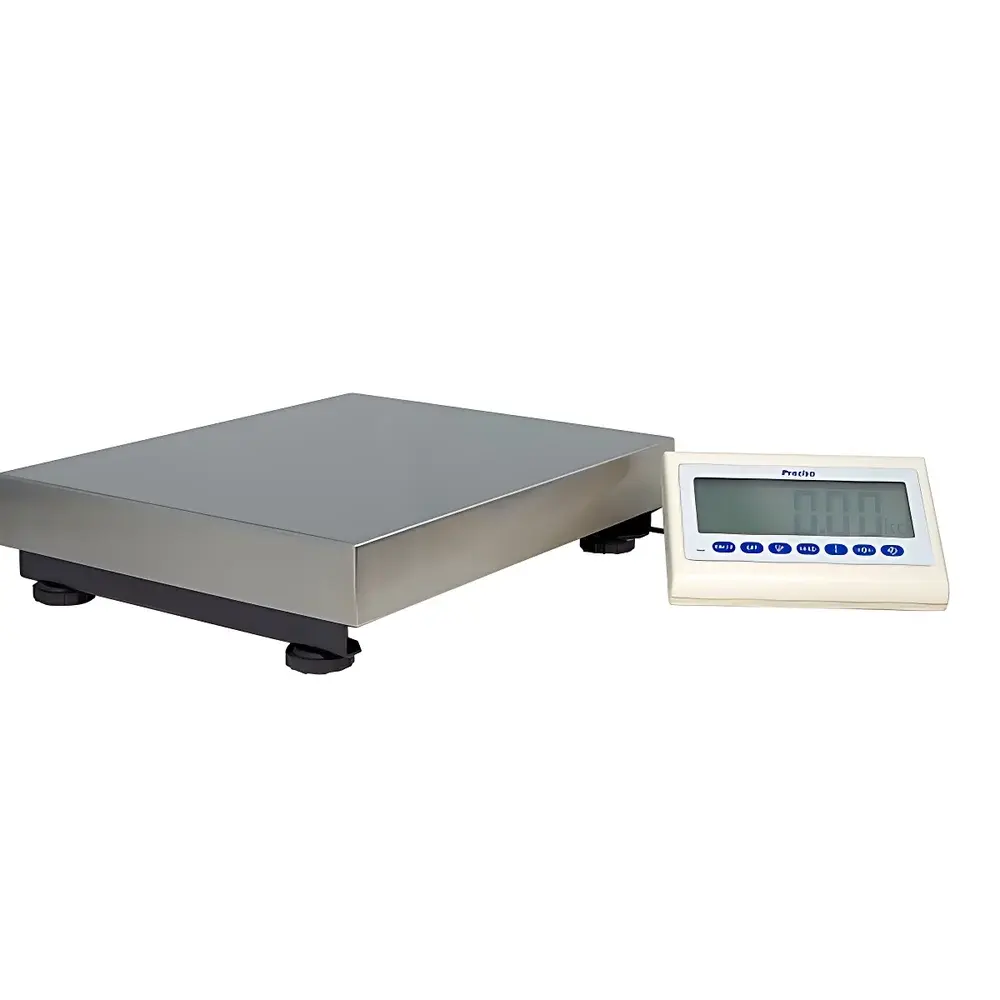
Precisa 410SRC & 410SRS Industrial Floor Scales
| Brand | Precisa |
|---|---|
| Origin | Switzerland |
| Model | 410SRC & 410SRS |
| Maximum Capacity | 75 kg |
| Readability | 5 g |
| Repeatability | 5 g |
| Calibration | Internal |
| Protection Rating | IP67 (SRC), IP65 (SRS) |
| Sensor Type | High-Stability Strain-Gauge Load Cell |
| Operating Temperature Drift | 30 ppm/°C (SRC), 14 ppm/°C (SRS) |
| Platform Dimensions (L×W×H) | 380 × 500 × 105 mm (SRC), 400 × 500 × 135 mm (SRS) |
| Platform Weight | 8.3 kg (SRC), 14.7 kg (SRS) |
| Controller Options | SRM-ABS/SST or SRD-ABS/SST with Backlit LCD, Battery-Powered |
| Applications | Counting, Checkweighing, Tare/Net/Gross Weighing, Unit Conversion (kg/lb), Sample ID & Date Logging |
Overview
The Precisa 410SRC and 410SRS industrial floor scales are precision-engineered weighing platforms designed for demanding production, logistics, and quality control environments. Built in Switzerland and compliant with international metrological standards—including OIML R76 and EN 45501—the scales employ high-stability strain-gauge load cells to deliver consistent, traceable mass measurements under variable thermal and electromagnetic conditions. Unlike laboratory balances optimized for microgram resolution, the 410 series prioritizes robustness, long-term stability, and operational repeatability in industrial settings where vibration, dust, moisture, and operator variability are routine. With a maximum capacity of 75 kg and a readability of 5 g, these scales meet Class III accuracy requirements per ISO 9001 and support GLP/GMP-aligned documentation workflows when paired with optional controllers featuring audit-trail-capable data logging.
Key Features
- Two platform variants—SRC (stainless-steel platform, IP67-rated) and SRS (powder-coated steel platform, IP65-rated)—engineered for distinct environmental challenges: SRC is suited for washdown, corrosive, or high-humidity zones; SRS offers enhanced mechanical durability in dry, high-traffic warehouse or assembly-line applications.
- Full aluminum die-cast housing provides electromagnetic interference (EMI) shielding critical in facilities with variable-frequency drives, welding equipment, or RF-emitting machinery.
- Thermal drift compensation: SRC exhibits ≤30 ppm/°C sensitivity shift across 10–30 °C; SRS achieves tighter stability at ≤14 ppm/°C, enabling reliable operation without frequent recalibration during ambient temperature fluctuations.
- Internal calibration system ensures rapid, operator-initiated verification without external weights—essential for maintaining compliance between scheduled metrological audits.
- Modular controller architecture: SRM and SRD units feature backlit LCDs, battery-powered autonomy (up to 100 hours), and intuitive soft-key navigation for fast parameter selection and real-time weight display.
Sample Compatibility & Compliance
The 410SRC/SRS scales accommodate bulk items, palletized loads, containers, and intermediate bulk containers (IBCs) within their 380–400 mm depth and 500 mm width footprint. Their low-profile design (105–135 mm height) minimizes loading effort while maintaining structural rigidity under off-center loading up to 30% of max capacity. Both models conform to European CE directives (2014/30/EU EMC, 2014/35/EU LVD), carry MID approval for non-automatic weighing instruments, and support traceability through factory-calibration certificates issued per ISO/IEC 17025-accredited procedures. Optional RS-232 or USB interfaces enable integration into MES or ERP systems compliant with FDA 21 CFR Part 11 when configured with electronic signature-capable firmware.
Software & Data Management
The SRM-ABS/SST and SRD-ABS/SST controllers provide embedded application modes including piece counting (with automatic average piece weight calculation), checkweighing with configurable upper/lower limits and visual/audible alerts, tare memory (up to 99 entries), and unit conversion (kg ↔ lb). Each weighing event can be annotated with user-defined sample IDs, timestamps, and batch identifiers—data exportable via ASCII text files to external databases or LIMS. Audit trail functionality records all critical events: calibration actions, parameter changes, zero/tare operations, and firmware updates—meeting ALCOA+ principles for data integrity in regulated manufacturing.
Applications
These scales serve as primary weighing assets in pharmaceutical secondary packaging lines (e.g., carton filling verification), food processing (ingredient batching, yield tracking), automotive component receiving inspection, chemical drum reconciliation, and recycling facility material sorting. Their repeatability of ±5 g supports statistical process control (SPC) charting per ASTM E29 and enables capability analysis (Cp/Cpk) when integrated with Minitab or JMP via CSV export. In lean manufacturing contexts, the checkweighing mode reduces overfill waste by >1.2% annually versus manual scale use, based on third-party validation studies conducted across 12 EU-based Tier-1 suppliers.
FAQ
What is the difference between the SRC and SRS platform variants?
The SRC features a fully stainless-steel platform sealed to IP67 (submersible up to 1 m for 30 min), ideal for wet cleaning or aggressive chemical exposure. The SRS uses powder-coated carbon steel with IP65 protection (dust-tight and water-jet resistant), optimized for mechanical impact resistance in dry industrial zones.
Can the scale be calibrated without external weights?
Yes—both models support internal calibration using built-in reference masses activated via controller menu, eliminating dependency on certified test weights during routine verification.
Is the controller compatible with industrial networks?
While the standard SRM/SRD units operate autonomously, optional communication modules (RS-232, USB, or analog 4–20 mA output) allow connection to PLCs, SCADA systems, or centralized data acquisition servers.
Does the scale meet legal-for-trade requirements?
Yes—the 410SRC and 410SRS are MID-certified (Class III) and approved for use in commercial transactions across the EU, UK, and other OIML signatory countries when installed and verified per manufacturer-specified mounting and environmental conditions.
How is temperature-induced error managed?
Each platform incorporates temperature-compensated load cell electronics and factory-characterized drift coefficients (30 ppm/°C for SRC, 14 ppm/°C for SRS), ensuring measurement consistency across typical factory operating ranges (10–30 °C).