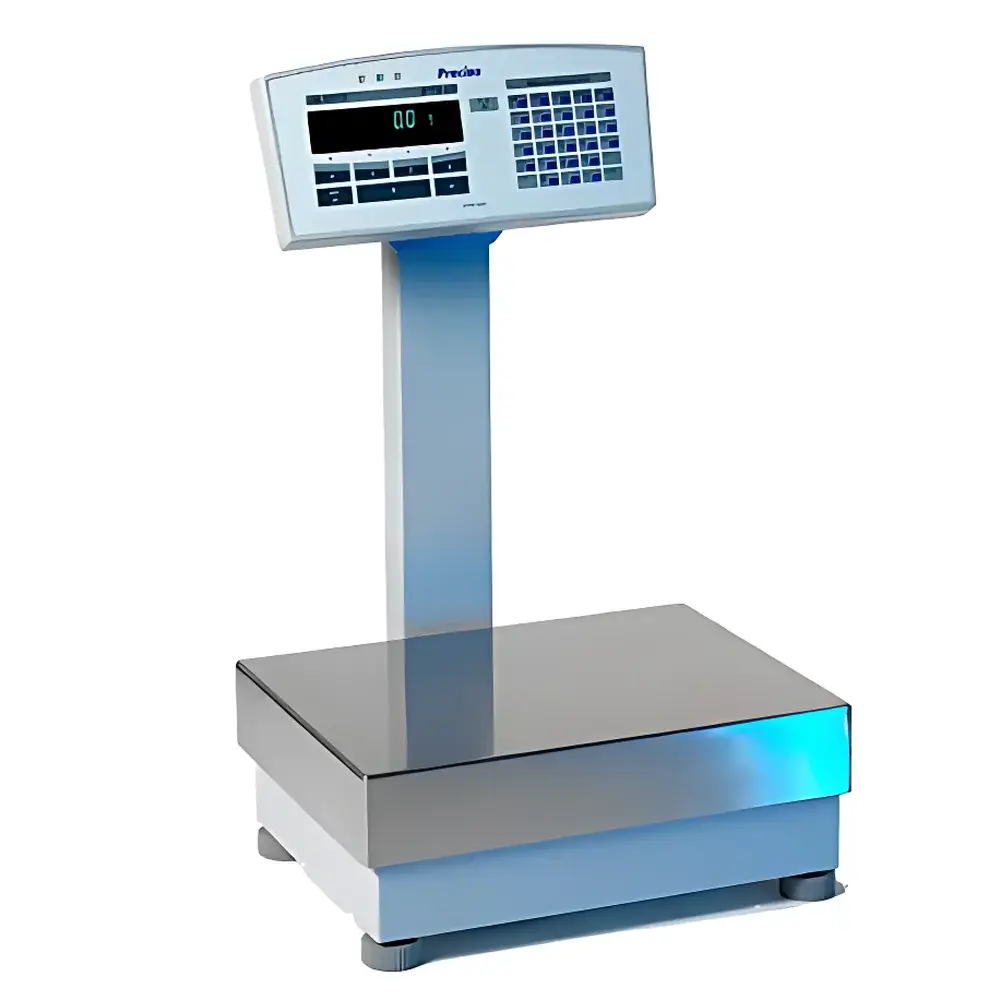
Precisa 490IBK/ITK/ISK Series Industrial Balances
| Brand | Precisa |
|---|---|
| Origin | Switzerland |
| Model | 490IBK / 490ITK / 490ISK |
| Max Capacity | 12.1 kg to 60.1 kg |
| Readability | 0.1 g to 1 g |
| Repeatability | 0.1 g |
| Calibration | Internal (SCS) with optional external ICM mode |
| Protection Rating | IP54 (optional IP65) |
| Construction | Die-cast aluminum housing, stainless steel weighing pan |
| Interface | RS232 (standard), Precisa BUS (ISK only), Ethernet (via optional module) |
| Compliance | Supports 3Q validation (IQ/OQ/PQ), GLP/GMP data integrity requirements |
Overview
The Precisa 490IBK/ITK/ISK Series represents a family of high-reliability industrial balances engineered for demanding production, quality control, and logistics environments. Built in Switzerland and leveraging electromagnetic force restoration (EMFR) sensor technology, these balances deliver metrological stability under variable thermal and mechanical conditions typical of factory floors. Unlike strain-gauge-based platforms, EMFR architecture ensures linearity, minimal drift, and long-term repeatability—critical for applications requiring traceable mass measurement per ISO/IEC 17025 and ASTM E898. The modular controller design—IBK (basic), ITK (advanced), and ISK (fully integrated)—enables scalable functionality without hardware replacement, supporting phased deployment across multi-site operations.
Key Features
- Die-cast aluminum housing with reinforced structural rigidity, providing immunity to electromagnetic interference (EMI) and vibration-induced error in proximity to motors, conveyors, or RF equipment.
- Stainless steel weighing pan (AISI 304) resistant to corrosion from solvents, cleaning agents, and humid industrial atmospheres.
- IP54-rated enclosure as standard; optional IP65 upgrade available for washdown or high-dust environments compliant with IEC 60529.
- Smart Calibration System (SCS): fully automatic internal calibration triggered by user-defined temperature thresholds (±0.5 °C deviation) or time intervals (e.g., every 2, 4, or 8 hours). Stores up to 50 calibration events with timestamp, operator ID, and environmental metadata.
- Dual-mode calibration support: SCS for routine verification and ICM (Intelligent Calibration Mode) for accredited external calibration using certified weights traceable to national standards (e.g., NIST, PTB).
- Real-time clock with battery backup ensures accurate timestamping of all measurements and audit trails—essential for FDA 21 CFR Part 11 compliance when paired with validated software.
Sample Compatibility & Compliance
These balances accommodate diverse sample forms—including bulk solids, packaged goods, liquid containers, and irregularly shaped components—within the 12.1–60.1 kg capacity range. The low-profile pan geometry and optimized load-cell placement minimize off-center error (<0.005% of full scale at 1/4 pan radius), satisfying OIML R76-1 Annex C requirements for Class II non-automatic weighing instruments. All models support 3Q validation documentation packages (Installation Qualification, Operational Qualification, Performance Qualification), including test protocols for repeatability, eccentricity, linearity, and sensitivity. Firmware adheres to GLP/GMP principles: audit trail logging, electronic signature capability (with password enforcement), and role-based access control for configuration changes.
Software & Data Management
RS232 serial interface enables direct connection to label printers, PLCs, or legacy SCADA systems with ASCII protocol support. The ISK variant adds Precisa BUS—a deterministic industrial fieldbus—allowing synchronized integration with remote displays, traffic light indicators, barcode scanners, I/O expansion modules, and Ethernet gateways (via optional ETH-1 adapter). Data export supports CSV, TXT, and XML formats with customizable delimiters and field mapping. When connected to Precisa’s LabX™-compatible middleware or third-party LIMS via OPC UA, balances contribute to automated batch records, statistical process control (SPC) charting, and real-time weight-triggered workflow actions—fully auditable under ISO 13485 or ICH Q7 frameworks.
Applications
- Pharmaceutical manufacturing: raw material receipt inspection, dispensing verification, and finished product checkweighing per USP and EU GMP Annex 8.
- Food & beverage: portion control, ingredient batching, and inline packaging verification with dynamic tolerance bands.
- Chemical synthesis: catalyst dosing, reagent addition, and reaction mass monitoring with configurable tare memory and recipe recall.
- Automotive component assembly: torque tool calibration weight checks, subassembly mass verification, and supplier incoming inspection.
- Recycling & scrap processing: bale weighing, density-based sorting, and metal recovery yield calculation using built-in density application (ITK/ISK).
FAQ
What is the difference between IBK, ITK, and ISK controllers?
The IBK provides core weighing functions (tare, unit conversion, counting, checkweighing). ITK adds advanced applications including dynamic differential weighing, multi-step formulation, minimum sample weight assessment, and density determination. ISK extends further with SmartBox® functionalities: intelligent piece-counting with statistical outlier rejection, and Finished Product Verification & Output (FPVO) for automated packaging line release logic.
Does the balance support regulatory-compliant audit trails?
Yes—when operated with password-protected administrator mode and timestamp-enabled firmware, all critical events (calibrations, configuration changes, weight recordings) are logged with operator ID, date/time, and contextual metadata—meeting ALCOA+ data integrity criteria for regulated industries.
Can the balance be integrated into an existing MES or ERP system?
Absolutely. Via RS232 or Precisa BUS (ISK), the device supports bidirectional communication with common industrial protocols. Optional Ethernet connectivity enables direct REST API or MQTT integration for cloud-based analytics and centralized fleet monitoring.
Is external calibration required for ISO/IEC 17025 accreditation?
Internal calibration (SCS) satisfies routine performance verification, but accredited external calibration using traceable standards is mandatory for scope inclusion in ISO/IEC 17025 testing laboratories—performed annually or after impact events, with full uncertainty budget reporting.
What maintenance is recommended for long-term accuracy?
Daily verification with calibrated check weights, quarterly mechanical inspection of load-cell mounts and leveling feet, and annual full recalibration by an ISO/IEC 17025-accredited service provider ensure sustained metrological reliability over the instrument’s service life (>10 years typical).