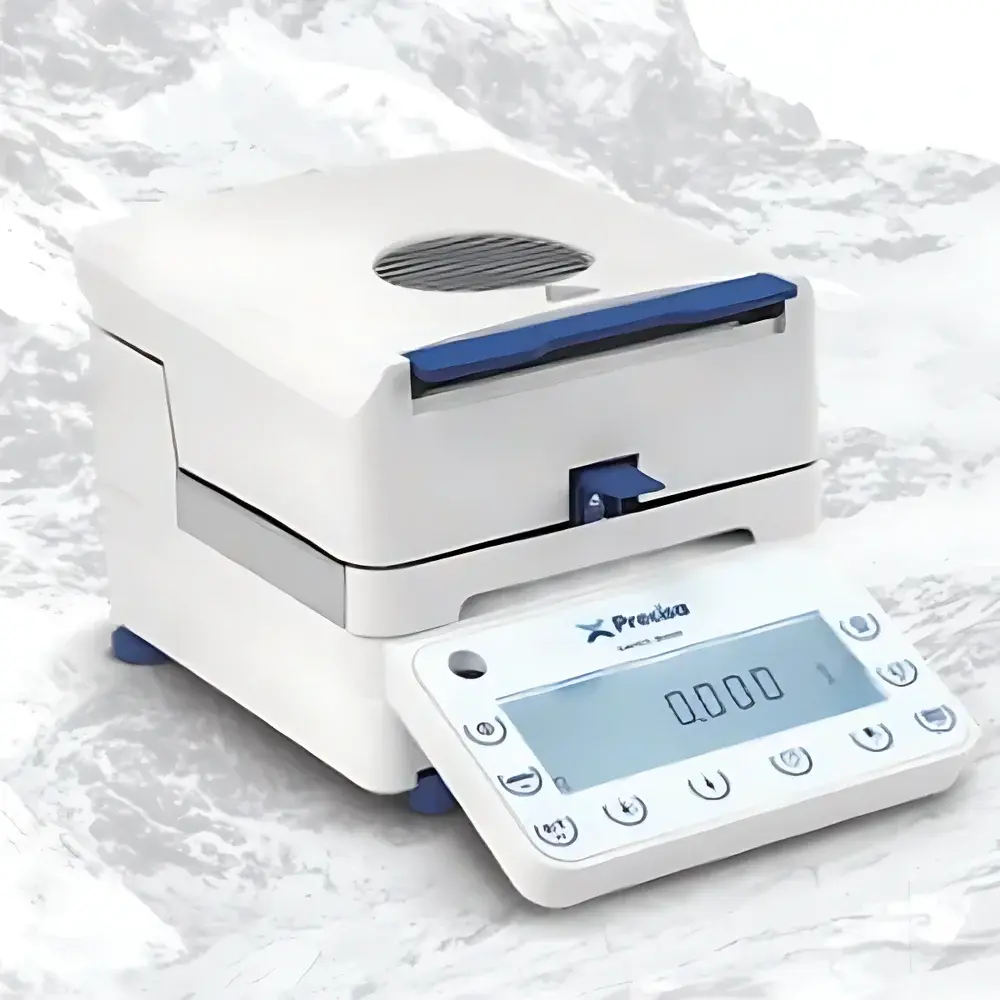
Precisa 530PBM Series Rapid Moisture Analyzer
| Brand | Precisa |
|---|---|
| Origin | Switzerland |
| Model | 530PBM |
| Instrument Type | Precision Moisture Analyzer |
| Maximum Weighing Capacity | 124 g |
| Readability | 1 mg |
| Sample Moisture Range | Optimized for low-moisture materials (e.g., polymers, pharmaceutical excipients, dried powders) |
| Repeatability | ±0.1% at 2 g |
| Heating Chamber | Removable, tool-free assembly/disassembly |
| Temperature Control | Programmable heating profile with auto-lid opening at user-defined end temperature |
| Status Indication | Dual-color LED (green = ready to heat |
| Air Buoyancy Compensation | Integrated computational fluid dynamics (CFD)-informed design to minimize convective and buoyancy errors during drying cycles |
| Sensor Technology | PHASTbloc™ monolithic weighing cell |
Overview
The Precisa 530PBM Series Rapid Moisture Analyzer is a precision laboratory instrument engineered for gravimetric moisture determination in low-humidity solid and semi-solid samples. It operates on the principle of thermogravimetric analysis (TGA): a pre-weighed sample is heated under controlled conditions until mass loss stabilizes, with moisture content calculated as the percentage of initial mass lost—excluding volatiles other than water where method validation permits. Built upon the robust mechanical architecture of the Precisa 520-series analytical balance platform, the 530PBM integrates a proprietary PHASTbloc™ monolithic weighing sensor, delivering high reproducibility and long-term stability without mechanical hysteresis or creep drift. Its design targets applications requiring regulatory-compliant, traceable, and operator-independent moisture quantification—particularly in quality control laboratories adhering to USP , ASTM D4457, ISO 15512, and ICH Q5C guidelines.
Key Features
- PHASTbloc™ weighing cell: A single-piece, stress-optimized load cell structure eliminating traditional pivot-and-knife-edge mechanisms—reducing maintenance intervals and improving resistance to mechanical shock and thermal gradient-induced error.
- Auto-lid functionality: Programmable lid-opening logic triggers at user-specified termination temperature, accelerating post-drying cooling and minimizing operator exposure to residual heat.
- Tool-free chamber disassembly: All internal heating chamber components—including heating plate, sample pan support, and reflective shield—are designed for manual removal without tools. Smooth, crevice-free surfaces enable full compatibility with ultrasonic cleaning baths and commercial dishwashers (IEC 60335-1 compliant cycles).
- Dual-color LED status system: Green indicates thermal readiness and stable zero; steady red denotes active heating phase; flashing red warns of surface temperature exceeding 50 °C—supporting GLP-aligned safety protocols.
- Air buoyancy mitigation: Computational fluid dynamics (CFD) modeling was applied during mechanical design to suppress convection currents and density-gradient-induced weighing artifacts, especially critical during rapid heating ramps common in low-moisture (<0.5 wt%) determinations.
Sample Compatibility & Compliance
The 530PBM is validated for use with homogeneous solids, granules, and viscous pastes exhibiting moisture contents between 0.01% and 15% w/w. It is routinely deployed for polymer resins (e.g., PET, PA6), lyophilized biologics, ceramic precursors, and anhydrous pharmaceutical actives. The instrument supports audit-ready operation under GMP environments: all calibration events (internal), method parameters, weight readings, and temperature logs are timestamped and stored with immutable metadata. Optional firmware enables 21 CFR Part 11–compliant electronic signatures and audit trail export in CSV or XML format. Device firmware complies with IEC 61010-1 (safety) and IEC 61326-1 (EMC) standards.
Software & Data Management
Data acquisition and method configuration are managed via the embedded touchscreen interface—no external PC required. Up to 20 user-defined methods can be stored locally, each specifying drying profile (ramp/hold steps), termination criteria (time-based, slope-based, or mass-change-threshold), auto-zero interval, and post-run lid behavior. Raw weight vs. time datasets are exportable via USB-A port in tab-delimited format. For enterprise integration, optional Ethernet-enabled firmware supports Modbus TCP communication for SCADA-level data ingestion and centralized LIMS synchronization.
Applications
- Pharmaceutical QC: Residual solvent and hydrate water quantification in APIs per ICH Q5C; moisture mapping across batch homogeneity studies.
- Plastics manufacturing: In-process verification of resin drying efficiency prior to extrusion or injection molding.
- Food science R&D: Determination of equilibrium moisture content in freeze-dried fruits, dairy powders, and cereal-based matrices.
- Materials research: Hydration kinetics of cementitious systems and metal-organic frameworks (MOFs) under controlled thermal ramping.
- Academic teaching labs: Hands-on demonstration of mass conservation principles, Arrhenius-type drying kinetics, and uncertainty propagation in gravimetric analysis.
FAQ
What is the recommended sample size range for optimal accuracy?
For repeatability ≤0.02%, a minimum sample mass of 10 g is advised. For high-value or limited-availability materials, validated protocols support 2 g loads with ±0.1% repeatability—subject to method-specific ruggedness testing.
Does the 530PBM support external calibration weights?
No—calibration is exclusively internal via motor-driven electromagnetic force compensation; no external weights or manual adjustment are required or supported.
Can the instrument differentiate between water and other volatiles?
Not inherently. The 530PBM reports total volatile loss as “moisture” unless paired with orthogonal techniques (e.g., FTIR gas-phase analysis or Karl Fischer titration) for method validation and specificity confirmation.
Is the PHASTbloc™ sensor repairable in the field?
Yes—the monolithic cell is modular and replaceable by certified service engineers using standardized torque procedures; no recalibration of the entire mechanical frame is needed post-replacement.
How is air buoyancy correction implemented?
Correction is structural, not algorithmic: chamber geometry, airflow baffling, and thermal symmetry were optimized using CFD simulation to minimize dynamic buoyancy effects—eliminating the need for real-time environmental parameter input (e.g., ambient humidity or barometric pressure).