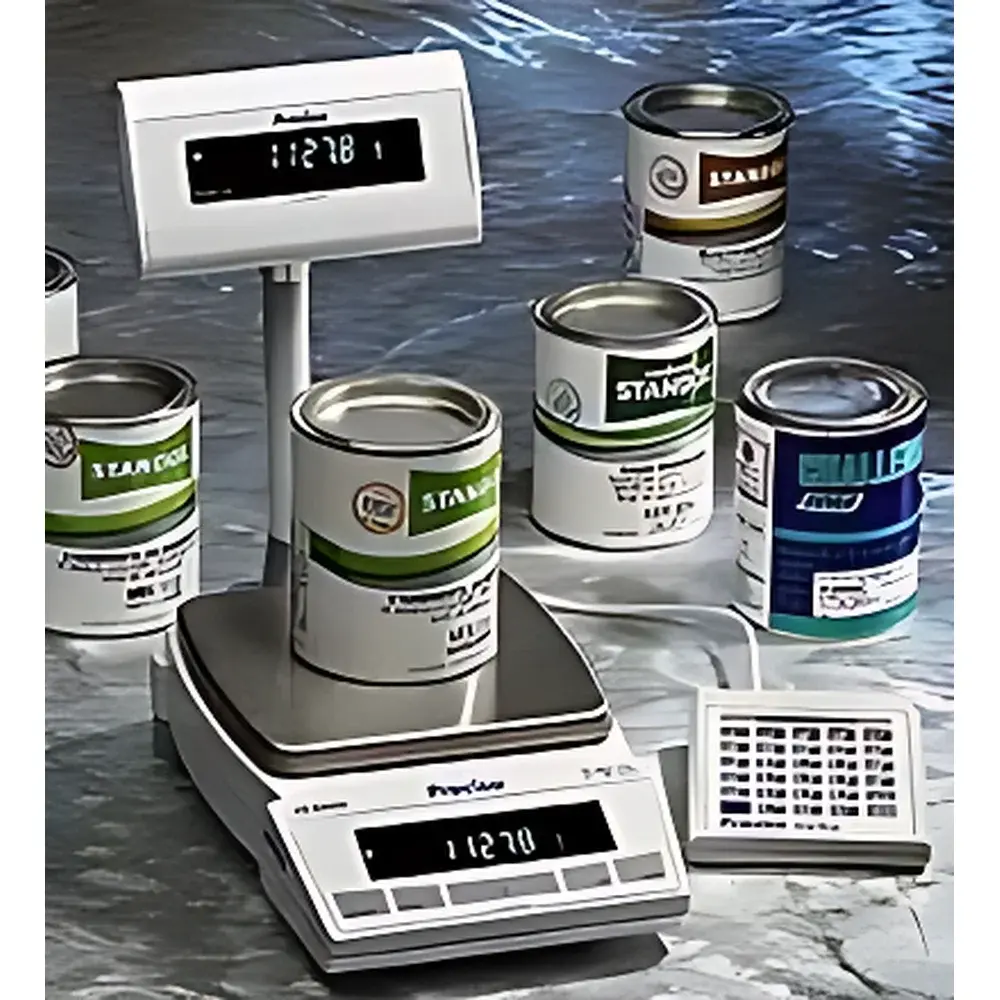
Precisa XS225A-SCS Analytical Balance
| Weighing Range | 225 g |
|---|---|
| Readability | 0.1 mg |
| Taring Range | 225 g |
| Reproducibility | ≤ 0.1 mg |
| Linearity Error | ±1 mg |
| Response Time | ~2–3 s |
| Stability Setting | 3-step adjustable |
| Operating Temperature | 0–40 °C |
| Sensitivity Drift (10–30 °C) | ±2 ppm/°C |
| Input Voltage | 115/230 V AC |
| Voltage Tolerance | +15 % / −20 % |
| Frequency | 50–60 Hz |
| Power Consumption | 6 VA |
| Display | Fluorescent (optional) |
| Dimensions (L×W×H) | 210 × 340 × 89 mm |
| Pan Diameter | Ø80 mm (chromium-nickel steel) |
| Net Weight | 3.7 kg |
| Internal Calibration | Motor-driven SCS system with built-in precision weights |
| Compliance | ISO 9001, ISO/IEC 17025 compatible workflows, GLP/GMP-ready audit trail support |
Overview
The Precisa XS225A-SCS Analytical Balance is a high-precision, fully automated laboratory balance engineered for reproducible mass measurement in regulated and research-intensive environments. Built upon the proven XS platform and enhanced with the SCS (Smart Calibration System) architecture, this instrument integrates a motorized internal calibration mechanism featuring traceable, factory-adjusted stainless-steel reference masses. Its operation relies on electromagnetic force compensation (EMFC) technology — a standard principle for analytical balances — ensuring stable, drift-resistant performance across variable ambient conditions. Designed for ISO/IEC 17025-aligned laboratories and compliant with Good Laboratory Practice (GLP) and Good Manufacturing Practice (GMP) documentation requirements, the XS225A-SCS delivers metrological integrity without requiring external weights for routine calibration. The balance operates within a wide environmental envelope (0–40 °C), with temperature-induced sensitivity drift tightly controlled at ±2 ppm/°C between 10–30 °C — a critical specification for labs lacking climate-stabilized weighing rooms.
Key Features
- SCS Smart Calibration System: Fully automatic, one-touch internal calibration with temperature-compensated motorized weight deployment — eliminates manual handling of calibration standards and reduces operator error.
- Three-stage stability adjustment: Enables optimization of response dynamics for diverse sample types — from volatile solvents to static powders — without compromising readability or repeatability.
- High-contrast fluorescent display (optional): Ensures legibility under low-light conditions or in brightly lit cleanrooms; supports simultaneous multi-parameter readout including net/gross/tare values.
- Integrated anti-static three-sided glass draft shield: Standard equipment — constructed from conductive-coated tempered glass to dissipate electrostatic charge, minimizing drift during low-mass measurements.
- 14 built-in weighing units and application modes: Includes piece counting, percentage weighing, density determination (with optional solid/liquid density kit), and formulation mode — all accessible via intuitive soft-key navigation.
- Robust mechanical design: Chromium-nickel steel weighing pan (Ø80 mm), IP42-rated housing, and shock-absorbing base ensure long-term mechanical stability and resistance to chemical splashes and minor impacts.
Sample Compatibility & Compliance
The XS225A-SCS accommodates a broad range of sample forms — from fine pharmaceutical powders and reference standards to precious metals, gemstones, and micro-volume reagents. Its 225 g capacity and 0.1 mg readability meet USP requirements for analytical balance verification in pharmacopeial testing. The instrument supports full traceability through time-stamped calibration logs, user-access-level control (password-protected configuration), and optional data export via RS232 or USB interface. All calibration and weighing events are recordable in accordance with FDA 21 CFR Part 11 when integrated with compliant LIMS or ELN software. The balance conforms to OIML R76-1 and EN 45501 accuracy classes for Class I analytical instruments, and its manufacturing quality system is certified to ISO 9001.
Software & Data Management
Data output is supported via bidirectional RS232 and USB-B interfaces, enabling seamless integration with laboratory information management systems (LIMS), electronic lab notebooks (ELN), and statistical process control (SPC) platforms. Optional PC software provides real-time graphing, batch reporting, and customizable certificate generation — including uncertainty budgets per EURACHEM/CITAC guidelines. Audit trail functionality records user ID, timestamp, action type (e.g., calibration, tare, print), and parameter changes — essential for GLP audits and regulatory submissions. No proprietary drivers are required; standard CDC or virtual COM port protocols ensure plug-and-play compatibility with Windows, macOS, and Linux hosts.
Applications
- Quantitative analysis in QC/QA labs: Accurate dispensing of active pharmaceutical ingredients (APIs), excipients, and reference standards per ICH Q5C and USP .
- Jewelry and precious metal valuation: High-resolution weighing of gold, platinum, and diamond parcels where sub-0.1 mg resolution directly impacts financial settlement.
- Academic and industrial research: Gravimetric preparation of molar solutions, catalyst loading, and nanomaterial dosing in materials science and catalysis labs.
- Environmental and food testing: Sample aliquoting for heavy metal analysis (e.g., EPA Method 200.8), moisture content determination, and nutritional labeling compliance.
- Density characterization: When paired with the optional solid/liquid density kit, enables rapid calculation of true density, apparent density, and porosity per ASTM D792 and ISO 1183.
FAQ
Does the XS225A-SCS require external calibration weights?
No — the SCS system performs fully automated internal calibration using built-in, factory-certified reference masses. External weights are only needed for periodic verification or accreditation audits.
Is the balance compatible with FDA 21 CFR Part 11 requirements?
Yes — when used with validated third-party data capture software supporting electronic signatures, audit trails, and role-based access control.
Can the stability setting be adjusted during operation?
Yes — the three-step stability filter (Fast/Medium/Slow) is configurable in real time via front-panel keys without interrupting an ongoing weighing sequence.
What environmental conditions affect linearity performance?
Linearity deviation remains within ±1 mg across the full 0–225 g range when operated within specified temperature (0–40 °C) and humidity (30–80 % RH non-condensing) limits.
Is the draft shield included as standard equipment?
Yes — a three-sided, anti-static glass draft shield with sliding doors is supplied with every unit, pre-aligned and mechanically interlocked to prevent accidental removal during calibration.