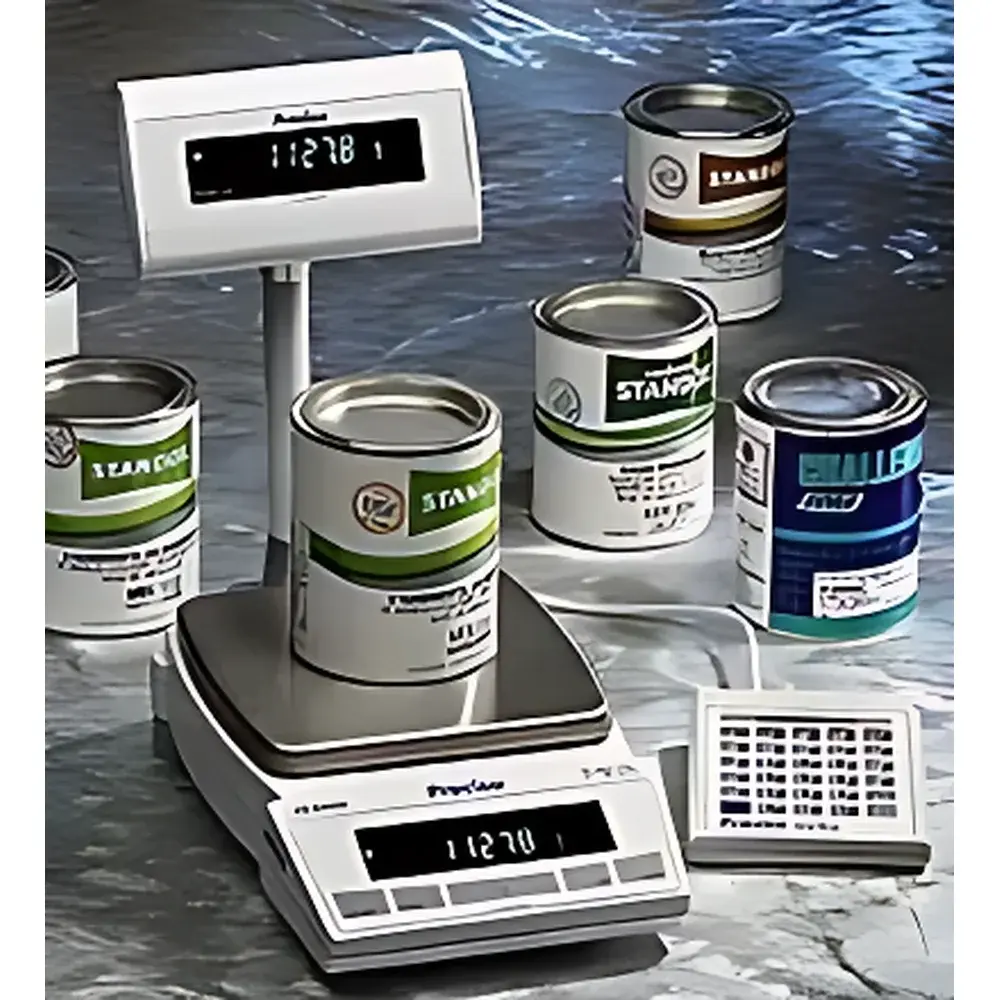
Precisa XS6250D Precision Electronic Balance
| Brand | Precisa |
|---|---|
| Model | XS6250D |
| Weighing Range | 6250 g |
| Readability | 0.1 g |
| Taring Range | 6250 g |
| Reproducibility | ≤ 0.1 g |
| Linearity | ±0.15 g |
| Response Time | 1–2 s |
| Stability Setting | 3-step adjustable |
| Operating Temperature | 0–40 °C |
| Sensitivity Drift (10–30 °C) | ±4 ppm/°C |
| Power Supply | 115/230 V AC, 50–60 Hz |
| Power Consumption | 6 VA |
| Display | Fluorescent (optional) |
| Dimensions (L×W×H) | 210 × 340 × 89 mm |
| Pan Size | 200 × 200 mm (chromium-nickel steel) |
| Net Weight | 5.6 kg |
Overview
The Precisa XS6250D is a high-performance, general-purpose precision electronic balance engineered for consistent accuracy and operational reliability in laboratory, quality control, and industrial weighing environments. Designed according to fundamental electromagnetic force compensation (EMFC) principles, the XS6250D delivers stable mass measurement by balancing the gravitational force acting on a sample against a precisely controlled electromagnetic counterforce—ensuring minimal mechanical wear and long-term calibration stability. With a 6250 g maximum capacity and 0.1 g readability, it bridges the gap between analytical and top-loading balances, offering robust performance for routine weighing tasks where moderate resolution and high repeatability are required. Its compact footprint (210 × 340 × 89 mm), corrosion-resistant chromium-nickel steel pan (200 × 200 mm), and wide operating temperature range (0–40 °C) make it suitable for use across diverse lab settings—from raw material intake inspection to formulation batching and packaging verification.
Key Features
- Fluorescent display with wide viewing angle and high contrast—ensures legible readings under variable ambient lighting conditions, including low-light or glare-prone environments.
- User-defined internal calibration using custom reference weights—eliminates dependency on certified external砝码 for routine recalibration and reduces metrological maintenance costs.
- Three-step adjustable stability setting—allows users to optimize response time versus noise rejection based on sample volatility, air currents, or vibration conditions.
- Automatic power-on at mains restoration—ensures immediate readiness after power interruption without manual reset.
- Programmable auto-off function—configurable idle timeout prevents unnecessary energy consumption while preserving component longevity.
- Robust housing and IP-rated internal electronics—designed to withstand typical laboratory handling and environmental fluctuations, including humidity and thermal drift (±4 ppm/°C sensitivity shift between 10–30 °C).
Sample Compatibility & Compliance
The XS6250D accommodates a broad spectrum of solid and granular samples—including powders, tablets, components, and packaged goods—thanks to its large 200 × 200 mm stainless-steel pan and 6250 g tare capacity. Its design supports GLP-compliant workflows through traceable calibration events and user-accessible calibration logs (when integrated with optional data export modules). While not certified for legal-for-trade applications (e.g., OIML R76 or NTEP), the balance meets essential metrological requirements referenced in ISO/IEC 17025 for testing laboratories and aligns with common internal QA/QC protocols used in pharmaceutical, food, and chemical manufacturing. Its linearity (±0.15 g) and reproducibility (≤0.1 g) are validated per manufacturer’s factory test report, supporting documented evidence for audit readiness.
Software & Data Management
The XS6250D features an RS-232 interface as standard, enabling seamless integration with LIMS, ERP, or statistical process control (SPC) platforms. When connected to compatible software (e.g., Precisa BalanceLink or third-party tools compliant with ASCII-based weighing protocols), users can capture timestamped weight data, perform real-time statistical analysis (mean, SD, CV%), and generate audit-ready reports. All data transfers support configurable delimiters and header formats to ensure compatibility with CSV import pipelines. Though the base unit does not include built-in 21 CFR Part 11 compliance features (e.g., electronic signatures or audit trails), its deterministic communication behavior and stable firmware architecture facilitate validation in regulated environments when deployed with validated host systems and procedural controls.
Applications
- Raw material receipt inspection and lot acceptance testing in chemical and polymer manufacturing.
- Weighing of excipients and active pharmaceutical ingredients (APIs) during non-GMP pilot-scale formulation.
- Quality assurance checks on filled containers, blister packs, or bulk shipments in food and nutraceutical production.
- Calibration lab support for verifying lower-capacity balances via substitution weighing methods.
- Educational laboratories requiring durable, intuitive instruments for teaching metrology fundamentals and uncertainty concepts.
FAQ
Is the XS6250D suitable for GMP-regulated environments?
It is not inherently 21 CFR Part 11-compliant but may be deployed in GMP contexts when paired with validated software, documented SOPs, and periodic performance verification per USP <41> and ISO 17025.
Does the balance support external calibration with non-Precisa weights?
Yes—the user-defined calibration mode accepts any traceable reference mass within the 6250 g range, provided it meets local metrological traceability requirements.
What is the expected service life under normal lab usage?
With proper handling and biannual verification, the EMFC sensor and electronics typically maintain specification for ≥8 years; the 2-year warranty covers parts and labor for manufacturing defects.
Can the fluorescent display be retrofitted on older XS-series models?
No—the display module is hardware-integrated and model-specific; only XS6250D units shipped from factory include this option.
How does temperature drift affect daily operation?
Within 10–30 °C, sensitivity variation remains within ±4 ppm/°C—translating to <±0.025 g error over a 10 °C ambient shift at full scale—well within typical tolerance bands for non-analytical applications.