
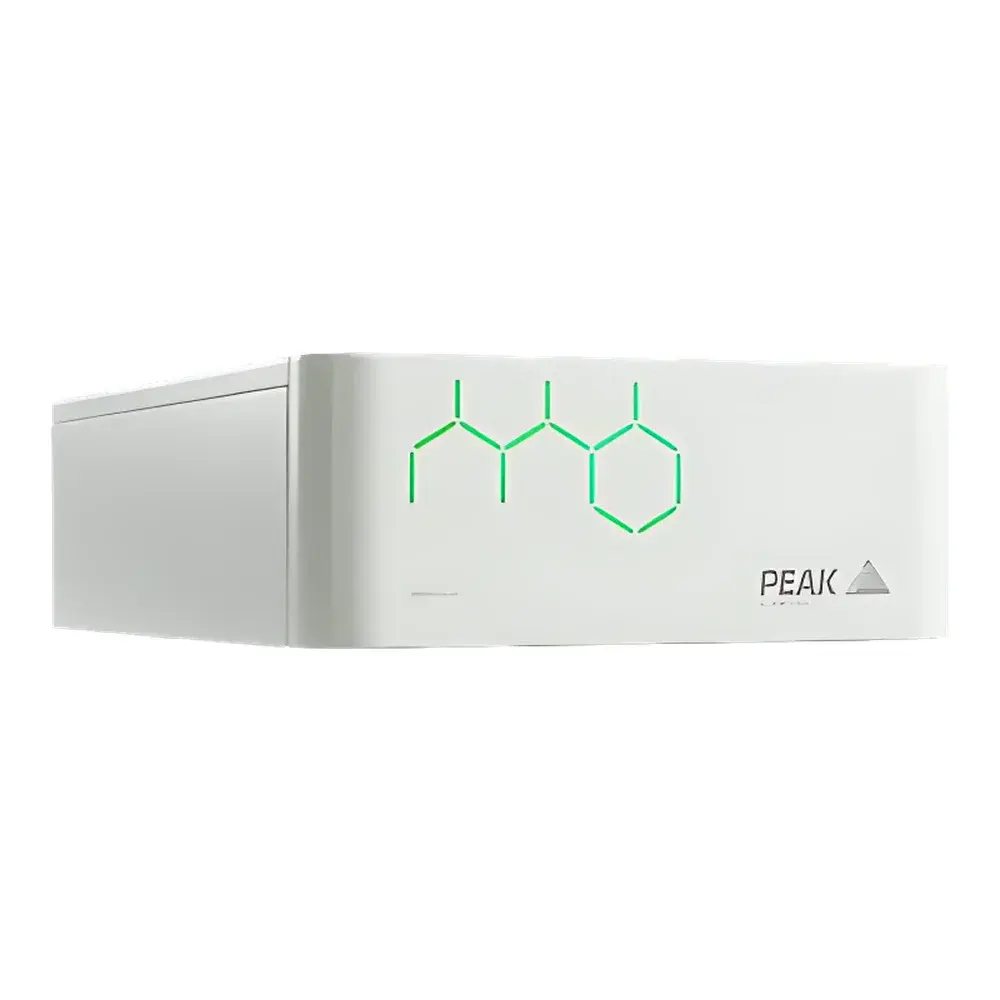
Precision Zero Air Zero-Grade Air Generator for VOC Monitoring
| Brand | PEAK |
|---|---|
| Origin | United Kingdom |
| Manufacturer Type | Original Equipment Manufacturer (OEM) |
| Import Status | Imported |
| Model | Precision Zero Air |
| Hydrocarbon Removal Principle | High-Temperature Catalytic Cracking |
| Maximum Output Flow Rate | 30 L/min |
| Output Pressure | 80 psi |
| Total Hydrocarbon Content | < 0.05 ppm (as methane equivalent) |
| Dew Point | −30 °C |
Overview
The Precision Zero Air Zero-Grade Air Generator is an engineered solution designed specifically to support volatile organic compound (VOC) monitoring systems requiring ultra-pure combustion air—particularly in gas chromatography–flame ionization detection (GC-FID), photoionization detection (PID), and online ambient air quality analyzers. Unlike compressed air from conventional compressors or bottled zero-air cylinders, this generator produces on-demand zero-grade air via a two-stage purification architecture: first, oil-free compression using a proprietary precision scroll compressor; second, catalytic hydrocarbon destruction at elevated temperatures (>350 °C), followed by desiccant-based drying and sub-micron particulate filtration. The result is a continuous, stable supply of air meeting ASTM D6196–22 and EPA Method TO-15/TO-17 specifications for hydrocarbon-free carrier and combustion gases. Its design prioritizes long-term stability, low maintenance burden, and compatibility with regulatory-compliant analytical workflows in environmental laboratories, industrial hygiene settings, and continuous emissions monitoring systems (CEMS).
Key Features
- Engineered for VOC analysis: Delivers consistent zero-grade air as combustion support gas for FID detectors and calibration standards preparation
- Ultra-low hydrocarbon output: Total hydrocarbons < 0.05 ppm (measured as methane), validated per ISO 8573-1 Class 1:2:1 for gaseous contaminants
- Stable pressure delivery: Regulated output up to 80 psi (5.5 bar) with ±0.5 psi pressure control accuracy across full flow range
- Rapid system readiness: Achieves specification-grade output within 60 minutes of cold start—no pre-conditioning or purge delays
- Integrated precision scroll compressor: Oil-free, low-vibration architecture with brushless DC motor and active thermal management
- Compact stackable chassis: 430 mm × 400 mm × 650 mm footprint; supports vertical stacking with other Precision-series generators (N₂, H₂) to optimize benchtop or rack-mounted deployment
- Service-intuitive design: Annual maintenance limited to replacement of dual-stage filter cartridges (coalescing + catalytic) with tool-free access and documented calibration traceability
Sample Compatibility & Compliance
The Precision Zero Air generator is compatible with all major VOC analyzers requiring certified zero-air input, including Thermo Fisher Scientific TRACE™ GC-FID, PerkinElmer Torion® T-9, and Siemens Ultramat™ 23 series. It meets the air purity requirements outlined in U.S. EPA Methods TO-14A, TO-15, and Method 25A for ambient and source testing. Its hydrocarbon removal efficiency complies with ISO 8573-1:2010 Class 1 for total hydrocarbons and Class 2 for water content (equivalent to −30 °C dew point at 100 kPa). All internal wetted materials conform to USP Class VI biocompatibility standards, and the unit operates within GLP/GMP-aligned environments when paired with optional audit-trail-capable software modules.
Software & Data Management
While the base unit operates autonomously via embedded microcontroller logic, optional RS-485 Modbus RTU or Ethernet/IP interfaces enable integration into centralized lab infrastructure. When connected to PEAK’s GasManager™ v3.2 platform (sold separately), users gain real-time monitoring of inlet pressure, catalyst temperature, dew point stability, and cumulative runtime—each logged with ISO/IEC 17025-compliant timestamping and user-accessible audit trails. Data export supports CSV and XML formats compatible with LIMS systems compliant with FDA 21 CFR Part 11 requirements for electronic records and signatures.
Applications
- Continuous emission monitoring (CEM) systems requiring certified zero-air for FID baseline verification and span calibration
- Calibration gas blending systems where hydrocarbon-free diluent air is critical for ppb-level VOC standard generation
- Indoor air quality (IAQ) monitoring networks deploying distributed PID or FID sensors in smart building environments
- Research laboratories conducting atmospheric chemistry studies requiring reproducible, traceable zero-air backgrounds
- Pharmaceutical cleanroom environmental monitoring per ISO 14644-1, where hydrocarbon interference must be excluded from particle counter purge air
FAQ
What is the expected lifetime of the catalytic converter under continuous operation?
With proper inlet air pre-filtration (provided by the integrated coalescing stage), the high-temperature catalytic bed is rated for ≥15,000 hours of service life—approximately 1.7 years at 24/7 operation.
Can this generator be used as a zero-air source for ozone generators or NOx analyzers?
No. This unit is optimized exclusively for hydrocarbon removal; it does not remove NOₓ, SO₂, or ozone precursors. For ozone photolysis applications, dedicated ozone-scrubbed zero-air generators are required.
Is external cooling or ventilation required?
Yes. The catalytic oxidation stage generates significant waste heat; the unit requires minimum 200 mm clearance above and rear exhaust routing to ambient space with ≥1 m³/min airflow capacity.
Does the generator include internal pressure regulation for downstream instruments?
Yes. A precision stainless-steel diaphragm regulator maintains constant outlet pressure across the full 0–30 L/min flow range, with built-in overpressure relief set at 100 psi.
How is compliance with ISO 8573-1 verified during factory acceptance testing?
Each unit undergoes 72-hour stability validation using flame ionization detection (FID) and tunable diode laser absorption spectroscopy (TDLAS) to quantify CH₄, C₂H₆, and total non-methane hydrocarbons at the outlet port. Full test reports are supplied with shipment.



