
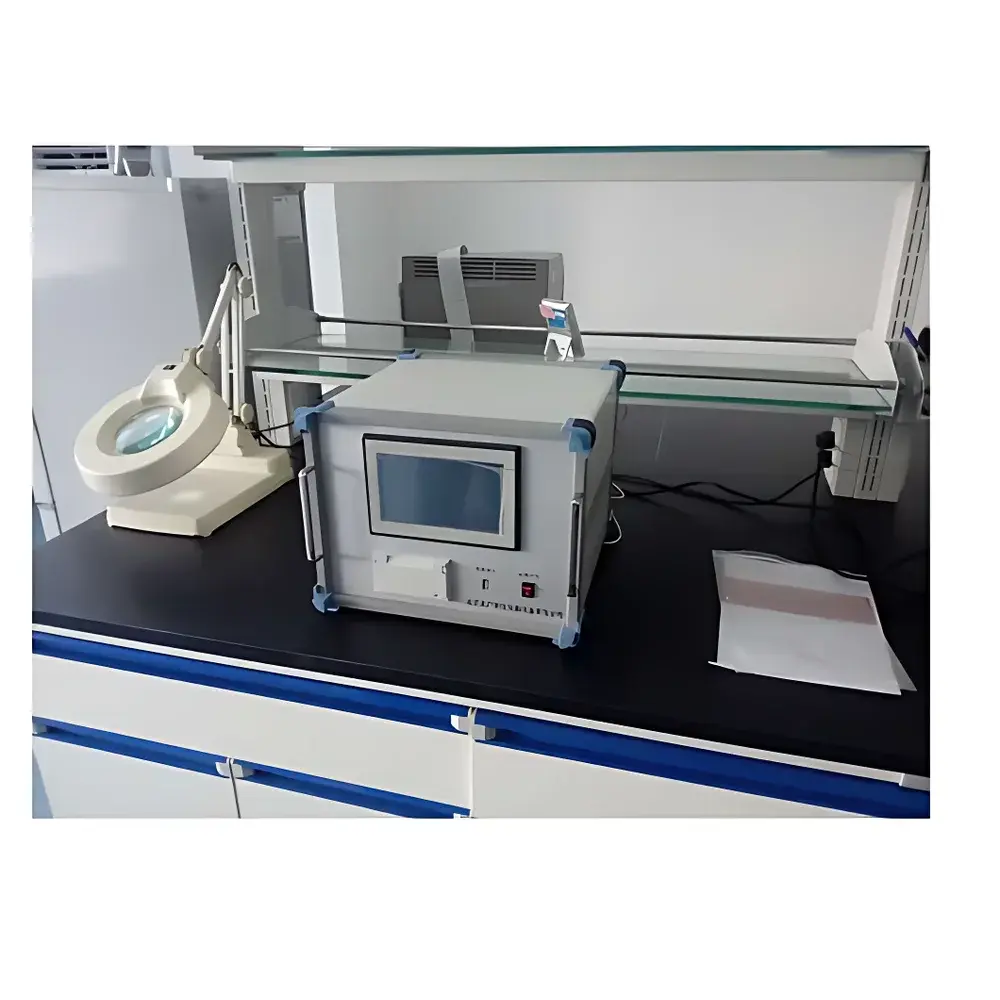
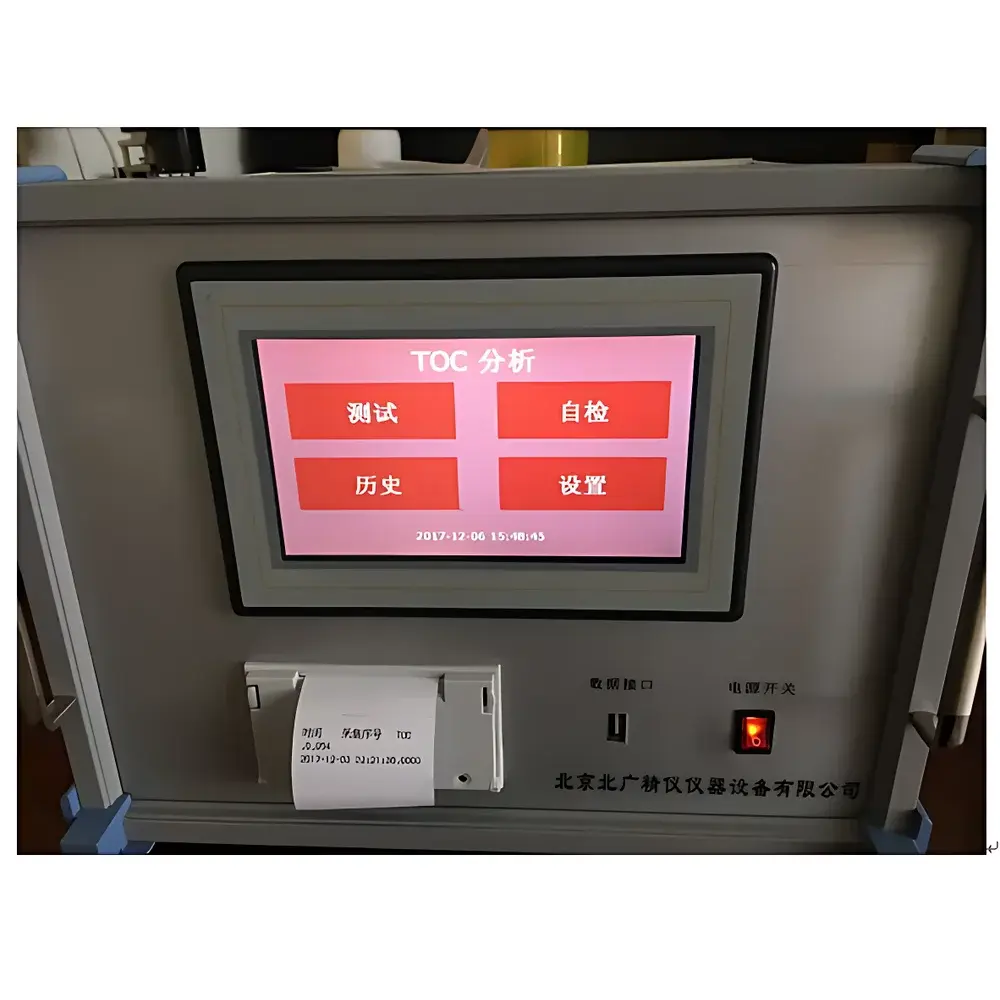
All Precision Instrument BC-40A Portable Pharmaceutical-Grade Total Organic Carbon Analyzer
| Brand | All Precision Instrument |
|---|---|
| Origin | Beijing, China |
| Manufacturer Type | Direct Manufacturer |
| Instrument Type | Portable TOC Analyzer |
| Detection Principle | Direct Conductivity Detection after UV/Persulfate Oxidation |
| Oxidation Method | High-Temperature Catalytic Combustion (supplemented by UV/persulfate for low-level precision) |
| Measurement Range | 0.01–1000 µg/L (0.01–1.000 mg/L) |
| Accuracy | ±4% of reading within calibrated range |
| Resolution | 0.001 mg/L (1 µg/L) |
| Detection Limit | 0.001 mg/L (1 µg/L) |
| Repeatability | ≤3% RSD |
| Sample Temperature Range | 1–95 °C |
| Analysis Time | ≤6 minutes per sample |
| Data Storage | Internal memory supporting ≥6 months of timestamped records |
| Compliance | USP <643>, EP 2.2.44, ChP 2020 Edition (General Chapter 0682), FDA CGMP Annex 1 (Water Systems), ISO 8573-1 (for pharmaceutical compressed air-associated water), GLP/GMP-ready audit trail capability |
Overview
The All Precision Instrument BC-40A Portable Pharmaceutical-Grade Total Organic Carbon Analyzer is a dedicated, regulatory-compliant instrument engineered for precise quantification of total organic carbon (TOC) in high-purity water systems used across pharmaceutical manufacturing, biotechnology, and sterile product development. It operates on the principle of selective oxidation followed by direct conductivity detection — a method validated for its robustness, reagent-free operation, and suitability for ultra-low-concentration measurement in purified water (PW) and water for injection (WFI). The system employs dual-path measurement: first, determination of total inorganic carbon (TIC) from unoxidized sample; second, oxidation of all carbon species (both organic and inorganic) to CO₂ via integrated high-temperature catalytic combustion (680 °C) with optional UV/persulfate pre-oxidation for enhanced recovery of recalcitrant organics. The resulting CO₂ dissolves in deionized water, forming carbonic acid, whose conductance is measured with a high-stability, temperature-compensated conductivity cell. TOC is calculated as the difference: TOC = TC − TIC. This differential approach eliminates baseline drift associated with variable inorganic carbonate concentrations and ensures trace-level accuracy without chemical reagents or carrier gases.
Key Features
- Portable, benchtop-ready design optimized for point-of-use verification — ideal for PW/WFI loop sampling, cleanroom environmental monitoring, and cleaning validation workflows.
- Embedded Linux-based control system with 7-inch capacitive color touchscreen (640 × 480 resolution), supporting intuitive navigation, one-touch analysis initiation, and automated sequence execution including system rinse, calibration, and measurement.
- Dual oxidation architecture: primary high-temperature catalytic combustion (680 °C) coupled with optional UV/persulfate oxidation for improved oxidation efficiency of chlorinated and aromatic compounds below 100 ppb.
- No consumable gases, no liquid reagents, no moving parts in the detection path — significantly reducing operational cost, downtime, and qualification burden.
- Integrated automatic line-flush and self-diagnostic routines; UV lamp and peristaltic pump tubing accessible without chassis disassembly.
- User-configurable alarm thresholds with relay output for real-time process interlock (e.g., divert valve activation upon TOC excursion).
- Comprehensive IQ/OQ/PQ documentation support package available, aligned with ASTM D5905, USP , and EU GMP Annex 1 requirements for water system qualification.
Sample Compatibility & Compliance
The BC-40A is specifically calibrated and validated for ultrapure aqueous matrices: purified water (PW), water for injection (WFI), and clean steam condensate per ICH Q5C and WHO TRS 970. It meets sensitivity and precision requirements outlined in USP (detection limit ≤ 50 ppb, accuracy ±5%), EP 2.2.44 (repeatability ≤ 5%, linearity R² ≥ 0.999), and Chinese Pharmacopoeia 2020 Edition General Chapter 0682. The analyzer supports both offline grab-sample analysis and optional online integration via 1/4″ PFA tubing and pressure-regulated flow cell (0.1–2 mL/min). All wetted materials — including sample lines, reaction chamber, and conductivity cell — are electropolished 316L stainless steel or PFA, ensuring extractables-free performance and compliance with USP Class VI and ISO 10993-5 biocompatibility standards. Instrument firmware includes configurable audit trail logging (user ID, timestamp, action, parameter change) meeting FDA 21 CFR Part 11 and EU Annex 11 data integrity expectations.
Software & Data Management
Data acquisition and reporting are managed through an embedded application supporting CSV export via USB port and RS-232 serial interface (Modbus RTU protocol compatible). Up to 10,000 test records — including raw conductivity values, TC/TIC/TOC results, calibration coefficients, and operator annotations — are stored with full time/date stamping and user authentication. Historical data retention exceeds six months at default sampling frequency (1 test/hour). Optional PC software enables trend analysis, SPC charting (X-bar/R), deviation investigation tracking, and automated report generation compliant with ALCOA+ principles (Attributable, Legible, Contemporaneous, Original, Accurate, Complete, Consistent, Enduring, Available). All data exports include digital signature metadata and checksum verification to prevent tampering.
Applications
- Real-time release testing of PW and WFI at distribution points per FDA Guidance for Industry (2022) and EMA CHMP Reflection Paper on Water for Pharmaceutical Use.
- Cleaning validation of API synthesis equipment, bioreactors, and fill-finish lines per PDA Technical Report No. 29 and ISPE Baseline Guide Vol. 4.
- Environmental monitoring of purified water storage tanks and distribution loops during routine surveillance and change control assessments.
- Supporting root cause analysis during out-of-specification (OOS) investigations involving microbial proliferation or leachables from polymeric components.
- Supplemental TOC monitoring in semiconductor ultrapure water (UPW) systems where organic contamination impacts wafer yield (per SEMI F57).
FAQ
Does the BC-40A comply with 21 CFR Part 11 requirements for electronic records?
Yes — when operated with enabled audit trail and user access controls, it satisfies predicate rule requirements for electronic signatures and record retention. Full Part 11 compliance requires site-specific configuration validation and administrative SOPs.
Can the instrument be used for online continuous monitoring?
It supports semi-continuous operation via optional flow cell and external pump module. True 24/7 online deployment requires integration with a PLC-controlled sample delivery system and redundant power supply.
What maintenance is required beyond routine calibration?
Annual verification of oxidation efficiency (using sucrose and 1,4-benzoquinone challenge solutions per USP ) and conductivity cell calibration using NIST-traceable KCl standards. UV lamp replacement every 12 months is recommended.
Is the system compatible with LIMS integration?
Yes — ASCII-formatted data output via RS-232 or USB allows seamless ingestion into most laboratory information management systems using standard HL7 or ASTM E1384 mapping protocols.
How is carryover minimized between high- and low-concentration samples?
The system executes a four-stage high-purity water flush (≥30 seconds each) prior to analysis, programmable up to six cycles. Residual TOC carryover is verified to be <1% at 1000 ppb → 10 ppb transition per internal validation protocol.







