
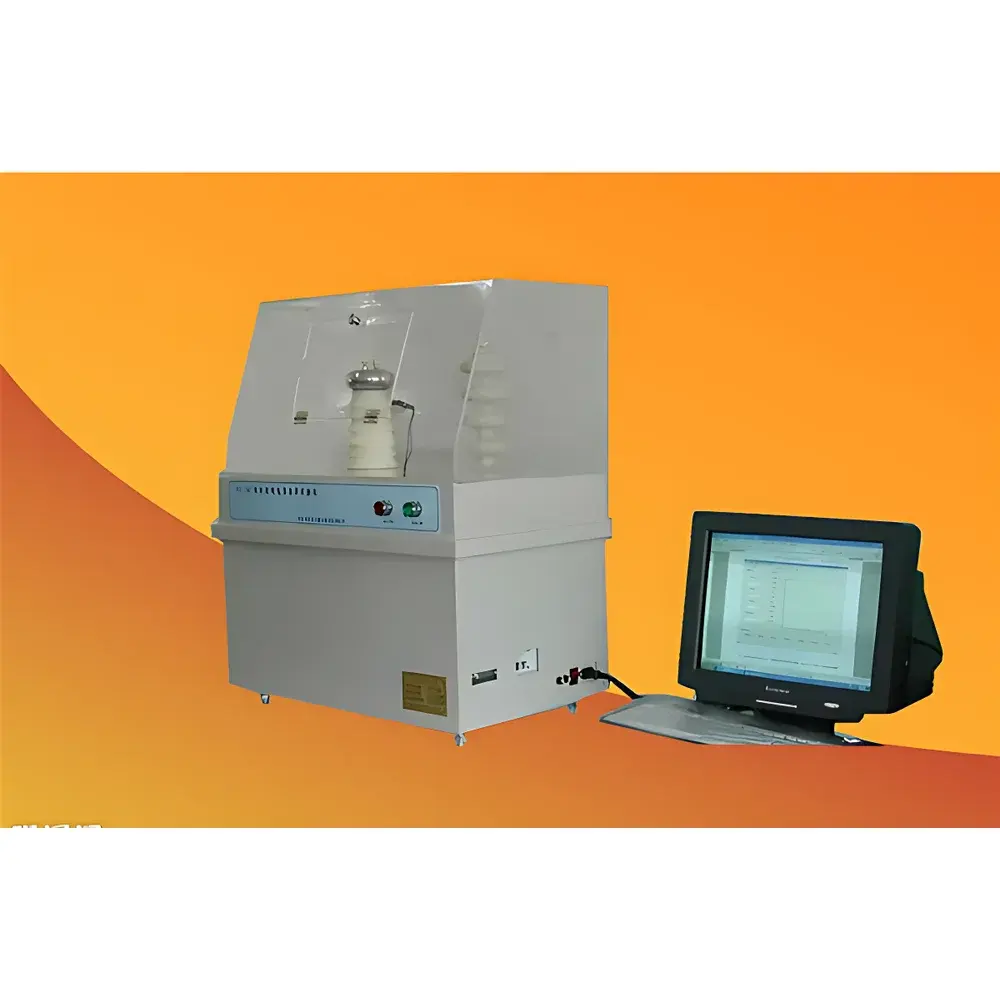
All Precision Instrument BC-50KV Dielectric Breakdown Tester
| Brand | All Precision Instrument |
|---|---|
| Origin | Beijing, China |
| Manufacturer Type | Direct Manufacturer |
| Model | BC-50KV |
| Output Voltage Range | AC/DC 0–50 kV |
| Rated Capacity | 5 kVA |
| Voltage Accuracy | ≤1% |
| Rise Rate Adjustment | 0.1–5.0 kV/s (continuously variable) |
| Test Modes | AC/DC stepwise ramp, constant-rate ramp, and hold-at-level withstand testing |
| Short-Circuit Response Time | ≤0.05 s |
| Leakage Current Measurement Range | 0–200 mA (real-time, mA-resolution) |
| Electrode Set per GB/T 1408.1–2006 | Two Φ25 mm × 25 mm |
| Test Mediums | Air or insulating oil |
| Compliance Standards | IEC 60243-1, ASTM D149, GB/T 1408.1–2006, UL 508, CSA C22.2 No. 0.3 |
Overview
The All Precision Instrument BC-50KV Dielectric Breakdown Tester is an industrial-grade high-voltage test system engineered for precise determination of dielectric strength and insulation integrity in solid electrical insulating materials—primarily polymers, elastomers, laminates, composites, and molded rubber/plastic components. Operating on the principle of controlled voltage escalation until electrical breakdown occurs, the instrument measures the maximum electric field (kV/mm) a material can withstand before catastrophic conduction initiates—a critical parameter defined in IEC 60243-1 and ASTM D149. Designed specifically for R&D labs, QC departments in rubber & plastic manufacturing, and third-party certification bodies, it delivers repeatable, traceable, and standards-compliant test outcomes under both AC and DC excitation. Its dual-mode architecture enables evaluation of time-dependent dielectric failure mechanisms—including partial discharge onset, tracking resistance, and thermal runaway—under realistic service conditions such as ambient air or standardized transformer oil immersion.
Key Features
- True dual-polarity output: AC 0–50 kV RMS and pulsed DC 0–50 kV (achieved via integrated high-voltage silicon stack with manual shorting bar bypass)
- Microprocessor-controlled motorized variac with closed-loop feedback ensures linear, jitter-free voltage ramping from 0.1 to 5.0 kV/s (user-selectable in 0.1 kV/s increments)
- Dual-channel real-time acquisition: Simultaneous digital sampling of test voltage (±1% accuracy) and leakage current (0.01–200 mA range, 10-bit resolution)
- Redundant safety architecture: Dual-stage overcurrent protection (<0.05 s cutoff), hardware-based arc detection, and dual-path fault alarm (local HMI + remote PC alert)
- Modular electrode configuration compliant with GB/T 1408.1–2006: Includes two 25 mm diameter × 25 mm height brass electrodes and one 75 mm diameter × 25 mm height electrode for comparative thickness-normalized testing
- Wireless operation enabled: Bluetooth 5.0 interface supports remote start/stop, parameter adjustment, and live waveform streaming up to 30 m line-of-sight
- Multi-user software environment with role-based access control, audit-trail logging, and 21 CFR Part 11–compatible electronic signatures (optional)
Sample Compatibility & Compliance
The BC-50KV accommodates flat, rigid, or semi-rigid specimens up to 10 mm thick and 100 mm × 100 mm planar dimension. It supports standardized test configurations per GB/T 1408.1–2006 (equivalent to IEC 60243-1), including short-time test, step-by-step test, and slow-rate ramp methods. Optional oil bath fixtures allow submerged testing per ASTM D877 and IEC 60156 protocols. The system meets electromagnetic compatibility (EMC) requirements per IEC 61326-1 and functional safety criteria per IEC 61010-1. Calibration certificates are traceable to CNAS-accredited national metrology institutes, and full documentation supports GLP/GMP validation packages required by medical device and automotive Tier-1 suppliers.
Software & Data Management
The embedded Windows-based control software provides ISO/IEC 17025–aligned data handling: automatic timestamping, user ID tagging, configurable pass/fail thresholds, and multi-curve overlay (≥5 traces) for batch comparison. Test reports export to PDF, CSV, and XML formats with embedded metadata (operator, date, environmental conditions, calibration status). Audit logs record all parameter changes, test starts/stops, and emergency interventions. Network deployment allows centralized database synchronization across multiple instruments—enabling cross-facility benchmarking and SPC charting. Optional add-ons include FDA 21 CFR Part 11 compliance modules with electronic signature workflows and encrypted database backups.
Applications
- Quality assurance of cable insulation, gaskets, bushings, and encapsulated electronic modules
- Material qualification for aerospace-grade silicone rubbers and flame-retardant thermoplastics
- Development testing of nanocomposite dielectrics and conductive polymer blends
- Regulatory submission support for UL recognition, CE marking, and CCC certification
- Failure analysis of aged or thermally stressed polymer insulators in power distribution systems
- Research into space charge accumulation and electroluminescence onset in high-k dielectrics
FAQ
What standards does the BC-50KV comply with for dielectric strength testing?
It conforms to IEC 60243-1, ASTM D149, GB/T 1408.1–2006, UL 508, and CSA C22.2 No. 0.3 for AC and DC breakdown testing of solid insulating materials.
Can the instrument perform both AC and DC tests without hardware modification?
Yes—DC output is achieved by removing the factory-installed shorting bar to engage the internal high-voltage silicon rectifier stack; no external components are required.
Is the leakage current measurement calibrated and traceable?
Yes—current sensing circuitry is factory-calibrated against NIST-traceable shunt resistors, with annual recalibration recommended per ISO/IEC 17025 guidelines.
Does the software support automated report generation for regulatory audits?
Standard software includes PDF report templates with embedded calibration IDs and operator credentials; optional 21 CFR Part 11 module adds electronic signature enforcement and immutable audit trails.
What is the maximum specimen thickness supported in air-gap testing?
For reliable breakdown localization and minimized edge effects, the recommended maximum thickness is 10 mm using the standard 25 mm diameter electrodes per GB/T 1408.1–2006 Clause 6.3.




