
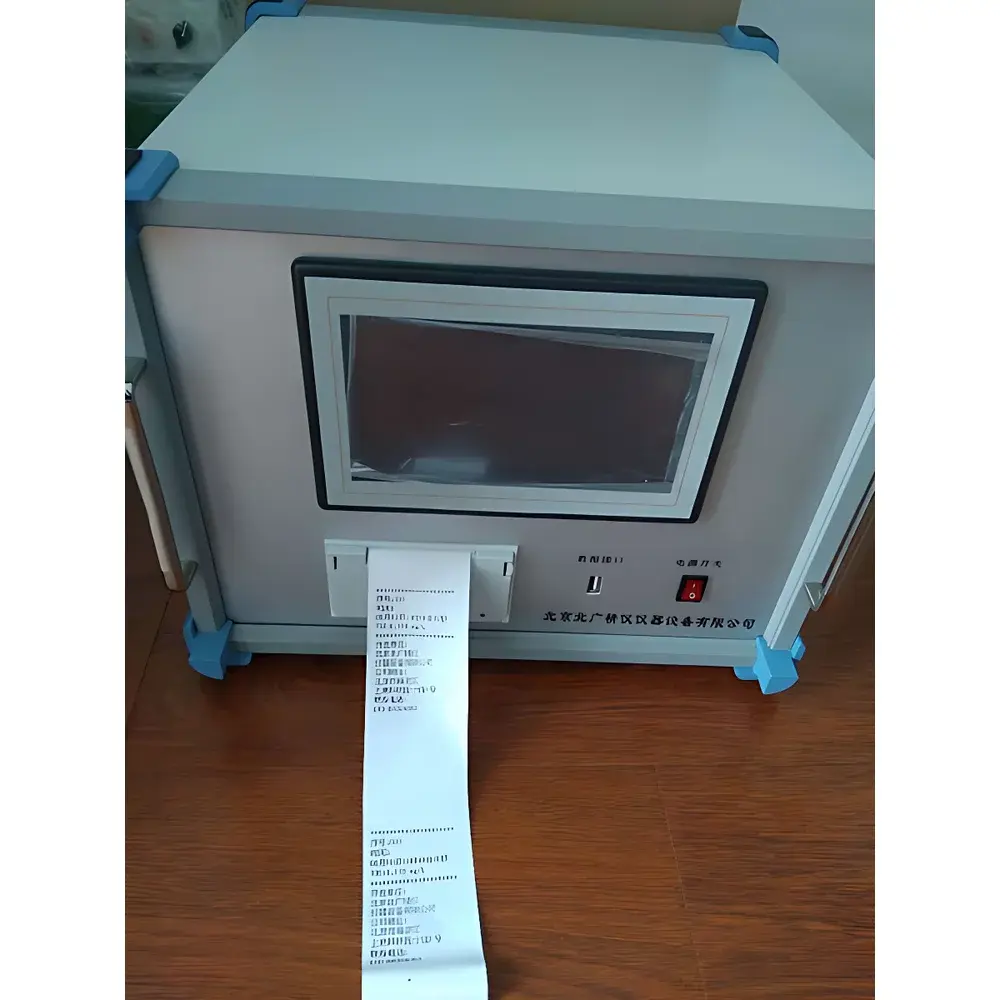
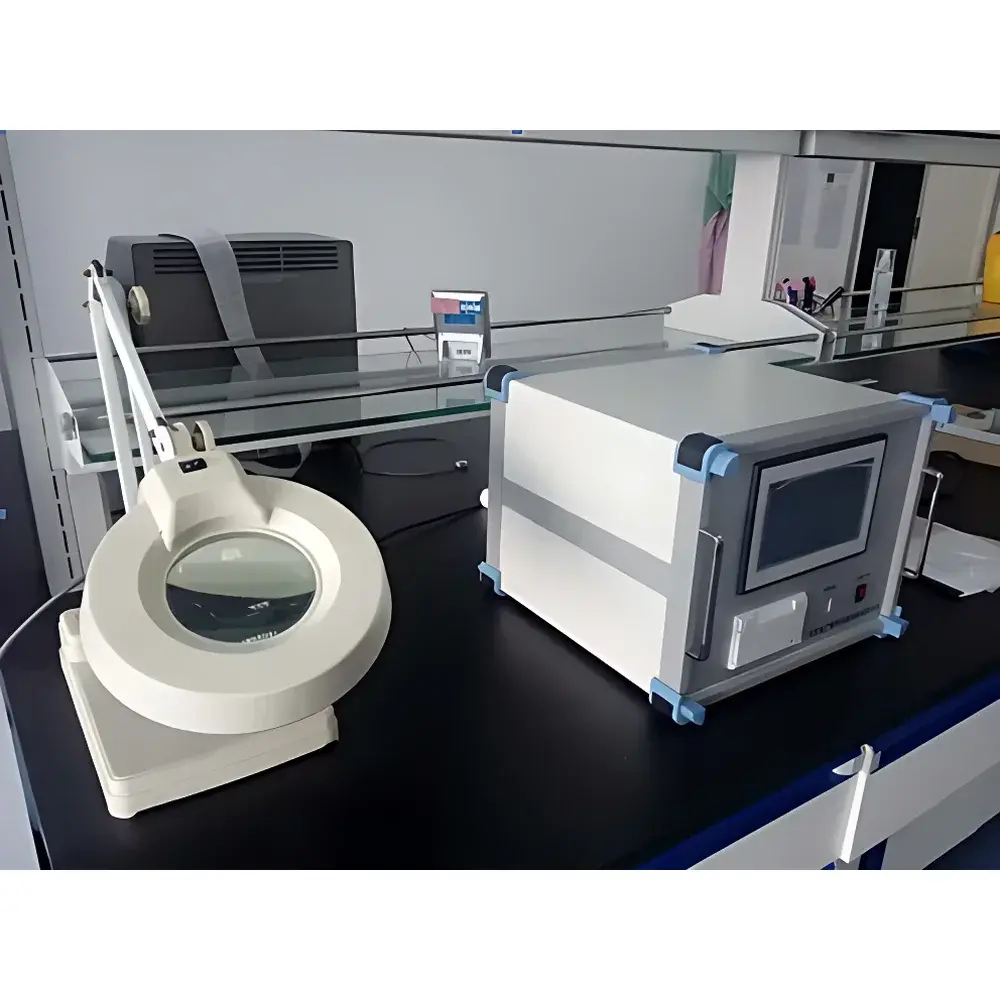
All Precision Instrument BC Portable Online/Offline Total Organic Carbon (TOC) Analyzer
| Brand | All Precision Instrument |
|---|---|
| Origin | Beijing, China |
| Manufacturer Type | Direct Manufacturer |
| Instrument Type | Portable TOC Analyzer |
| Detection Principle | Membrane Conductivity Detection |
| Oxidation Method | UV/Persulfate Oxidation |
| Measurement Range | 0.001–1.5 mg/L |
| Accuracy | ±5% |
| Resolution | 1 µg/L |
| Detection Limit | 0.001 mg/L |
| Repeatability | ≤3% |
| Power Supply | AC 220 V ±22 V, 50 Hz ±1 Hz |
| Power Consumption | 95 W |
| Dimensions | 340 × 390 × 145 mm |
| Weight | 15 kg |
| Response Time | ≤6 min |
| Sample Temperature Range | 1–95 °C |
| Ambient Temperature | 10–40 °C |
| Relative Humidity | ≤85% RH |
| Linearity Error | ±5% |
| Control Interface | Color Touchscreen with Embedded System |
| Connectivity | Bluetooth Wireless Control |
| Compliance | Chinese Pharmacopoeia 2015 Edition, Appendix VIII R |
Overview
The All Precision Instrument BC Portable Online/Offline Total Organic Carbon (TOC) Analyzer is engineered for precise, reliable quantification of organic carbon content in ultrapure water systems used across pharmaceutical, biotechnology, semiconductor, and power generation industries. It operates on the fundamental principle of differential conductivity measurement following oxidation of organic compounds to carbon dioxide (CO2). The instrument employs dual-stage detection: first measuring total inorganic carbon (TIC) via direct conductivity in the native sample, then oxidizing all organic carbon to CO2 using a combined 185 nm UV lamp and persulfate reagent—generating hydroxyl radicals (•OH) that mineralize organics quantitatively. The resulting CO2 dissolves to form carbonic acid, altering solution conductivity proportionally to total carbon (TC). TOC is calculated as the arithmetic difference: TOC = TC − TIC. This differential approach eliminates matrix interference from variable inorganic carbonate species and ensures compliance with pharmacopeial requirements for method specificity and sensitivity.
Key Features
- Portable, benchtop-ready design (15 kg) enables flexible deployment for both online process monitoring and offline laboratory analysis—ideal for point-of-use verification in purified water loops or cleanroom QC labs.
- Dual-mode operation supports continuous online flow-through measurement (with optional bypass manifold) and discrete offline vial-based analysis—eliminating need for separate instruments.
- UV/persulfate oxidation system achieves >95% oxidation efficiency for refractory compounds including methanol, ethanol, acetone, and low-molecular-weight organic acids—validated per USP <643> and EP 2.2.44 system suitability criteria.
- Membrane-conductivity detection eliminates gas-transfer membranes and IR detectors—reducing calibration drift, maintenance intervals, and consumable dependency.
- Embedded ARM-based controller with 7-inch color touchscreen provides intuitive navigation, real-time trend visualization, and password-protected user roles aligned with FDA 21 CFR Part 11 data integrity expectations.
- No carrier gases, high-pressure reactors, or moving mechanical parts—only UV lamp and peristaltic pump tubing require scheduled replacement (lamp life ≥ 10,000 h; tubing change interval ≥ 3 months at 1 sample/hour).
- Automated alarm logic triggers visual/audio alerts and dry-contact output signals when TOC exceeds user-defined thresholds—enabling integration with SCADA or PLC systems for automated process intervention.
Sample Compatibility & Compliance
The BC analyzer is validated for use with low-conductivity water matrices: purified water (PW), water for injection (WFI), ultrapure water (UPW), and deionized water (DIW) with conductivity < 10.0 µS/cm. It meets all functional requirements specified in the Chinese Pharmacopoeia 2015 Edition, Appendix VIII R, including mandatory system suitability testing (SST) for recovery (85–115%), repeatability (RSD ≤ 3%), and detection limit (≤ 0.05 mg/L). Instrument qualification packages (IQ/OQ/PQ) are available with full traceability to NIST-traceable sucrose and sodium bicarbonate standards. While not certified to ISO/IEC 17025, its performance aligns with ISO 8573-7 (compressed air purity) and ASTM D5907-21 (TOC in water) for routine environmental and industrial hygiene applications.
Software & Data Management
- Onboard storage retains ≥ 10,000 test records with timestamp, operator ID, sample ID, raw conductivity values (TIC/TC), calculated TOC, SST results, and UV lamp operating hours.
- Data export via USB or Bluetooth to CSV-compatible spreadsheets—no proprietary software required.
- Touchscreen interface supports multi-language localization (English, Chinese, Spanish), audit trail logging (user actions, parameter changes, calibration events), and electronic signature capability for GLP/GMP environments.
- Calibration routines include zero-point verification (high-purity DI water), span calibration (1.0 mg/L sucrose standard), and SST validation (0.5 mg/L sucrose + 0.5 mg/L NaHCO3)—all documented with automatic pass/fail flags.
Applications
The BC analyzer serves critical quality control functions in regulated manufacturing: real-time monitoring of PW/WFI distribution loops per EU GMP Annex 1; cleaning validation of stainless-steel piping and bioreactors via rinse water TOC profiling; UPW qualification in semiconductor fab fabs (SEMI F57-0301); and routine surveillance of boiler feedwater in thermal power plants. Its portability supports field verification during commissioning, troubleshooting of carbon breakthrough in mixed-bed resins, and periodic verification of online analyzers without process interruption. In academic and environmental labs, it supports EPA Method 415.3-compliant wastewater screening and research into natural organic matter (NOM) removal kinetics in advanced oxidation processes.
FAQ
Does the BC analyzer comply with FDA 21 CFR Part 11 for electronic records?
Yes—audit trail, user authentication, and electronic signature functionality are implemented per ALCOA+ principles; however, full Part 11 compliance requires site-specific validation protocols.
Can it measure samples with conductivity above 10 µS/cm?
No—elevated ionic strength causes non-linear conductivity response and suppresses oxidation efficiency; dilution with certified TOC-free water is required prior to analysis.
What is the recommended maintenance schedule?
UV lamp replacement every 12 months (or after 10,000 h); peristaltic pump tubing every 90 days under continuous operation; quarterly conductivity electrode cleaning with 0.1 M HCl followed by DI water rinse.
Is external calibration gas or standard solutions required?
No—calibration uses aqueous sucrose (organic carbon source) and sodium bicarbonate (inorganic carbon source); no compressed gas cylinders or IR gas cells are needed.
How is system suitability testing performed?
A 0.5 mg/L sucrose + 0.5 mg/L NaHCO3 mixture is analyzed three times; recovery must be 85–115%, and %RSD ≤ 3% across replicates—results are automatically logged and flagged if out-of-spec.
Related Products







