
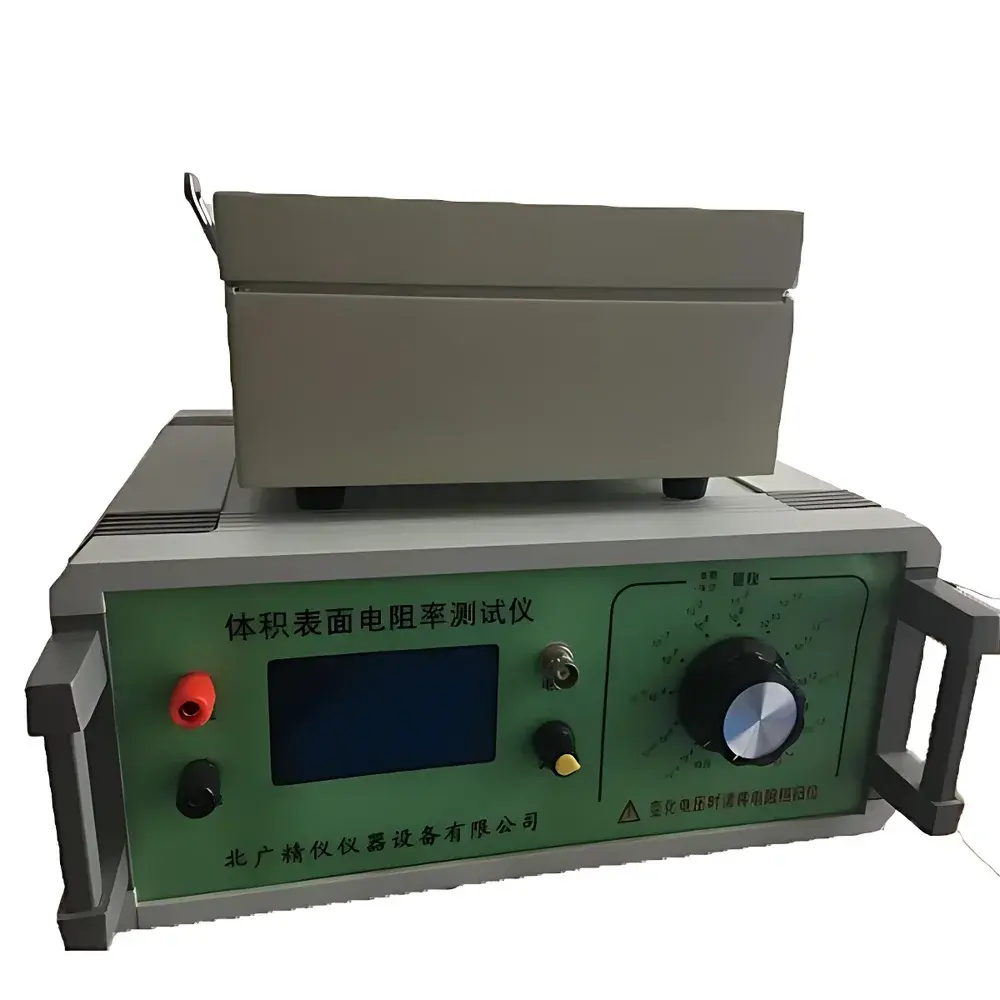
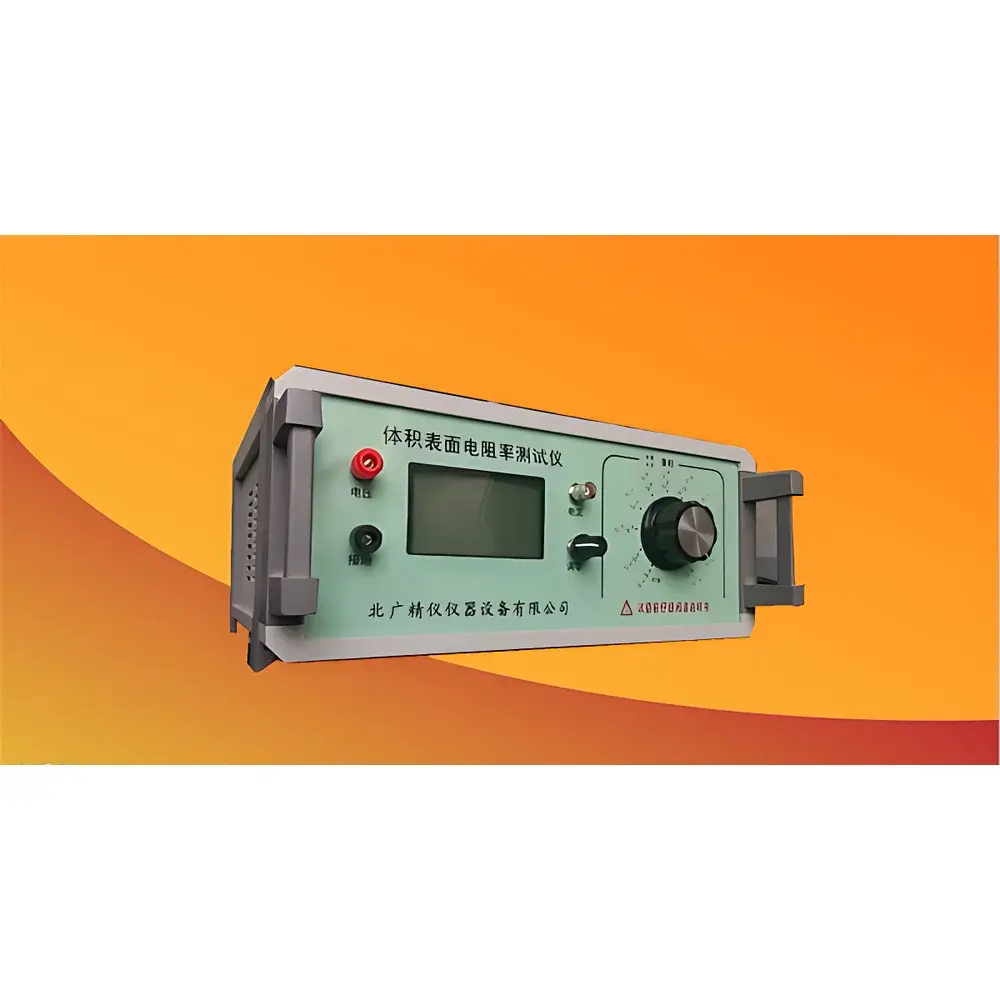
All Precision Instrument BES Electrostatic Discharge (ESD) Resistance Tester for Surface & Volume Resistivity Measurement
| Brand | All Precision Instrument |
|---|---|
| Origin | Beijing, China |
| Manufacturer Type | Direct Manufacturer |
| Product Category | Domestic |
| Model | BES |
| Price | USD 1,700 (approx.) |
| Resistance Range | 1 × 10⁴ Ω to 1 × 10¹⁸ Ω |
| Current Range | 2 × 10⁻⁴ A to 1 × 10⁻¹⁶ A |
| Test Voltages | 10 V, 50 V, 100 V, 250 V, 500 V, 1000 V (selectable) |
| Basic Accuracy | ±1% |
| Display | 32-bit LED LCD (simultaneous resistance and current readout) |
| Operating Environment | 0–40 °C, <80% RH |
| Power Supply | AC 220 V, 50 Hz, ~5 W |
| Dimensions | 285 mm × 245 mm × 120 mm |
| Weight | ~2.5 kg |
| Standard Electrodes | Solid disc electrode (Ø100 mm), concentric ring electrode (OD 75 mm / ID 55 ± 0.2 mm), cylindrical electrode (Ø50 mm), point-to-point probe set |
| Shielding Enclosure | 200 mm × 200 mm × 90 mm (internal height 50 mm) |
Overview
The All Precision Instrument BES Electrostatic Discharge (ESD) Resistance Tester is a precision benchtop instrument engineered for the quantitative measurement of surface resistivity (ρs) and volume resistivity (ρv) of solid insulating materials, powders, elastomers, textiles, flooring, work surfaces, and ESD-protective garments. It operates on the principle of direct-current (DC) voltage application across defined electrode geometries—per ASTM D257-99 and IEC 62631-3-1—followed by high-impedance current measurement using guarded electrometer circuitry. The instrument supports standardized electrode configurations required for compliance with international ESD control standards including ANSI/ESD S20.20, IEC 61340-2-3, and ISO 6359. Its wide dynamic range (10⁴–10¹⁸ Ω) enables characterization of both conductive (e.g., carbon-loaded polymers) and ultra-high-resistivity materials (e.g., optical-grade quartz or polyimide films), making it suitable for QC laboratories, ESD program validation teams, and R&D facilities engaged in material development for cleanrooms, electronics assembly, and aerospace applications.
Key Features
- Programmable DC test voltages (10 V to 1000 V) with automatic polarity reversal capability for leakage current compensation.
- Guarded triaxial input architecture minimizing stray capacitance and surface leakage errors during ultra-high-resistance measurements (>10¹⁵ Ω).
- Integrated 32-bit LED display showing real-time resistance (Ω), current (A), and applied voltage simultaneously—no external software required for basic operation.
- Dual-mode electrode support: fixed geometry (concentric ring, solid disc, cylinder) for standardized resistivity calculation per ASTM D257 Annex A3–A5; and point-to-point probes for field-deployable surface resistance mapping (per ANSI/ESD S4.1, S7.1, STM 2.1).
- Onboard data storage for up to 100 test records—including timestamp, voltage setting, resistance value, and pass/fail flag—enabling GLP-compliant audit trails without PC dependency.
- Compliance-ready design: calibrated traceable to NIST-traceable standard resistors; supports full documentation for FDA 21 CFR Part 11–aligned environments when paired with optional secure software logging.
Sample Compatibility & Compliance
The BES tester accommodates rigid solids (≥55 mm diameter for volume resistivity; ≥100 mm for surface resistivity), flexible sheets, granular powders (using optional powder electrode kit), and liquids (with liquid cell accessory). It fully satisfies the electrode geometry, voltage ramp, and dwell time requirements specified in GB/T 1410–2006, GB/T 10581–2006, GB/T 1692–2008, GB/T 2439–2001, GB/T 12703.4–2010, and GB/T 10064–2006. For ESD system verification, it meets ANSI/ESD S9.2 (footwear), STM 97.1 (personnel-flooring system), STM 12.1 (chairs), and TR53 (compliance verification protocol). All measurements adhere to the environmental conditioning guidelines in IEC 61340-5-1 (23 °C ± 2 °C, 12–25% RH for Class 0 environments; 23 °C ± 2 °C, 40–60% RH for general-purpose testing).
Software & Data Management
While functional as a standalone instrument, the BES supports optional USB-to-PC communication via RS-232 or TTL-level UART interface (cable sold separately). Compatible Windows-based software enables automated report generation (PDF/CSV), statistical process control (SPC) charting, batch comparison against specification limits, and electronic signature capture for 21 CFR Part 11 compliance. Audit trail functionality logs all user actions—including parameter changes, calibration events, and data exports—with immutable timestamps. Raw data files include metadata such as operator ID, sample ID, ambient temperature/humidity (when interfaced with optional external sensors), and electrode configuration used.
Applications
- Qualification of ESD-safe workbenches, mats, floor tiles, and wrist straps per ANSI/ESD S4.1 and S7.1.
- Verification of personnel grounding systems—including footwear, flooring, and continuous monitors—per STM 97.1 and IEC 61340-5-1.
- QC release testing of antistatic packaging films, conductive foams, and carbon-fiber composites.
- Research into humidity-dependent resistivity decay of polymer coatings and nanocomposites.
- Validation of cleaning efficacy on ESD-sensitive surfaces (pre- vs. post-cleaning resistivity delta analysis).
- Failure analysis of insulating components exhibiting electrostatic discharge-induced latch-up or gate oxide damage.
FAQ
What standards does the BES tester directly support?
It natively complies with ASTM D257-99, IEC 62631-3-1, GB/T 1410–2006, GB/T 10064–2006, and all ANSI/ESD Association standards referenced in the S20.20 ESD Control Program document.
Can the instrument measure resistivity of powdered samples?
Yes—when equipped with the optional powder compression electrode kit, which applies controlled pressure (1–5 MPa) to form a reproducible pellet for volume resistivity determination per ASTM D150.
Is calibration traceable to national standards?
Calibration is performed using NIST-traceable standard resistors (10⁴–10¹² Ω certified to ±0.1%; 10¹³–10¹⁸ Ω certified to ±5%). Certificate of Calibration includes uncertainty budget per ISO/IEC 17025.
Does the device meet requirements for GMP/GLP environments?
With optional software-enabled electronic signatures, audit trail export, and password-protected parameter locking, it supports ALCOA+ data integrity principles and qualifies for use in regulated pharmaceutical and medical device manufacturing settings.
How often should recalibration be performed?
Annual recalibration is recommended under normal use; however, laboratories operating under ISO/IEC 17025 must establish interval based on risk assessment, historical stability data, and usage frequency—typically every 6–12 months.



