
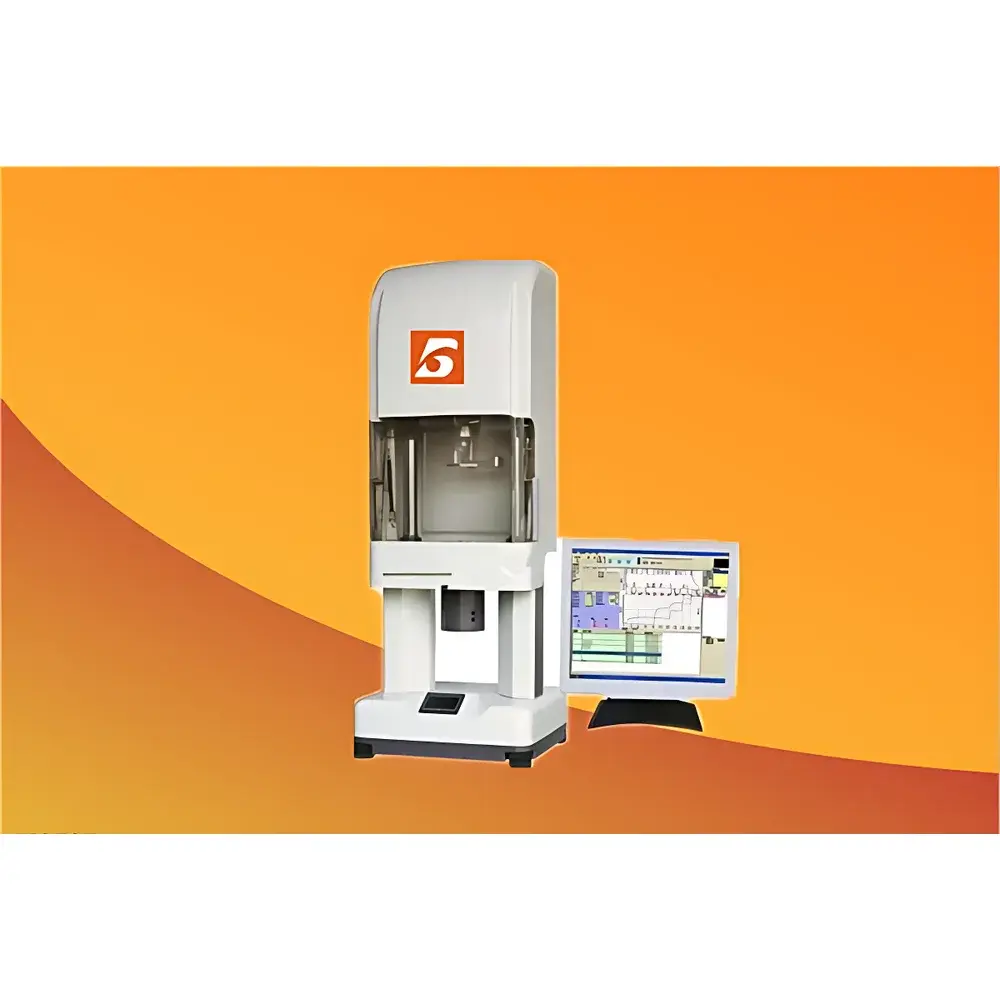
All Precision Instrument BML-400-B Capillary Rheometer
| Brand | All Precision Instrument |
|---|---|
| Origin | Beijing, China |
| Manufacturer Type | Direct Manufacturer |
| Instrument Type | Capillary Rheometer |
| Model | BML-400-B |
| Maximum Load Capacity | 25 kN |
| Temperature Range | 50–450 °C |
| Temperature Accuracy | ±0.1 °C (chamber), ±0.2 °C (barrel) |
| Barrel Diameter Options | 9.5, 12, 15 mm (custom lengths available) |
| Piston Speed Range | 0.0005–20 mm/s |
| Dynamic Speed Ratio | 1:40,000 |
| Pressure Sensor Range | Up to 2000 bar |
| Pressure Accuracy | < ±0.25% FS |
| Capillary Dies | Five standard options (e.g., 5/0.5-L=5 mm/D=0.5 mm |
| Die Material | Tungsten carbide |
| Barrel & Piston Material | Nitrided stainless steel |
| Control Mode | Constant piston speed or constant pressure |
| Compliance | ASTM D3835, ISO 11443, GB/T 3680 |
Overview
The All Precision Instrument BML-400-B Capillary Rheometer is a high-precision, benchtop-capable instrument engineered for the quantitative characterization of polymer melt rheology under controlled thermal and mechanical conditions. It operates on the fundamental principle of capillary flow rheometry: molten polymer is extruded through a precisely dimensioned die under programmable piston displacement, enabling direct measurement of pressure drop across the die and volumetric flow rate. From these primary measurements—and using established rheological models such as the Rabinowitsch–Mooney correction and Bagley end-effect compensation—the instrument calculates shear stress, shear rate, and apparent or true shear viscosity across a broad dynamic range (10−3–104 s−1). Designed for R&D laboratories and QC environments in polymer compounding, extrusion process development, and thermoplastic formulation, the BML-400-B delivers traceable, reproducible data compliant with international standards including ASTM D3835 (Standard Test Method for Determination of Melt Flow Rates of Thermoplastics Using Capillary Rheometers) and ISO 11443 (Plastics — Determination of the Rheological Properties of Thermoplastics in the Molten State Using Capillary Rheometers). Its modular architecture supports rapid configuration changes—barrel, die, load cell, and pressure transducer—ensuring optimal setup per material class and test objective.
Key Features
- High-resolution servo-driven piston actuation with dual-mode control: constant-speed (for steady-state viscosity profiling) and constant-pressure (for extensional-sensitive transient analysis)
- Programmable multi-step velocity profiles—up to infinite segments per test—enabling simulation of complex processing conditions (e.g., startup, ramp, hold, shutdown) within a single run
- Modular barrel system with interchangeable diameters (9.5 mm, 12 mm, 15 mm) and custom-length options (standard 200 mm; extended lengths available upon request)
- Tungsten carbide capillary dies supplied in five geometric configurations—including L/D ratios from 5 to 30—to support both low-shear and high-shear regime analysis
- Nitrided stainless steel barrel and piston assembly, resistant to abrasion and chemical degradation, suitable for filled, reinforced, and abrasive polymer systems
- Integrated safety interlock on front access door and dual mechanical/electronic overload protection for pressure and load sensors
- Brushless DC drive motor with torque-limiting circuitry, ensuring stable operation across full speed range (0.0005–20 mm/s) without stalling or thermal drift
- PID-controlled heating system with ±0.1 °C chamber stability and ±0.2 °C barrel zone accuracy, validated per ASTM E74 and ISO/IEC 17025 calibration protocols
Sample Compatibility & Compliance
The BML-400-B accommodates a wide spectrum of thermoplastic and thermosetting materials—including polyolefins (PP, PE), engineering resins (PA6, PC, PBT), elastomers (TPE, TPU), and filled composites (glass-, carbon-, mineral-filled grades). Its robust thermal design (max 450 °C) and high-pressure capability (up to 2000 bar) enable reliable testing of high-melt-strength polymers and reactive systems. All hardware components meet RoHS directives and carry CE marking per Machinery Directive 2006/42/EC. Data acquisition and reporting conform to GLP and GMP requirements: audit trails, user access levels, electronic signatures, and raw-data immutability are supported via optional 21 CFR Part 11-compliant software modules. Standard test methods implemented include ASTM D3835 (MFR/MVR), ISO 11443 (shear viscosity), and GB/T 3680 (Chinese national standard for capillary rheometry).
Software & Data Management
The dedicated BML-400 control and analysis software runs on Windows-based host PCs and provides full instrument orchestration—from temperature ramping and piston motion programming to real-time pressure/force logging and post-test rheogram generation. Raw sensor data (pressure, position, temperature, time) are recorded at ≥100 Hz and stored in vendor-neutral CSV format. Built-in calculation engines apply standardized corrections (Bagley, Rabinowitsch, Weissenberg–Rabinowitsch) and generate plots of η(γ̇), τ(γ̇), and log-log master curves. Export options include PDF reports with embedded metadata (operator ID, calibration date, environmental conditions), Excel-compatible datasets, and image exports (PNG/SVG) for publication-ready figures. Optional network integration enables centralized data archiving via SQL database backends and compatibility with LIMS platforms.
Applications
- Development and optimization of extrusion-grade polymer formulations
- Quality control of incoming resin batches against viscosity and melt elasticity specifications
- Correlation of lab-scale rheological behavior with industrial extruder performance (die swell, sharkskin, melt fracture onset)
- Thermal stability assessment via time–temperature superposition (TTS) and Arrhenius modeling
- Evaluation of shear-thinning behavior and zero-shear viscosity estimation for long-chain branched polymers
- Validation of constitutive models (e.g., Carreau–Yasuda, Cross, Giesekus) used in CAE simulation tools (e.g., Moldflow, Polyflow)
- Regulatory submission support for medical-grade polymers (ISO 10993, USP Class VI) requiring documented flow behavior
FAQ
What capillary die geometries are included with the BML-400-B?
Two capillary dies are supplied standard: (1) 5/0.5 (L = 5 mm, D = 0.5 mm) and (2) 20/1 (L = 20 mm, D = 1 mm). Additional dies—including 10/1, 30/1, and 20/2—are available as optional accessories.
Can the BML-400-B perform extensional viscosity measurements?
No—it is a uniaxial capillary rheometer designed for shear-dominated flow analysis. For extensional rheology, a filament stretching rheometer (FSR) or extensional viscosity fixture for rotational systems is recommended.
Is nitrogen purge capability integrated?
Yes—the instrument includes a dedicated gas inlet port compatible with inert gas (N₂ or Ar) purging to prevent thermal oxidation during high-temperature tests.
What calibration certificates are provided?
Each unit ships with factory-issued calibration reports for temperature (per ASTM E74), pressure (deadweight tester traceable to NIST), and displacement (laser interferometer verified). On-site IQ/OQ documentation packages are available upon request.
Does the system support automated cleaning cycles?
Yes—an optional pneumatic motor-driven cleaning rod system is available for rapid post-test barrel clearance, reducing manual labor and cross-contamination risk between samples.



