
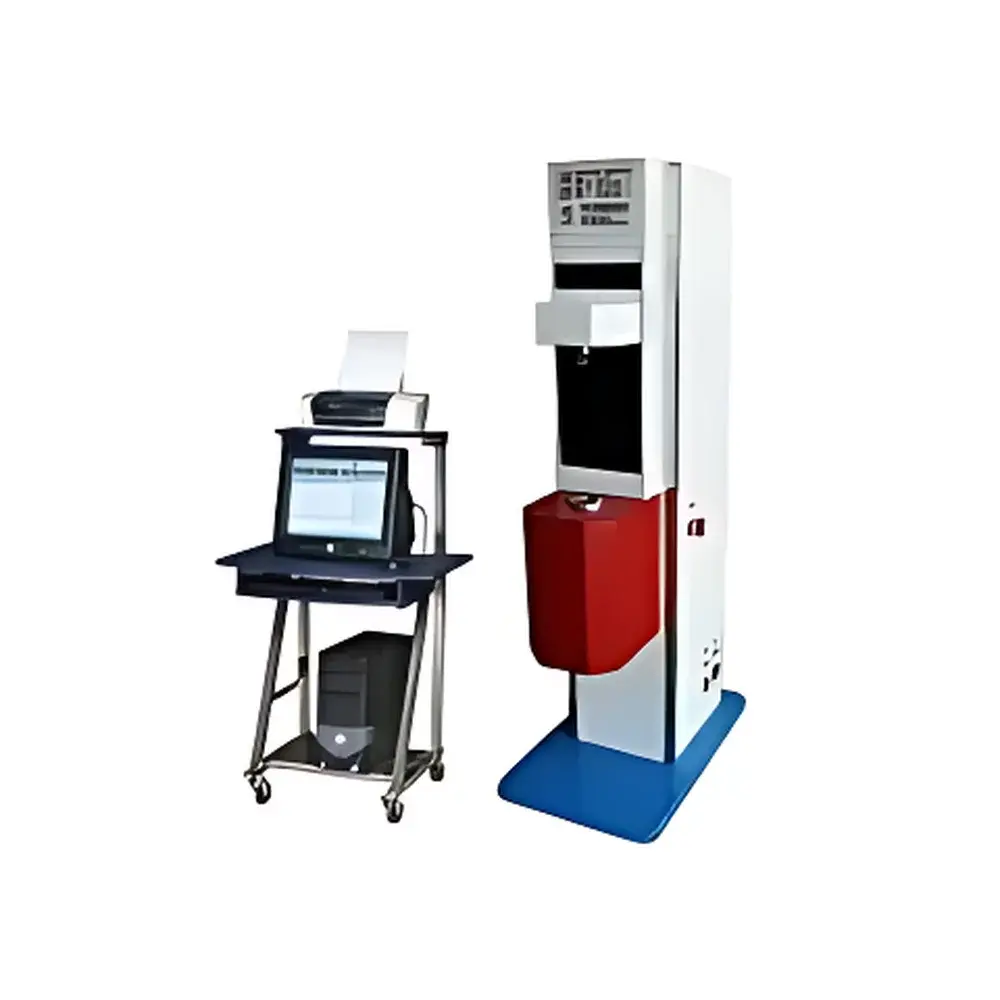
All Precision Instrument BML-400 Series Capillary Rheometer
| Brand | All Precision Instrument |
|---|---|
| Origin | Beijing, China |
| Manufacturer Type | OEM Manufacturer |
| Instrument Type | Capillary Rheometer |
| Model | BML-400 |
| Maximum Load Capacity | 10 kN / 25 kN (configurable) |
| Piston Speed Range | 0.0005–20 mm/sec |
| Dynamic Speed Ratio | 1:40,000 |
| Maximum Test Temperature | 400 °C |
| Temperature Control Accuracy | ±0.2 °C (in barrel), ±0.5 °C (overall) |
| Barrel Diameter Options | 9.5 mm, 12 mm, 15 mm (custom lengths available) |
| Capillary Die Options | (1) 5/0.5 mm (L=5 mm, D=0.5 mm), (2) 10/1 mm, (3) 20/1 mm, (4) 30/1 mm, (5) 20/2 mm |
| Pressure Sensor Range | 700–2000 bar (configurable) |
| Die Material | Tungsten carbide |
| Barrel & Piston Material | Nitrided stainless steel, corrosion- and wear-resistant |
| Safety Features | Interlocked front access door, dual overload protection, torque-limiting motor circuit |
| Power Supply | 1-phase, 220 V, 50/60 Hz, 8–12 A |
| Dimensions (W×D×H) | 64×64×165 cm |
| Weight | 250 kg |
Overview
The All Precision Instrument BML-400 Series Capillary Rheometer is a high-precision, computer-controlled instrument engineered for the quantitative characterization of polymer melt rheology under controlled temperature, pressure, and shear conditions. It operates on the fundamental principle of capillary flow rheometry: molten polymer is extruded through a precisely dimensioned die under programmable piston velocity or constant pressure, enabling direct measurement of pressure drop across the die and volumetric flow rate. From these primary measurements—and using established rheological corrections (Rabinowitsch, Bagley, Weissenberg-Rabinowitsch)—the instrument computes shear stress, shear rate, apparent viscosity, and extensional viscosity parameters in accordance with ISO 11443:2005 and ASTM D3835. Designed for R&D laboratories and QC environments in polymer compounding, extrusion process development, and thermoplastic formulation, the BML-400 delivers reproducible data essential for material selection, process optimization, and regulatory documentation (e.g., FDA 21 CFR Part 11–compliant reporting when integrated with validated software modules).
Key Features
- Modular mechanical architecture supporting rapid interchange of load cells (1–50 kN), pressure transducers (3.5–200 MPa), and standardized tungsten carbide capillary dies—including flat-end, conical, and zero-length configurations.
- High-resolution servo-driven piston actuation with closed-loop speed control (0.0005–20 mm/sec), enabling both constant-shear-rate and constant-stress test modes with programmable multi-step profiles.
- Thermally stable barrel assembly featuring PID-controlled electric heating, ±0.2 °C intra-barrel temperature uniformity, and interchangeable nitrided stainless-steel barrels (9.5–20 mm ID) compatible with filled and fiber-reinforced compounds.
- Integrated safety system comprising interlocked front access door, dual mechanical/electronic overload cutoffs, and brushless DC motor torque limiting—fully compliant with CE machinery directive requirements.
- Front-panel intuitive interface supplemented by dedicated Windows-based BML-400 control software with real-time data acquisition, automated viscosity calculation (including Bagley and Rabinowitsch corrections), and export-ready report generation (PDF/CSV/XLS).
Sample Compatibility & Compliance
The BML-400 accommodates thermoplastic polymers (PP, PE, PS, PC, ABS, PBT), thermoplastic elastomers (TPE, TPU), engineering resins (PA6, POM, PEEK), and reactive thermosets (epoxy, phenolic prepolymers). Its hardened barrel and tungsten carbide dies resist abrasion from mineral-filled, glass-fiber-reinforced, or conductive carbon-black formulations. The system meets ISO 11443:2005 for capillary rheometry and supports traceable calibration per ISO/IEC 17025 when operated with certified reference materials. Optional audit-trail logging, electronic signatures, and user-access controls enable alignment with GLP and GMP workflows—particularly relevant for pharmaceutical excipient characterization and medical-grade polymer qualification.
Software & Data Management
The BML-400 control software provides full experimental scripting: users define temperature ramps (0.1–20 °C/min), piston velocity profiles (up to 99 steps), dwell times, and pressure hold segments. All raw sensor data (load, pressure, temperature, position, time) are timestamped and stored in a structured binary format. Post-acquisition, the software applies standard rheological models—including Poiseuille flow correction, non-Newtonian power-law fitting, and Arrhenius activation energy estimation—to generate master curves, viscosity vs. shear rate plots, and thermal stability indices. Data export complies with LIMS interoperability standards (ASTM E1469), and optional 21 CFR Part 11 modules support electronic records integrity, role-based permissions, and immutable audit trails.
Applications
- Quantification of shear-thinning behavior and melt fracture onset in extrusion-grade polyolefins.
- Determination of melt flow index (MFI)-equivalent values under non-standard shear rates for advanced polymer grades.
- Characterization of processing windows for injection molding and blow molding simulations.
- Evaluation of thermal degradation kinetics via viscosity decay at elevated isothermal holds.
- Validation of constitutive models (e.g., Cross, Carreau-Yasuda) used in CAE software such as Moldflow or Polyflow.
- Quality control of incoming resin batches against contractual rheological specifications.
FAQ
What capillary die geometries are included as standard?
Two capillary dies are supplied standard: 20/1 mm (L = 20 mm, D = 1 mm) and 5/0.5 mm (L = 5 mm, D = 0.5 mm). Additional dies—including 10/1 mm, 30/1 mm, and 20/2 mm—are available as configurable options.
Is the system compatible with nitrogen purge for oxygen-sensitive polymers?
Yes—the barrel assembly includes a sealed gas inlet port; optional N₂ purging kits maintain inert atmosphere during high-temperature testing up to 400 °C.
Can the BML-400 perform extensional viscosity measurements?
While primarily a shear rheometer, the BML-400 supports extensional analysis via converging die configurations and Trouton ratio estimation when paired with appropriate post-processing algorithms.
What maintenance is required for long-term calibration stability?
Annual verification using NIST-traceable load cells and calibrated pressure standards is recommended. Routine cleaning of the barrel and die with specified solvents (e.g., xylene, THF) prevents carbon buildup and ensures repeatability.
Does the system support automated cleaning cycles?
An optional pneumatic motor-driven cleaning rod system is available for semi-automated barrel clearance between tests—reducing operator exposure to hot surfaces and minimizing downtime.



