
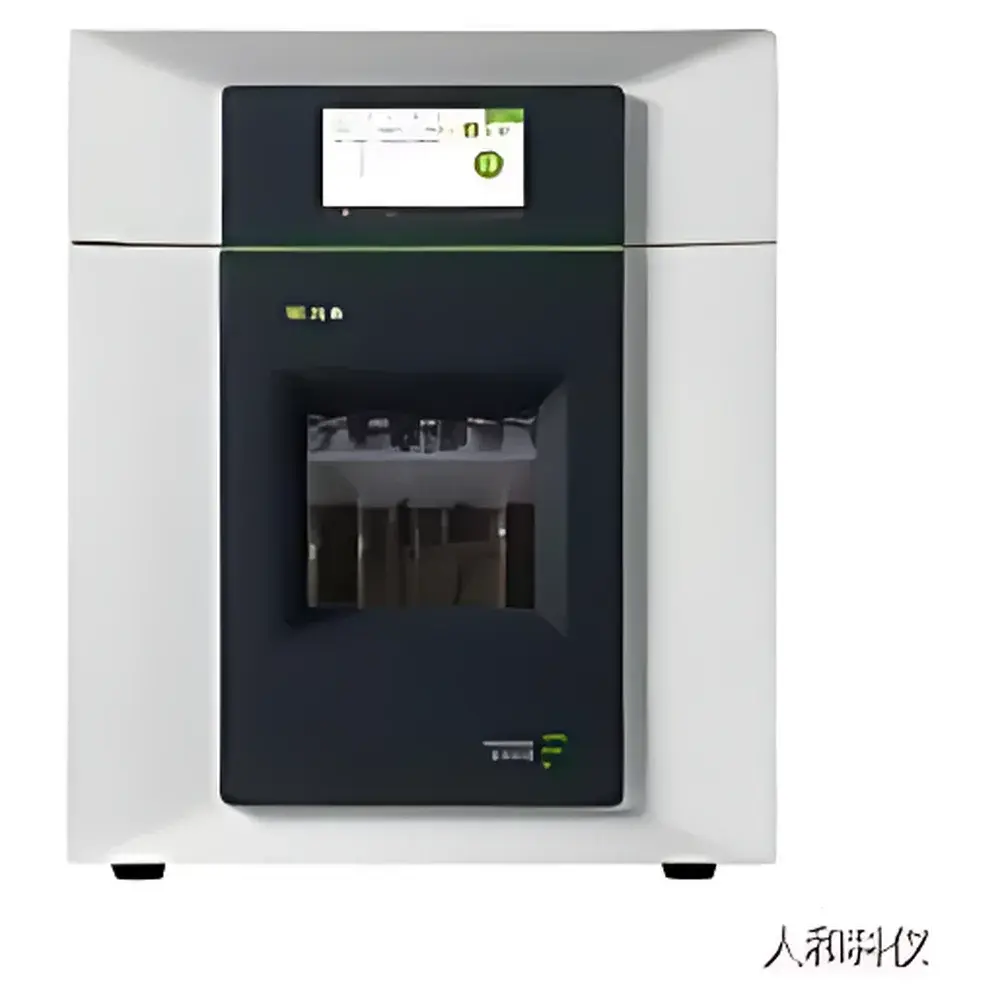
PreeKem Aurora-6 Microwave Digestion System
| Brand | PreeKem |
|---|---|
| Origin | Shanghai, China |
| Manufacturer Type | Authorized Distributor |
| Origin Category | Domestic (China) |
| Model | Aurora-6 |
| Quotation | Upon Request |
| Cavity Grade | Industrial-Grade |
| Sample Capacity | 16–40 vessels |
| Microwave Source | Dual Magnetron System |
| Max Temperature | 500 °C |
| Max Pressure | 15 MPa |
| Cavity Material | 316L Stainless Steel |
| Power Input | 220–240 V / 50 Hz, 16 A |
| Installed Power | 3200 W |
| Microwave Frequency | 2450 MHz |
| Output Mode | Non-pulsed Continuous Microwave |
| Power Control Accuracy | ±1 W |
| Control Algorithm | High-Frequency Closed-Loop PID |
| Display | 7-inch HD Color Touchscreen |
| Cooling System | Twin-Air Dual-Direction Forced Air Cooling with Optimized Duct Design |
| Operating Ambient | 5–40 °C, 15–80% RH |
| Dimensions (H×W×D) | 665 × 546 × 590 mm |
| Weight | 70 kg |
Overview
The PreeKem Aurora-6 Microwave Digestion System is an industrial-grade sample preparation platform engineered for high-throughput, reproducible, and fully traceable acid digestion of solid and semi-solid matrices. It operates on the principle of controlled microwave energy absorption—where polar molecules (e.g., HNO₃, HCl, HF) rapidly convert electromagnetic energy into thermal energy within sealed quartz or high-performance polymer vessels. This enables rapid, uniform heating under inert, pressurized conditions—significantly accelerating decomposition kinetics while minimizing volatile element loss and cross-contamination. Designed for laboratories processing ≥100 samples per day—including environmental monitoring labs, geological survey centers, food safety QA/QC facilities, and metallurgical R&D departments—the Aurora-6 integrates dual magnetron power delivery, real-time infrared bottom-vessel temperature monitoring, and closed-loop pressure regulation to meet ISO 17025-compliant method validation requirements.
Key Features
- Industrial cavity architecture constructed from electropolished 316L stainless steel—resistant to corrosion from aggressive acid mixtures (e.g., aqua regia, HF/HNO₃ blends) and certified for ≥5 years structural warranty.
- Dual 1.6 kW magnetron system delivering up to 3200 W total installed power with non-pulsed, continuous-wave output and ±1 W precision control via high-frequency PID feedback loop.
- Real-time infrared temperature sensing at vessel base—combined with continuous rotational scanning—to eliminate cold-spot bias and ensure accurate thermal profiling across all 40 positions.
- Twin-Air bidirectional forced-air cooling system with adaptive fan-speed modulation and optimized airflow ducting; achieves <15 min post-digestion cooldown from 220 °C to <60 °C without manual intervention.
- Self-diagnostic pre-start sequence verifying door interlock integrity, pressure transducer calibration, temperature sensor continuity, and microwave leakage shielding before enabling magnetron activation.
- 7-inch high-resolution capacitive touchscreen interface supporting multilingual UI (English, Chinese, Spanish), graphical real-time display of temperature/power/pressure curves, and audit-trail-enabled method execution logging.
Sample Compatibility & Compliance
The Aurora-6 accommodates standard rotor configurations for 16, 24, or 40 high-pressure digestion vessels (vessel volumes: 15–110 mL), compatible with both quartz and reinforced PTFE-TFM liners. It supports digestion protocols aligned with EPA Method 3051A/3052, ASTM D5511, ISO 11466, GB/T 17141–1997, and USP . All hardware and firmware comply with IEC 61000-6-3 (EMC) and IEC 61000-6-4 emission standards. Data integrity features—including electronic signatures, time-stamped method logs, and immutable parameter history—support compliance with FDA 21 CFR Part 11 and GLP/GMP documentation requirements when deployed in regulated environments.
Software & Data Management
The embedded operating system includes a built-in method library containing >120 validated digestion protocols—categorized by matrix type (soil, sludge, plant tissue, polymer, alloy), regulatory standard (EPA, ISO, GB), and acid system (HNO₃/HF, HNO₃/H₂O₂, HCl/HNO₃). Methods are editable but version-controlled, with change history retained. All run data—including temperature ramp profiles, pressure trajectories, power modulation events, and alarm timestamps—are exported in CSV or XML format. Optional Ethernet/Wi-Fi connectivity enables remote monitoring and integration with LIMS via standard RESTful API endpoints.
Applications
- Environmental analysis: Total metal determination (As, Cd, Cr, Pb, Hg, Ni) in soils, sediments, and airborne particulates per EPA SW-846.
- Geochemical testing: Rare earth element (REE) and trace metal quantification in rock and mineral samples using HF-based dissolution.
- Food and feed safety: Multi-element screening (Ca, Mg, Fe, Zn, Cu, Se) in cereals, dairy products, and dietary supplements under ISO 11885.
- Pharmaceutical excipient testing: Residual catalyst (Pd, Pt, Rh) quantification in active pharmaceutical ingredients (APIs) per ICH Q2(R2).
- Materials science: Digestion of ceramic composites, battery cathode materials (NMC, LFP), and nanomaterials for elemental release assessment.
FAQ
What safety certifications does the Aurora-6 hold?
The system complies with IEC 61010-1 (Safety Requirements for Electrical Equipment for Measurement, Control, and Laboratory Use) and IEC 62471 (Photobiological Safety of Lamps and Lamp Systems) for its IR sensors. Full CE marking documentation is available upon request.
Can the Aurora-6 be integrated into an automated sample handling workflow?
Yes—via optional RS-232/RS-485 serial interface or TCP/IP protocol, it supports handshake-triggered start/stop commands and status polling from robotic autosamplers or centralized lab automation platforms.
Is method transfer possible between Aurora-6 and other PreeKem models?
Method files (.pmd format) are backward-compatible across the Aurora series (Aurora-3, Aurora-6, Aurora-12); however, pressure/temperature setpoints must be verified against vessel rating limits for each configuration.
How is temperature calibration verified during routine operation?
Each run initiates an automatic reference check using a factory-calibrated IR sensor array; deviation >±2 °C triggers a service alert and halts microwave initiation until recalibration is performed by authorized field service personnel.
Does the system support digestion under oxygen atmosphere?
No—the Aurora-6 is designed exclusively for sealed-vessel acid digestion under inert nitrogen or argon purge; oxygen introduction is prohibited due to explosion risk and cavity material compatibility constraints.
Related Products



