
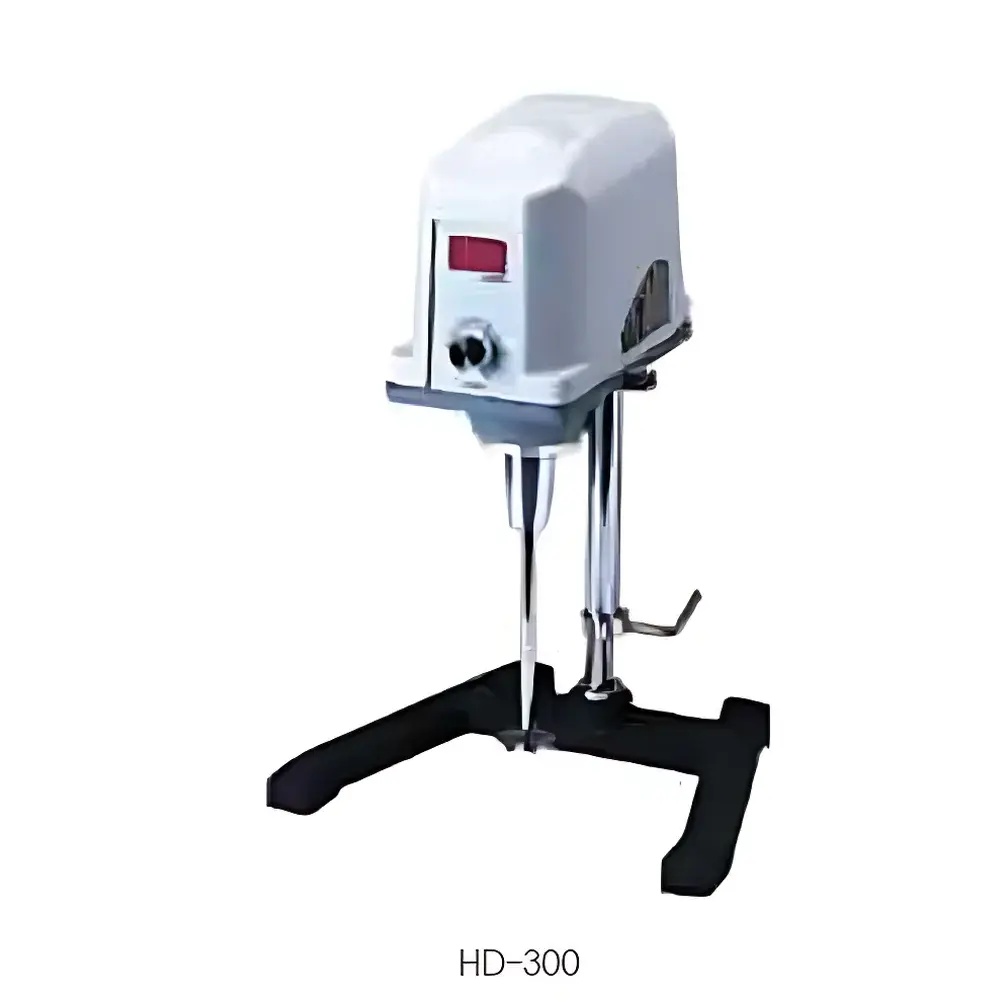
Prema HD300 Digital High-Speed Homogenizer
| Brand | Prema |
|---|---|
| Origin | Taiwan |
| Model | HD300 |
| Instrument Type | Probe-type Rotor-Stator Homogenizer |
| Dimensions (W×D×H) | 370 × 270 × 500 mm |
| Speed Range | 0–12,000 rpm |
| Motor Power | DC 220 W |
| Processing Volume | 0.1–5 L |
| Display | Digital LED Speed Readout |
| Speed Control | Continuously Variable Analog Knob |
| Safety Features | Thermal Cut-off, Overload Protection, Fuse |
| Optional Accessories | Motorized Lift Stand, HM-Series Homogenizing Probes |
Overview
The Prema HD300 Digital High-Speed Homogenizer is a precision-engineered probe-type rotor-stator homogenizer designed for reproducible mechanical dispersion, emulsification, and particle size reduction in laboratory-scale liquid-phase processing. Operating on the principle of high-shear fluid dynamics—where a rapidly rotating stainless-steel rotor draws sample into a close-tolerance stator gap, generating intense hydrodynamic cavitation, turbulent flow, and localized shear rates exceeding 10⁵ s⁻¹—the HD300 delivers consistent microstructural modification across viscous and low-viscosity formulations. Its 220 W DC motor provides stable torque delivery across the full 0–12,000 rpm speed range, enabling precise control over energy input without speed drift under load. The instrument is purpose-built for applications requiring scalable process development data, including formulation optimization, stability testing, and pre-GMP batch preparation in pharmaceutical, cosmetic, and fine chemical laboratories.
Key Features
- Digital LED speed display with real-time feedback compensation circuitry ensures ±1% speed accuracy across the entire operating range.
- Continuously variable analog speed control via front-panel rotary knob enables intuitive, stepless adjustment—critical for method development and transient process optimization.
- Ergonomic spring-loaded vertical stand allows rapid probe insertion and sample vessel exchange without tooling or re-alignment; compatible with standard cylindrical glass or stainless-steel beakers (50–1000 mL) and jacketed reactors.
- Low-noise, vibration-damped drive architecture minimizes mechanical transmission to adjacent instrumentation and supports long-duration operation at elevated speeds.
- Integrated dual-stage safety system includes thermal cut-off switch (activated at ≥85°C motor housing temperature), electronic overload detection, and replaceable ceramic fuse (250 V / 1 A).
- Modular probe interface accepts standardized 10–25 mm diameter HM-series homogenizing heads (e.g., HM20, HM30), each engineered for specific shear profiles and clearance tolerances per ISO 17025-compliant calibration protocols.
Sample Compatibility & Compliance
The HD300 accommodates aqueous, organic, and semi-viscous media—including suspensions up to 40% w/w solids, emulsions (O/W and W/O), polymer solutions (up to 10,000 mPa·s), and heat-sensitive biologics—when operated within validated time–speed envelopes. All wetted parts (probe shaft, stator sleeve, and tip) are constructed from ASTM F899-certified 316L stainless steel, ensuring corrosion resistance and cleanability per FDA 21 CFR Part 11 and EU GMP Annex 15 requirements. While the base unit does not include audit-trail functionality, its analog control architecture meets GLP documentation standards when paired with external calibrated tachometers and manual logbook entries. Optional motorized lift systems support SOP-driven height repeatability (±0.5 mm), facilitating alignment consistency across multi-operator environments.
Software & Data Management
The HD300 operates as a standalone analog-controlled instrument with no embedded firmware or network interface. Speed setpoints and runtime are manually recorded; however, its digital LED readout is compatible with third-party data acquisition systems via 0–10 V analog output (available upon request with OEM adapter). For regulated environments, users may integrate the HD300 into validated workflows using external USB-based tachometer loggers (e.g., Omega HHM100 series) that generate timestamped CSV files compliant with 21 CFR Part 11 electronic record requirements. Prema provides traceable calibration certificates (NIST-traceable tachometer verification) and maintenance logs aligned with ISO/IEC 17025 clause 6.4.10.
Applications
- Pharmaceutical: Preparation of nanoemulsions for topical delivery, homogenization of active pharmaceutical ingredient (API) suspensions prior to filtration or lyophilization, and excipient dispersion in oral liquid formulations.
- Cosmetics: Stabilization of silicone-in-water emulsions, pigment dispersion in foundation bases, and rheological conditioning of surfactant micellar systems.
- Chemical R&D: Exfoliation of layered materials (e.g., graphene oxide dispersions), catalyst slurry homogenization for heterogeneous reaction screening, and polymer latex stabilization.
- Food Science: Lab-scale production of dairy alternatives (e.g., oat milk homogenization), flavor oil dispersion in beverage concentrates, and enzymatic reaction mixture homogenization under controlled temperature conditions.
FAQ
What is the maximum recommended viscosity for continuous operation?
For sustained 12,000 rpm operation, media viscosity should not exceed 5,000 mPa·s at 25°C. Higher viscosities require reduced speed and intermittent duty cycles to prevent thermal overload.
Can the HD300 be used with corrosive solvents such as chloroform or THF?
Yes—provided all wetted components (probe, stator, O-rings) are confirmed compatible. Standard 316L stainless steel resists most organics; however, prolonged exposure to halogenated solvents requires post-use cleaning with ethanol/isopropanol and visual inspection for pitting.
Is the HD300 suitable for sterile processing?
The unit itself is not autoclavable; however, HM-series probes and stators are fully sterilizable via dry heat (160°C/2 h) or ethylene oxide. Aseptic operation requires laminar flow hood integration and validated probe surface decontamination protocols.
Does Prema offer IQ/OQ documentation packages?
Yes—Prema provides customizable Installation Qualification (IQ) and Operational Qualification (OQ) templates aligned with ASTM E2500 and ISPE Baseline Guide principles, including test protocols for speed accuracy, thermal stability, and mechanical repeatability.



