
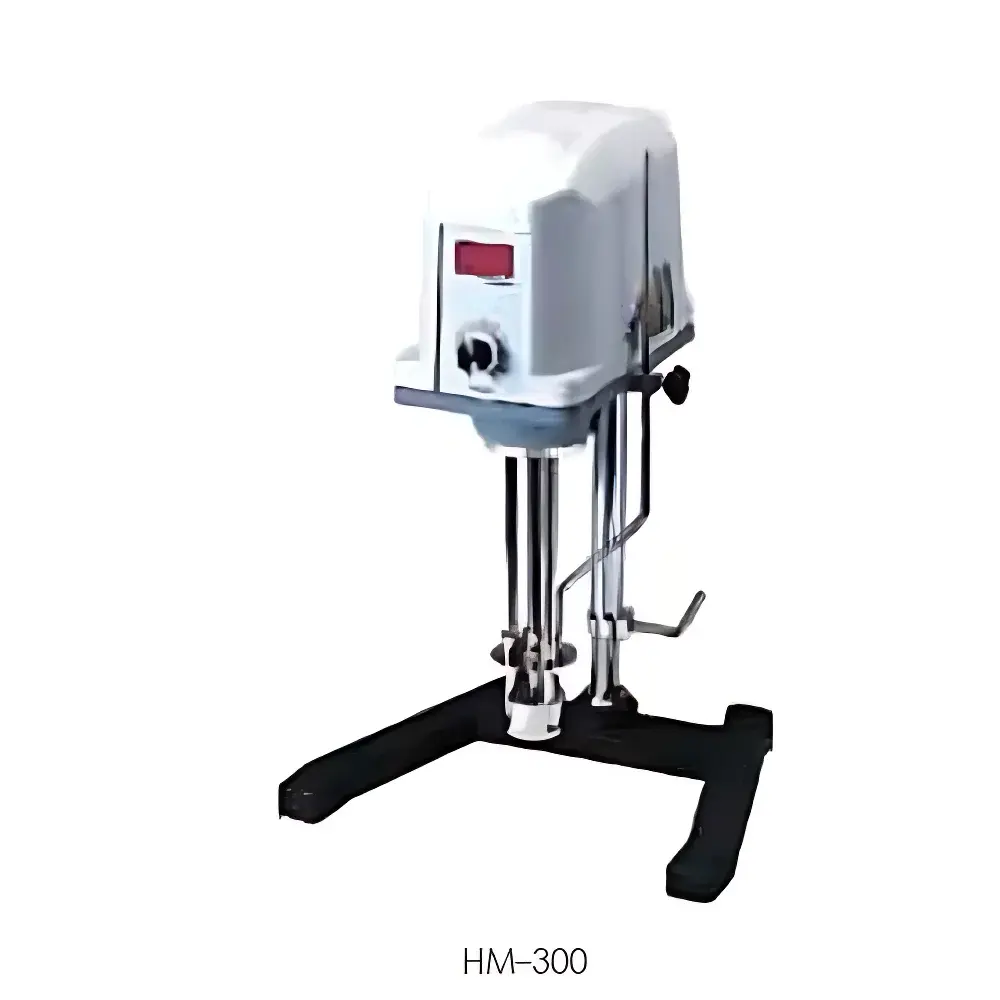
Prema HM300 Digital High-Speed Homogenizer
| Brand | Prema |
|---|---|
| Origin | Taiwan |
| Model | HM300 |
| Drive Type | Probe-type rotor-stator homogenizer |
| Dimensions (W×D×H) | 370 × 270 × 500 mm |
| Speed Range | 0–12,000 rpm |
| Motor Power | DC 220 W |
| Capacity | 0.1–2 L |
| Display | Digital LED speed readout |
| Speed Control | Continuous variable (analog knob) |
| Shaft Material | SUS316 stainless steel |
| Safety Features | Thermal cut-off, overload protection, fuse |
| Mounting | Spring-loaded vertical stand |
| Optional Accessories | Motorized lift unit, HD-series dispersing heads |
Overview
The Prema HM300 Digital High-Speed Homogenizer is an engineered solution for laboratory-scale homogenization, emulsification, dispersion, and cell lysis applications requiring precise mechanical energy input. Operating on the rotor-stator principle—where a high-speed rotating probe generates intense shear forces within a fixed stator sleeve—the HM300 delivers reproducible particle size reduction and phase stabilization across viscous and low-viscosity samples. Its core architecture centers on a brushless DC motor with closed-loop speed feedback, ensuring stable rotational output under varying load conditions. Designed for routine use in QC labs, R&D facilities, and academic research environments, the HM300 meets fundamental operational requirements for GLP-compliant sample preparation workflows involving pharmaceutical suspensions, cosmetic emulsions, food matrix homogenates, and biological lysates.
Key Features
- Continuous analog speed control via precision rotary knob, enabling fine-tuned adjustment from 0 to 12,000 rpm without stepped increments
- Digital LED display with real-time rpm readout and integrated feedback compensation circuitry for ±1% speed stability under dynamic load
- Spring-actuated vertical stand with quick-release mechanism for rapid probe exchange and sample vessel alignment—reducing setup time between replicates
- Rotor and stator components fabricated from ASTM A276 Type 316 stainless steel, offering superior corrosion resistance against organic solvents, acids, and alkaline media
- Integrated dual-stage safety system: thermally activated cut-off switch prevents motor overheating; electronic current limiter safeguards against stall-induced overload
- Low-noise mechanical design with vibration-damped housing and balanced rotor assembly, suitable for shared lab spaces and noise-sensitive environments
Sample Compatibility & Compliance
The HM300 accommodates sample volumes from 100 mL to 2 L in standard cylindrical glass or stainless-steel vessels (e.g., beakers, jacketed reactors). Its rotor-stator geometry supports both aqueous and non-aqueous systems—including oil-in-water emulsions, polymer dispersions, nanoparticle suspensions, and tissue homogenates. While not certified to ISO/IEC 17025 or FDA 21 CFR Part 11 out-of-the-box, the instrument’s repeatable performance aligns with method validation protocols referenced in USP , ISO 13320 (laser diffraction), and ASTM D445 (kinematic viscosity) when used as a sample conditioning step. Documentation packages—including factory calibration reports and material traceability certificates for critical wetted parts—are available upon request for audit readiness.
Software & Data Management
The HM300 operates as a standalone analog-controlled device with no embedded firmware or network interface. All operational parameters—including actual speed, runtime, and status flags—are conveyed exclusively through the front-panel LED display. For laboratories requiring electronic recordkeeping, optional integration with external data loggers (e.g., NI CompactDAQ or Keysight 34972A) is supported via analog 0–10 V tachometer output (available on request). This analog signal enables timestamped speed monitoring and correlation with downstream analytical instrumentation—supporting basic 21 CFR Part 11 compliance when paired with validated third-party acquisition software and audit-trail-enabled storage infrastructure.
Applications
- Pharmaceutical: Preparation of nanoemulsions for topical delivery systems; homogenization of active pharmaceutical ingredient (API) suspensions prior to HPLC analysis
- Food Science: Stabilization of dairy-based dressings and plant-protein beverages; reduction of fat globule size in infant formula model systems
- Materials Research: Exfoliation of graphene oxide dispersions; deagglomeration of ceramic nanopowders in ethanol or NMP
- Life Sciences: Mechanical lysis of bacterial cultures (E. coli, Bacillus spp.) and soft mammalian tissues (liver, spleen) for proteomic extraction
- Quality Control: Batch-to-batch consistency testing of industrial lubricants and pigment concentrates using standardized rotor-stator protocols
FAQ
What is the maximum recommended viscosity for continuous operation?
The HM300 is optimized for fluids up to 5,000 mPa·s at 25°C. For higher-viscosity materials, intermittent duty cycles (e.g., 30 s ON / 60 s OFF) are advised to prevent thermal accumulation.
Can the HM300 be used with corrosive solvents such as chloroform or concentrated HCl?
SUS316 construction provides broad chemical compatibility, but direct exposure to halogenated solvents or strong oxidizers requires verification per NACE MR0175/ISO 15156 guidelines; PTFE-sealed optional probes are recommended for aggressive media.
Is calibration traceable to national standards?
Speed calibration is performed using a NIST-traceable optical tachometer during final QA; certificate of conformance includes measurement uncertainty (k=2) and environmental conditions.
Does the unit support programmable ramp profiles or multi-step sequences?
No—speed is manually adjusted via analog control. For automated sequencing, integration with external PLC or LabVIEW-controlled motorized lift systems is required.
What maintenance intervals are recommended for long-term reliability?
Lubrication-free motor design eliminates routine greasing; annual inspection of stator wear, shaft runout (10 MΩ @ 500 VDC) is advised per ISO 5388 maintenance schedules.
Related Products



