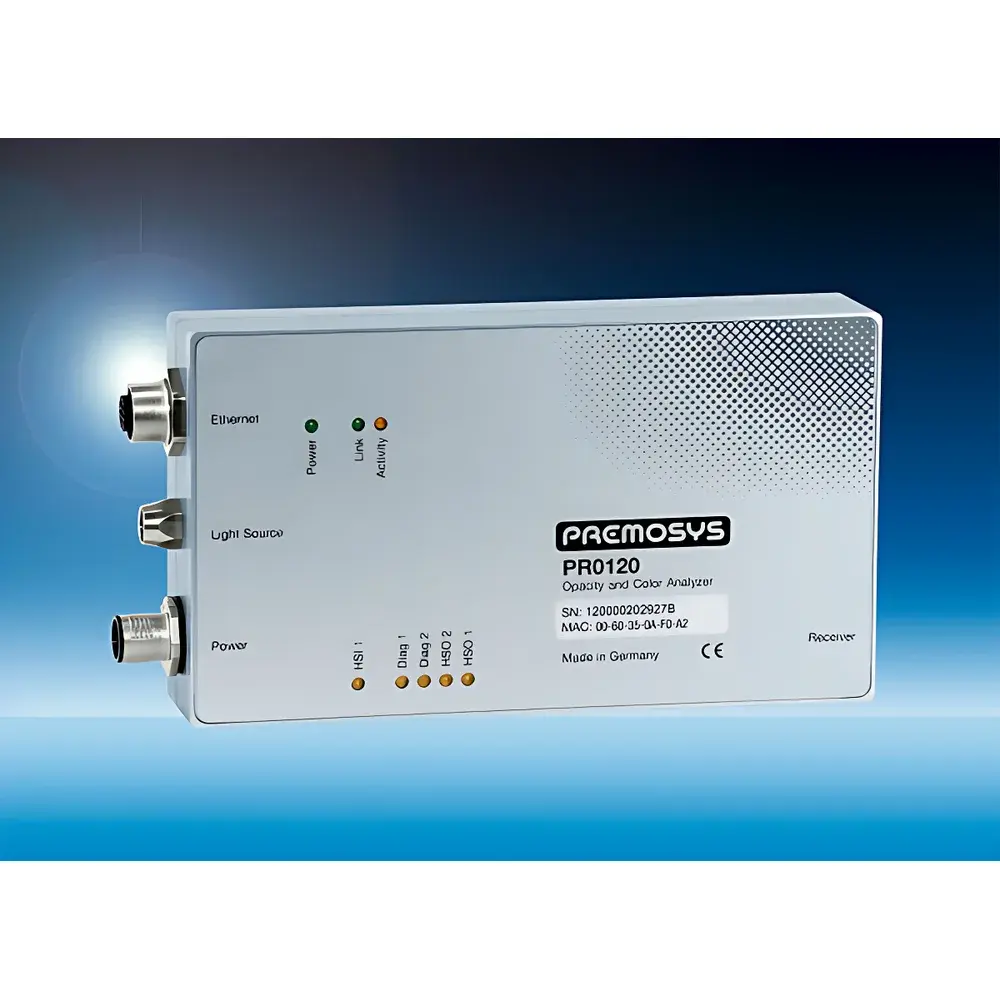

PREMOSYS PR0120 Opacity & Colorimetry Analyzer
| Brand | PREMOSYS |
|---|---|
| Origin | Germany |
| Model | PR0120 |
| Optical Detection Range | 400–700 nm |
| Sampling Rate | 2 kHz |
| Color Space | CIELAB (L*a*b*) |
| Long-Term Color Stability | ΔE < 0.2 |
| Color Resolution | < 0.1 ΔE |
| Repeatability | < 0.2 ΔE |
| Gain Stages per Channel | 11 |
| ADC Resolution | 16-bit |
| Communication Interfaces | 100 Mbps Ethernet (UDP), RS-232 |
| Power Supply | 24 V DC |
| Light Source | Dual-Power Adjustable High-Intensity LED |
Overview
The PREMOSYS PR0120 Opacity & Colorimetry Analyzer is a high-precision, dual-function optical measurement system engineered for continuous, traceable color and opacity quantification in industrial process control and laboratory environments. Based on spectrophotometric transmittance and reflectance principles, the instrument employs a stabilized dual-power LED light source with built-in radiometric calibration and real-time ambient light compensation to ensure measurement integrity under variable lighting conditions. Its core optical architecture operates across the visible spectrum (400–700 nm), enabling compliant evaluation of both opacity—expressed as optical density (OD) from 0 to 5—and chromaticity via the CIELAB color space. The system’s modular design separates signal acquisition (PR120 electronics unit) from illumination (PR0108 light engine), facilitating maintenance, recalibration, and application-specific reconfiguration without system downtime. Designed for long-term operational stability, the PR0120 delivers sub-ΔE 0.2 repeatability over extended periods—meeting baseline requirements for GLP-compliant color monitoring and ISO 11664-4 (CIE 1976 L*a*b* color space) traceability.
Key Features
- Modular two-unit architecture: PR120 electronics module and PR0108 calibrated LED light engine for independent serviceability and metrological traceability
- High-speed synchronized detection at 2 kHz sampling rate, supporting real-time process feedback and transient event capture
- 16-bit analog-to-digital conversion with 11 programmable gain stages per channel, ensuring dynamic range optimization across low- and high-transmittance samples
- Full-spectrum (400–700 nm) photometric detection with ambient light compensation algorithm, eliminating need for dark enclosures in most production settings
- Dual-mode optical path compatibility: configurable for transmission (OD 0–5) or bidirectional reflectance measurements using interchangeable lens assemblies
- Integrated real-time counter for time-stamped data correlation with PLC triggers, batch IDs, or conveyor position signals
- Industrial-grade communication stack: native UDP over 100 Mbps Ethernet for integration into SCADA/MES systems; optional RS-232 for legacy device bridging
- Onboard radiometric calibration reference and factory-traceable LED spectral output profile—no external calibration standards required for routine operation
Sample Compatibility & Compliance
The PR0120 supports a broad range of translucent and opaque liquid, paste, film, and solid-state samples—including polymer melts, pharmaceutical suspensions, food emulsions, ink formulations, and coated substrates. Its variable working distance (enabled by swappable collimating and focusing lenses) accommodates sample thicknesses from 0.1 mm to >50 mm and vessel diameters up to 150 mm. The system complies with ISO 7724-1 (colorimetry—general principles), ISO 9276-3 (representation of results of particle size analysis—part 3: classification of calculated values), and ASTM D2244 (standard practice for calculation of color tolerances). For regulated industries, raw data export supports 21 CFR Part 11 audit trail requirements when integrated with validated host software; all measurements include embedded timestamps, operator ID fields, and configuration checksums.
Software & Data Management
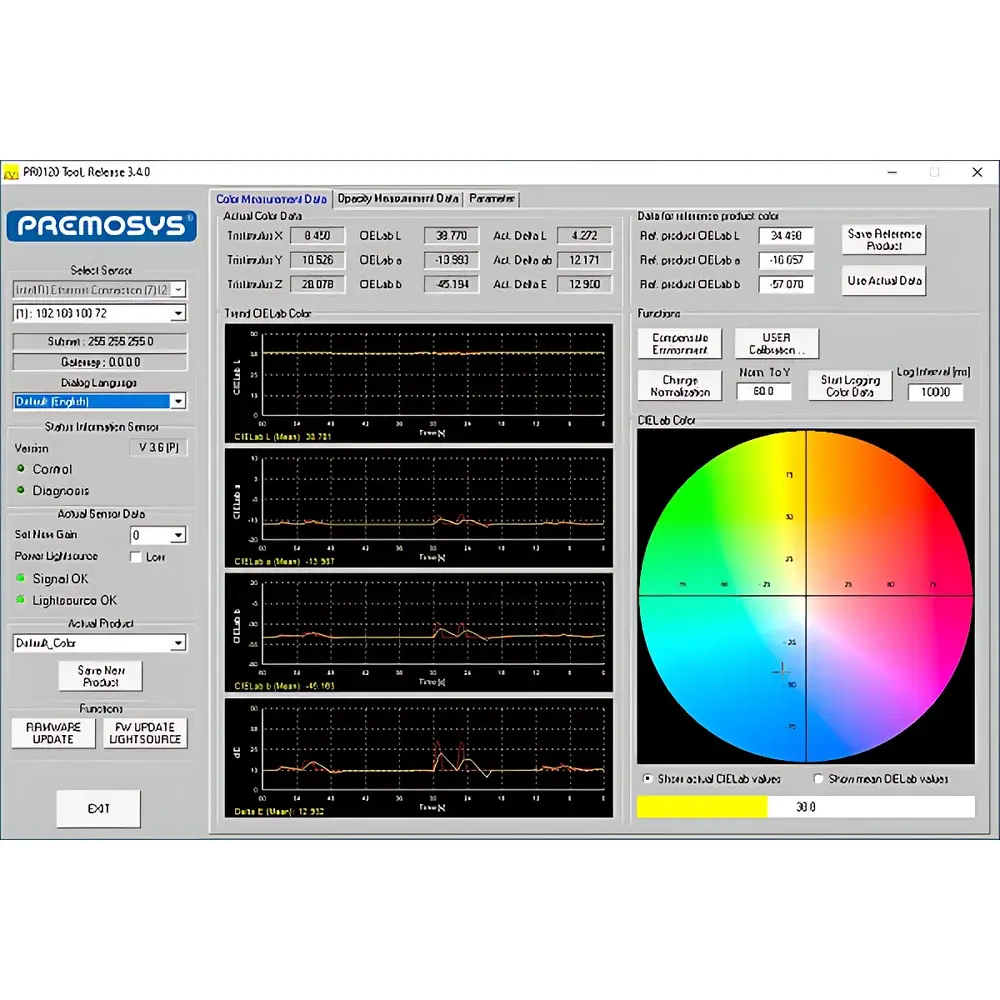
The PR0120 interfaces via a documented Win32 DLL (UDPWIN32) for custom integration into LabVIEW, Python, or C# applications. It also supports direct connection to PREMOSYS’ proprietary ProcessColor Suite—a Windows-based platform offering real-time dashboarding, SPC charting (X-bar/R, Cp/Cpk), trend analysis with user-defined alarm thresholds, and automated report generation in PDF/CSV/XLSX formats. All acquired spectra and derived parameters (L*, a*, b*, C*, h°, OD, ΔE00) are stored with full metadata: sensor temperature, LED drive current, gain setting, lens ID, and environmental timestamp. Raw spectral logs retain 16-bit resolution for retrospective reprocessing using updated color-matching functions or custom weighting algorithms.
Applications
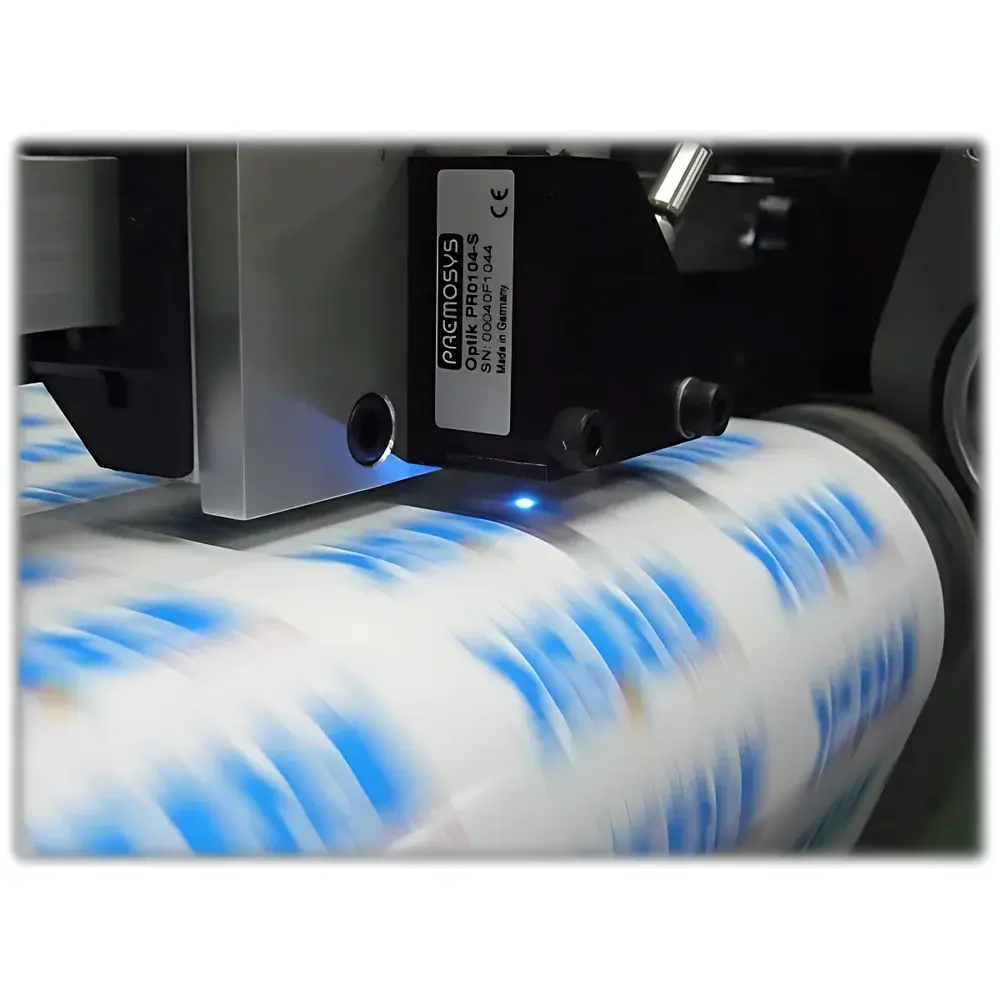
- Real-time color consistency monitoring in paint, coating, and ink manufacturing lines
- Opacity verification of pharmaceutical suspensions and ophthalmic solutions per USP <905> content uniformity guidelines
- Batch-to-batch color deviation tracking in food & beverage processing (e.g., dairy creams, fruit concentrates, soy sauces)
- In-line quality gate for plastic film extrusion—detecting gel particles, pigment dispersion anomalies, or thermal degradation
- Lab-based formulation development where CIELAB delta-E tolerances must be maintained below 0.5 across multiple production scales
- Regulatory submission support: generating auditable color stability datasets for FDA IND/NDA dossiers or EMA marketing authorization applications
FAQ
Does the PR0120 require annual recalibration against NIST-traceable standards?
No—its integrated radiometric reference and factory-characterized LED spectral output enable drift-free operation for ≥12 months under typical industrial conditions. Optional annual verification using PREMOSYS-certified reference tiles is recommended for GMP environments.
Can the system measure both transmission and reflectance on the same sample without hardware reconfiguration?
Yes—using the dual-port optical head option (PR-OPD-2P), users can switch between modes via software command; mechanical alignment remains fixed, preserving measurement reproducibility.
Is the UDP interface compatible with Siemens SIMATIC PCS 7 and Emerson DeltaV DCS platforms?
Yes—the protocol uses standard UDP datagrams with configurable packet structure and CRC-16 checksums; integration kits and Modbus TCP gateway adapters are available upon request.
What is the minimum measurable OD value with acceptable SNR?
At OD 0.05 (90% transmittance), the system achieves SNR > 85 dB using default lens configuration and high-power LED mode, verified per ISO 15739:2013 imaging noise methodology.
How is ambient light interference mitigated during open-bench installation?
Through synchronized pulsed illumination and lock-in amplification—ambient contributions are rejected in real time by phase discrimination, not post-processing subtraction.
Related Products