
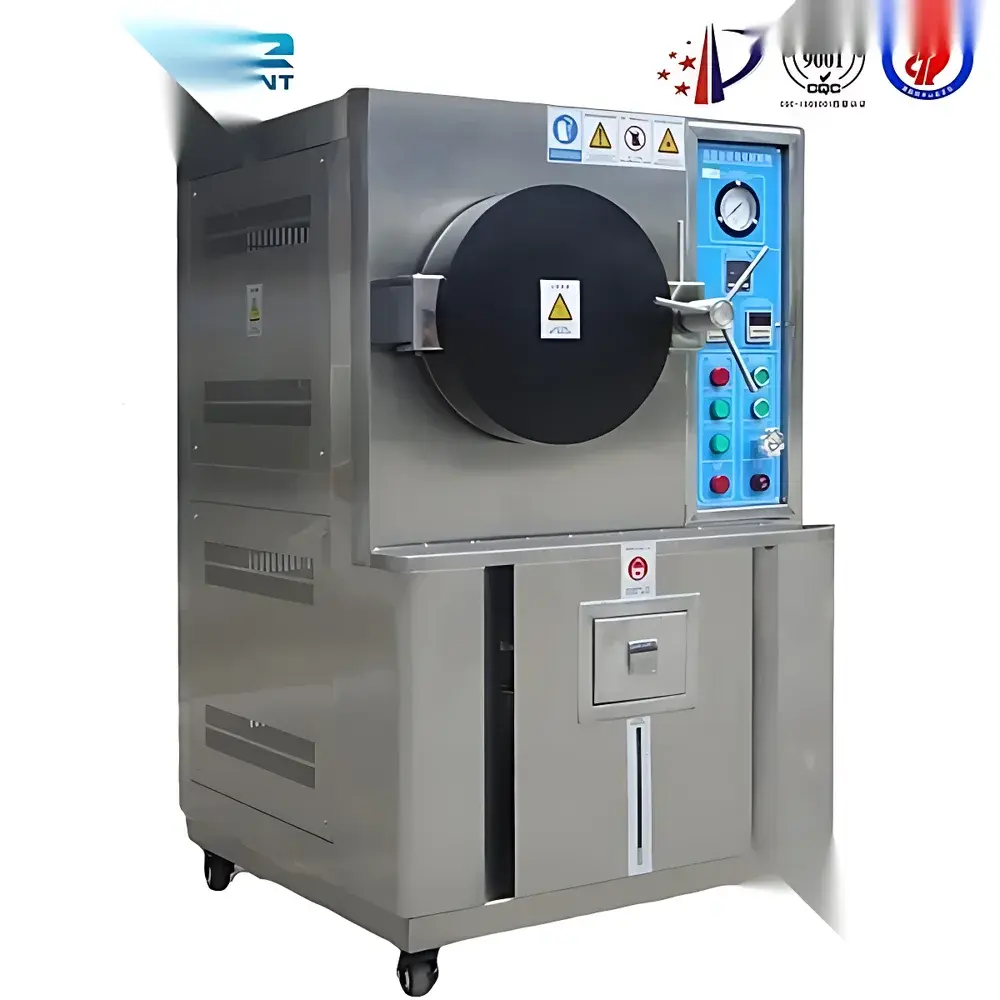
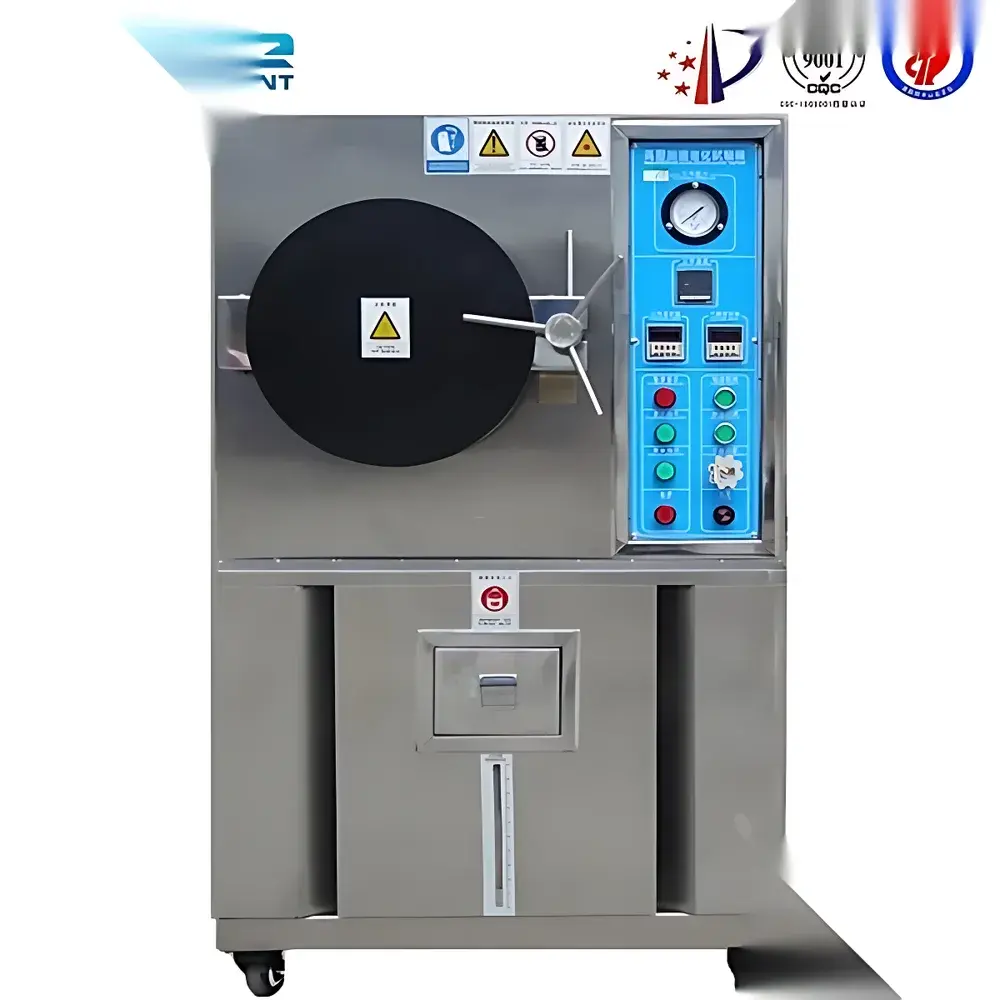
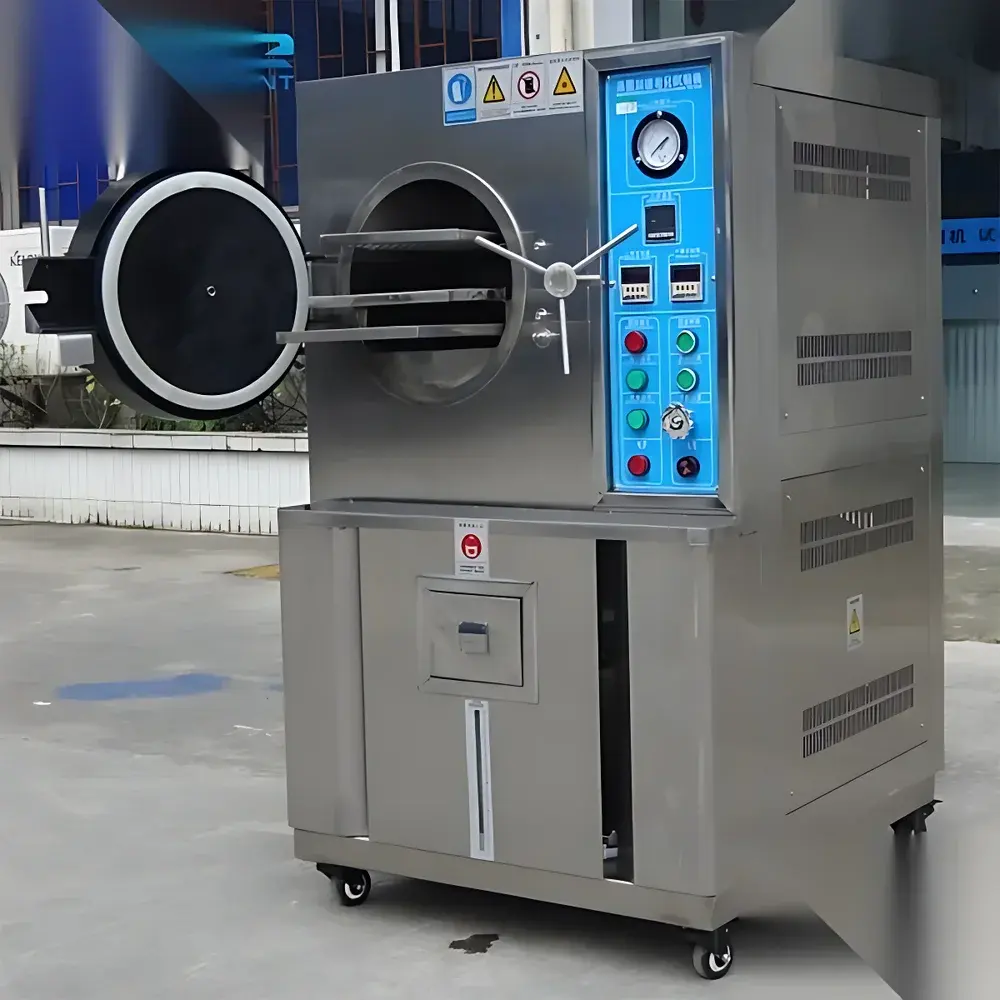
Pressure Cooker Test (PCT) Aging Chamber – Industrial-Grade Environmental Stress Tester
| Key | Chamber Dimensions (W×D×H): 800×800×800 mm or 1000×1000×1000 mm |
|---|---|
| Rated Voltage | 220 V ±10%, 50 Hz |
| Sample Rack Height Adjustment Range | 0–750 mm |
| Timer Range | 0–99 h 59 min |
| Timer Accuracy | ±1 min |
| Cycle Control (Load/Blow) | 0–99 h 59 min / 1 s–9999 min |
| Dust Concentration | 2–4 kg/m³ (dry talcum powder) |
| Powder Specification | Passes 75 µm square mesh sieve (wire diameter 50 µm) |
| Internal Construction | SUS201 stainless steel chamber |
| External Casing | A3 steel with electrostatic powder coating |
| Ambient Operating Conditions | 15–35 °C, 45–75 %RH (uncontrolled |
| Control System | PLC-based HMI touchscreen controller with PT100 temperature sensors |
| Safety Protections | Overtemperature cutoff, phase-loss detection, earth-leakage circuit breaker, reinforced tempered glass viewport (800×800 mm or 1000×1000 mm) |
| Airflow Design | Non-laminar, vertically oriented recirculating duct system |
Overview
The Pressure Cooker Test (PCT) Aging Chamber is an industrial-grade environmental stress testing system engineered to accelerate moisture ingress and thermal degradation in electronic components, semiconductor packaging, PCB assemblies, and hermetic seals under high-humidity, elevated-temperature, and pressurized conditions. Unlike standard humidity chambers, this PCT system operates without active pressure regulation—instead relying on controlled ambient laboratory conditions (15–35 °C, 45–75 %RH) combined with precise dust dispersion cycles and thermal stabilization of test media. It conforms to the functional intent of JEDEC JESD22-A102 (Steady-State Moisture Resistance) and supports pre-compliance screening per IPC-TM-650 2.6.25 and MIL-STD-883 Method 1008. The chamber’s non-laminar vertical airflow architecture ensures uniform particulate suspension and consistent exposure across multi-layer sample racks, minimizing stratification artifacts during extended aging protocols.
Key Features
- Two standard internal volume configurations: 512 L (800×800×800 mm) and 1000 L (1000×1000×1000 mm), both optimized for high-density sample loading and reproducible dust distribution.
- PLC-integrated touchscreen HMI controller with user-programmable cycle logic—enabling independent scheduling of load duration, blow intervals, and dwell periods from 1 second to 9999 minutes.
- PT100-class temperature sensing integrated into dust heating zones, ensuring stable thermal conditioning of talcum powder prior to dispersion—critical for eliminating hygroscopic variability.
- Adjustable sample rack height (0–750 mm range) accommodates heterogeneous device geometries, including stacked modules, wafer-level packages, and through-hole mounted assemblies.
- Reinforced tempered glass viewport (800×800 mm or 1000×1000 mm) provides real-time visual monitoring without compromising structural integrity or environmental containment.
- Dual-safety architecture: independent overtemperature cutoff relay plus Class B earth-leakage circuit breaker (30 mA trip threshold), compliant with IEC 61000-4-5 surge immunity requirements.
Sample Compatibility & Compliance
This PCT aging chamber supports a broad spectrum of non-hermetic and semi-hermetic devices—including QFN, BGA, CSP, and molded plastic ICs—where moisture diffusion kinetics are governed by polymer matrix permeability and interfacial delamination thresholds. Its passive environmental design aligns with GLP-aligned lab practices: no internal humidification or pressurization systems eliminate calibration drift risks associated with steam generators or pneumatic regulators. While not a certified ISO/IEC 17025 reference instrument, it meets mechanical and electrical safety prerequisites outlined in UL 61010-1 and EN 61010-1. Dust concentration control (2–4 kg/m³) and particle size fidelity (≤75 µm via 50 µm wire mesh sieve) ensure repeatability across inter-laboratory validation studies conducted under ASTM D1898 and IPC-9701 frameworks.
Software & Data Management
The embedded controller logs timestamped operational events—including cycle start/stop, temperature excursions, and fault triggers—with local storage capacity exceeding 30 days of continuous 10-second interval data. Export is supported via USB 2.0 to CSV format for traceability in FDA 21 CFR Part 11–aligned quality systems. Audit trail functionality records operator ID, parameter changes, and emergency stop activations—meeting minimum ALCOA+ principles (Attributable, Legible, Contemporaneous, Original, Accurate, Complete, Consistent, Enduring, Available). Remote monitoring is available via optional Ethernet module (Modbus TCP), enabling integration into centralized MES platforms without proprietary drivers.
Applications
- Pre-screening of mold compound susceptibility to popcorning and wire bond lift under moisture-saturated thermal cycling.
- Evaluation of conformal coating barrier efficacy against fine particulate infiltration and capillary condensation at lead-frame interfaces.
- Accelerated life testing of automotive ECUs exposed to under-hood microclimates with airborne contaminants.
- Qualification of MEMS sensor housings subjected to combined dust-loading and thermal soak per AEC-Q200 stress profiles.
- Process validation support for reflow soldering lines where flux residue interaction with ambient humidity must be assessed prior to board cleaning.
FAQ
Does this chamber actively control temperature or relative humidity?
No. It operates within ambient laboratory conditions (15–35 °C, 45–75 %RH). Optional auxiliary heaters may be installed to prevent dust agglomeration due to localized condensation.
Can the system be validated per IQ/OQ protocols?
Yes—its deterministic PLC logic, calibrated PT100 sensors, and event-logged operation support documented installation and operational qualification when paired with third-party metrology services.
What dust standards does the chamber accommodate?
It is configured for dry talcum powder meeting ASTM D923 specifications, with particle size verified using a 75 µm square-mesh sieve (wire diameter 50 µm) as defined in ISO 12103-1 A2 standard test dust.
Is remote diagnostics supported out-of-the-box?
Basic Modbus TCP communication is available via optional Ethernet interface; full SCADA integration requires configuration by qualified systems integrators.
How is airflow uniformity verified during commissioning?
Non-intrusive anemometry mapping (per ISO 14644-3 Annex B) is recommended at three vertical planes (top/mid/bottom) using ≥16 measurement points per plane to confirm velocity deviation ≤±15 % of mean.



