
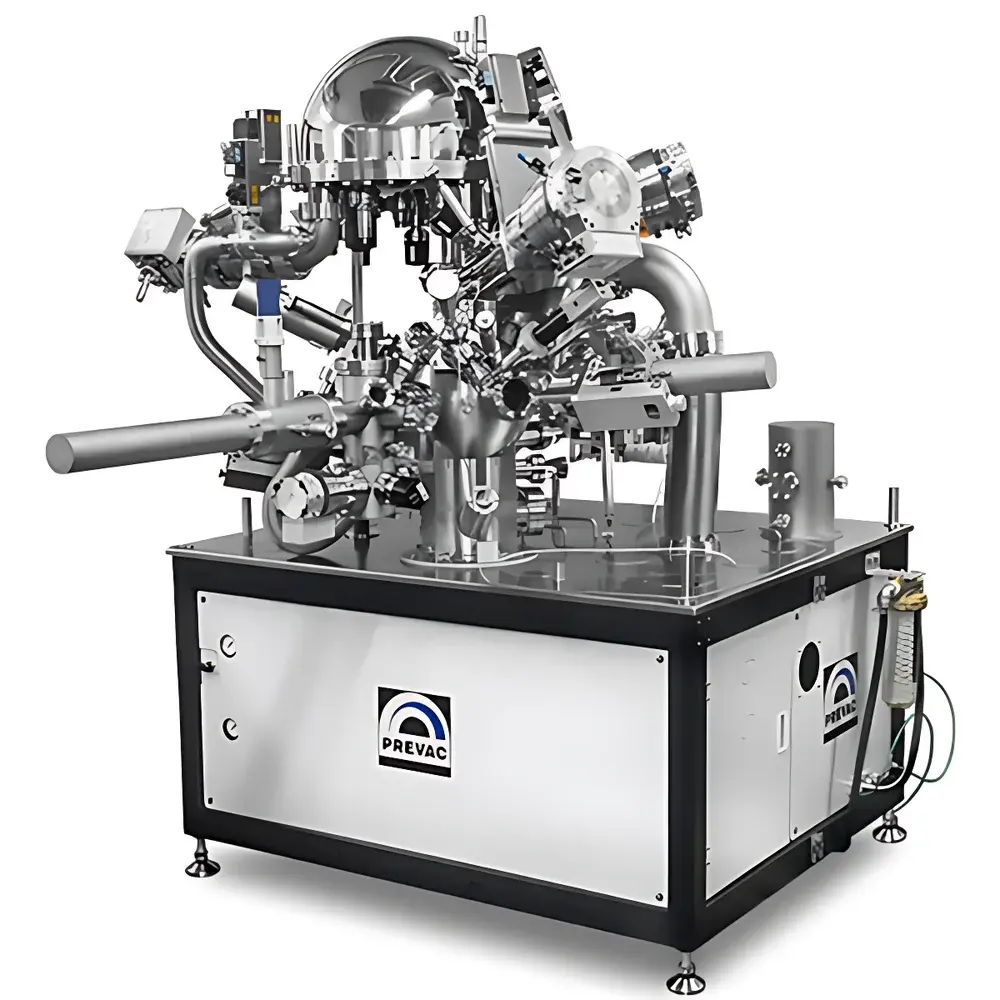
PREVAC HPPES High-Pressure Photoelectron Spectroscopy System
| Brand | PREVAC |
|---|---|
| Origin | Poland |
| Model | HPPES |
| Pressure Range | 2×10⁻⁹ mbar – 50 mbar |
| Base Pressure (UHV mode) | ≤1×10⁻⁹ mbar (configuration-dependent) |
| Sample Temperature Range | 20 K (LHe/LN₂-cooled) to 1400 °C |
| Analyzer Type | High-Pressure Hemispherical Energy Analyzer (EA15-HP5 / EA15-HP50) |
| X-ray Sources | Dual-anode monochromated AlKα / AgLα and non-monochromated AlKα / MgKα |
| UV Source | Powered He(I)/He(II) discharge lamp |
| Ion Source | Broad-beam Ar⁺ for sputter depth profiling or surface cleaning |
| Neutralizer | Electron flood gun |
| Manipulator | Motorized or manual 4–6 axis, with precise angular and translational control |
| Load-Lock Chamber | Integrated, with linear transfer to analysis chamber |
| Vacuum System | Composite pumping stack including roughing pump, turbomolecular pump (TMP), titanium sublimation pump (TSP), and cryo-shielded ion pump |
| Software Platform | Spectrium (Tango-compatible, PLC-integrated) |
| Compliance | UHV/HPXPS/APXPS/UPS/ARPES/AES/EELS/ISS/IPES/LEIPS standards |
Overview
The PREVAC HPPES High-Pressure Photoelectron Spectroscopy System is an engineered UHV-to-ambient-pressure surface science platform designed for quantitative, element-specific, and chemical-state-resolved characterization of solid–gas and solid–liquid interfaces under operando and near-realistic conditions. Based on the photoelectric effect, the system measures the kinetic energy distribution of photoelectrons emitted from sample surfaces upon irradiation with photons—enabling direct determination of electronic structure, valence band dispersion, work function, surface dipole, oxidation states, and interfacial bonding configurations. Unlike conventional ultra-high vacuum (UHV) PES systems limited to <10⁻⁸ mbar, the HPPES architecture maintains analytical integrity across a continuous pressure range spanning nine orders of magnitude—from 2×10⁻⁹ mbar (standard UHV base pressure) up to 50 mbar—making it uniquely suited for high-pressure XPS (HPXPS), ambient-pressure UPS (APUPS), and in situ catalysis, electrochemical interface, and corrosion studies. Its modular vacuum architecture, differential pumping design, and high-transmission hemispherical analyzer (EA15-HP5/HP50) ensure high signal-to-noise ratio and energy resolution (ΔE/E < 0.1%) even at elevated pressures.
Key Features
- Multi-regime vacuum capability: seamless transition between UHV (≤10⁻⁹ mbar), high-vacuum, and near-ambient pressure (up to 50 mbar) via integrated differential pumping stages and pressure-stable analyzer optics.
- Configurable excitation sources: dual-anode monochromated X-ray source (AlKα, AgLα) for high-resolution core-level spectroscopy; non-monochromated dual-anode source (AlKα/MgKα) for enhanced flux; dedicated UV lamp (He(I)/He(II)) for valence band mapping and work function analysis.
- Integrated surface preparation and probing tools: broad-beam Ar⁺ ion source for depth profiling and oxide removal; electron flood neutralizer for charge compensation on insulating samples; optional gas cluster ion source (GCIS) for gentle sputtering of organic and polymer layers.
- Thermally versatile sample manipulation: motorized 4–6 axis manipulator supporting cryogenic cooling (down to 20 K with LHe/LN₂ cryostat) and resistive heating up to 1400 °C—enabling temperature-programmed reactions, phase transformation studies, and thermal desorption analysis.
- Modular load-lock architecture: rapid sample exchange without breaking main chamber vacuum; linear transfer mechanism ensures reproducible positioning and minimizes contamination risk.
- Full-system automation: PLC-based hardware coordination with real-time status visualization, interlock monitoring, and synchronized control of pumps, valves, sources, detectors, and manipulators via Spectrium software.
Sample Compatibility & Compliance
The HPPES system accommodates diverse sample geometries—from 10 × 10 mm² wafers to 2-inch diameter substrates—and supports conductive, semiconductive, and insulating materials including catalysts, 2D materials, MOFs, perovskites, battery electrodes, and functional thin films. All internal surfaces are electropolished stainless steel with UHV-compliant sealing (CF and ISO-K flanges); all feedthroughs meet ISO 10110 optical surface specifications where applicable. The system complies with ISO 27493 (vacuum terminology), ASTM E1908-22 (XPS data reporting), and supports GLP/GMP-aligned audit trails through Spectrium’s built-in electronic logbook and 21 CFR Part 11-compliant user access controls. Optional residual gas analyzers (RGA) and calibrated capacitance manometers enable traceable pressure validation per EN 60068-2-41.
Software & Data Management
Spectrium—a Tango Device Server–based control and analysis suite—provides unified orchestration of all hardware subsystems. It enables recipe-driven measurement sequences (e.g., temperature-ramped APXPS, angle-resolved UPS sweeps, or multi-source depth profiles), real-time spectral preview, and batch processing of kinetic energy spectra into binding energy scales with Shirley or Tougaard background subtraction. Raw data are stored in HDF5 format with embedded metadata (instrument configuration, pressure history, source parameters, calibration constants). Integration with third-party analysis tools (e.g., CasaXPS, Igor Pro, Python-based PyXPS) is supported via standardized export protocols. Spectrium also facilitates remote diagnostics, firmware updates, and hardware abstraction—allowing future expansion with synchrotron beamline interfaces or electrochemical cells via additional Tango-controlled devices.
Applications
The HPPES system serves as a primary tool in heterogeneous catalysis research (e.g., CO₂ hydrogenation, NH₃ synthesis), where surface adsorbates and active sites must be characterized *in situ* under reactive gas mixtures. It enables operando UPS band alignment measurements at semiconductor–electrolyte interfaces for photoelectrochemical water splitting. In energy storage, it resolves SEI evolution on Li-ion battery cathodes during gas-phase aging or partial pressure cycling. For advanced materials development, ARPES-capable configurations map Fermi surface topology in topological insulators under controlled atmospheres; HPXPS quantifies oxidation state gradients across buried interfaces in multilayer optoelectronic devices. Its compatibility with ISS, AES, and EELS extends its utility to interfacial diffusion kinetics, grain boundary segregation, and nanoscale compositional grading.
FAQ
What pressure regimes does the HPPES support for photoelectron detection?
It operates continuously from ultrahigh vacuum (2×10⁻⁹ mbar) to 50 mbar, with optimized transmission and energy resolution maintained across the full range via differential pumping and pressure-adapted analyzer lens settings.
Can the system perform both XPS and UPS in the same experimental session?
Yes—Spectrium allows rapid switching between monochromated X-ray and UV sources with automatic recalibration of pass energy and lens voltages; cross-calibration is traceable to NIST SRM 2041.
Is the system compatible with external synchrotron beamlines or laser sources?
Absolutely—the 310 mm analysis chamber features multiple radial CF100 and CF63 ports, enabling integration of external photon sources, time-of-flight detectors, or custom optical access for pump–probe experiments.
How is charge neutralization handled for insulating samples at high pressure?
A low-energy electron flood gun is standard; optional low-energy ion beams or dual-beam neutralizers can be added for challenging dielectrics under APXPS conditions.
What level of vacuum integrity is guaranteed after bake-out?
With standard LN₂ cryo-shielding and TSP/TMP/ion pump combination, base pressure ≤5×10⁻¹⁰ mbar is routinely achieved post-bake (150 °C, 24 h), verified by calibrated Bayard–Alpert and cold-cathode gauges.





