
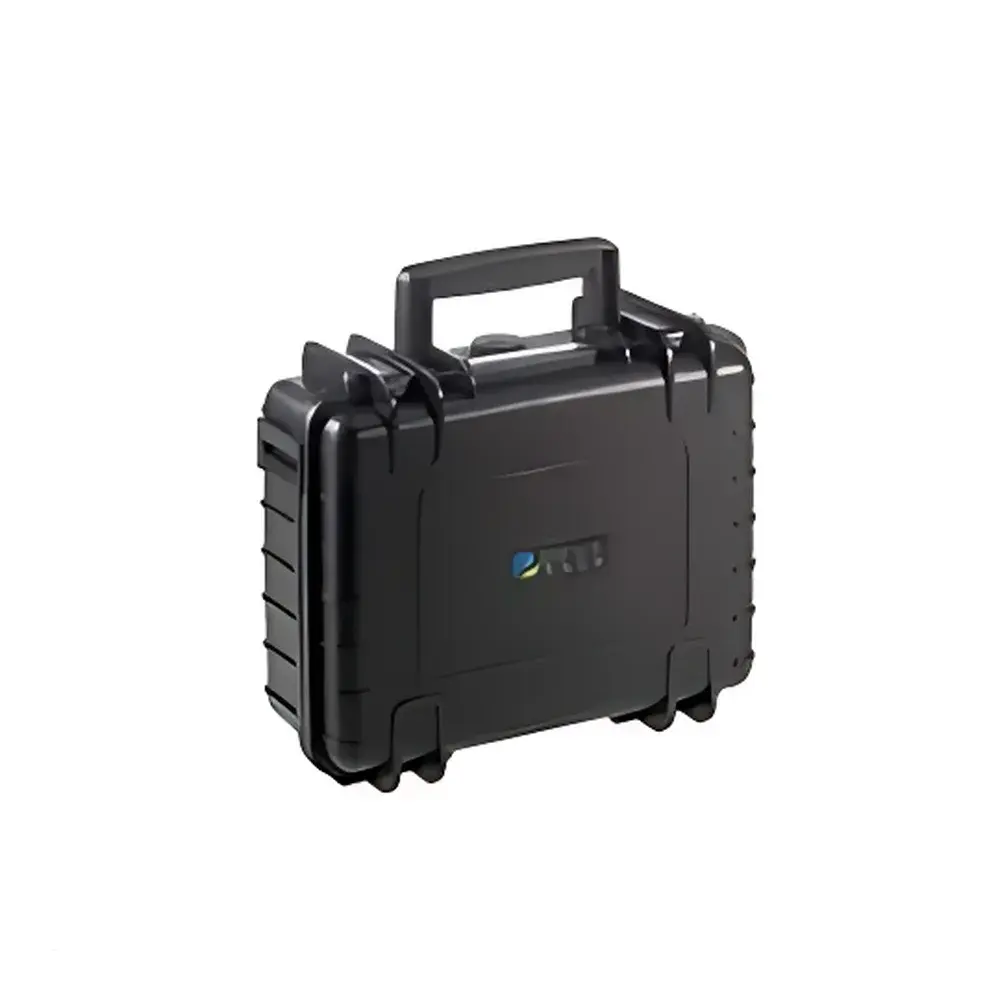
Pri-eco PRI-501 Dual-Channel CO₂ and H₂O Analyzer
| Brand | Pri-eco |
|---|---|
| Origin | Beijing, China |
| Manufacturer Type | Direct Manufacturer |
| Country of Origin | China |
| Model | PRI-501 |
| Detection Principle | Dual-Wavelength Non-Dispersive Infrared (Dual-NDIR) |
| Measurable Gases | CO₂ (0–2000 ppm), H₂O (0–6 % vol) |
| Accuracy | ±2 % of reading (CO₂), ±2 % of reading (H₂O) |
| Zero Stability (CO₂) | ±2 % over 12 months |
| Repeatability (CO₂) | ±0.3 % at zero, ±1.5 % at span |
| Temperature Drift (CO₂) | ±0.03 %/°C (ambient), ±2 %/year (thermostated) |
| Operating Temperature | −20 to +45 °C |
| Operating Pressure | 800–1150 mbar |
| Sample Flow Rate | 1 L/min (adjustable) |
| T90 Response Time | 10 s (adjustable) |
| Warm-up Time | 1 min |
| Humidity Range | <99 % RH, non-condensing |
| Output Interfaces | RS-232, analog (0–5 V / 4–20 mA) |
| Dimensions & Weight | 250 × 160 × 90 mm, 1.2 kg |
| Power Supply | 7–28 V DC |
Overview
The Pri-eco PRI-501 Dual-Channel CO₂ and H₂O Analyzer is a field-deployable, high-stability gas concentration measurement instrument engineered for continuous, real-time monitoring of carbon dioxide and water vapor in environmental and ecological research applications. It employs dual-wavelength non-dispersive infrared (Dual-NDIR) spectroscopy — a well-established, interference-resistant optical technique that leverages two discrete infrared absorption bands to isolate target gas signals while actively compensating for spectral overlap, source intensity drift, and optical path degradation. Unlike single-beam NDIR systems, the PRI-501’s dual-channel architecture enables simultaneous reference and measurement signal acquisition, significantly enhancing long-term baseline stability and measurement fidelity under variable ambient conditions. The analyzer integrates a silicon wafer-based infrared emitter with optimized thermal management, a high-sensitivity pyroelectric detector array, and an embedded high-speed microprocessor unit capable of real-time digital signal processing. Its fully automated pressure and temperature compensation — derived from co-located, factory-calibrated absolute pressure and Pt100-grade temperature sensors — ensures traceable accuracy across operational ranges defined by ISO 17025-compliant calibration protocols.
Key Features
- Dual-wavelength NDIR detection architecture for independent, cross-compensated CO₂ and H₂O quantification
- Silicon wafer infrared light source with extended lifetime and field-replaceable design
- Integrated high-precision absolute pressure sensor (±0.1 % FS) and calibrated RTD temperature sensor (±0.15 °C)
- Real-time on-board compensation for barometric pressure, ambient temperature, and internal thermal gradients
- Compact form factor (250 × 160 × 90 mm) suitable for portable deployment, eddy covariance towers, soil respiration chambers, and controlled-environment facilities
- Low power consumption (7–28 V DC input) enabling battery or solar-powered operation in remote locations
- T90 response time ≤10 s (configurable) with 1-minute warm-up requirement for full specification compliance
- Robust mechanical housing rated for outdoor use (IP54 equivalent) with condensation-resistant optical path design
Sample Compatibility & Compliance
The PRI-501 is designed for direct analysis of ambient air, chamber headspace, soil pore gas, and canopy-level atmospheric samples without pre-concentration or chemical scrubbing. It meets fundamental performance criteria aligned with ASTM D6216 (standard test method for CO₂ measurement in ambient air) and supports data integrity requirements for GLP and ISO 14064-3 greenhouse gas inventory verification. Its pressure and temperature compensation algorithms are traceable to NIST-traceable reference standards, and its output stability characteristics satisfy long-term monitoring requirements specified in EPA Method TO-11A for continuous gas analyzers. The device operates reliably within 800–1150 mbar pressure range and −20 to +45 °C ambient temperature — covering >95 % of terrestrial field sites globally. Humidity tolerance up to 99 % RH (non-condensing) eliminates need for external dryers in most ecosystem monitoring configurations.
Software & Data Management
The PRI-501 communicates via standard RS-232 serial interface and provides configurable analog outputs (0–5 V or 4–20 mA) for integration with SCADA, CR1000X, or Campbell Scientific dataloggers. A dedicated ASCII command protocol enables bidirectional control, including flow rate adjustment, zero/span calibration initiation, and diagnostic query. Firmware supports time-stamped data logging with internal clock synchronization (optional GPS input). All configuration changes, calibration events, and error flags are recorded in a non-volatile audit trail compliant with FDA 21 CFR Part 11 principles — including user identification, timestamp, and action type — facilitating regulatory reporting and QA/QC documentation. Optional PC-based software provides real-time visualization, batch export (CSV/Excel), and automated calibration reminder scheduling.
Applications
- Soil respiration flux measurements using dynamic closed-chamber or gradient methods
- Eddy covariance systems requiring fast-response, low-drift CO₂/H₂O co-sensing
- Controlled-environment agriculture: CO₂ enrichment feedback control in greenhouses and open-top chambers
- Atmospheric boundary layer profiling and vertical gradient studies
- Long-term ecosystem monitoring networks (e.g., NEON, ICOS, FLUXNET)
- Laboratory-based plant physiology experiments requiring simultaneous gas exchange and humidity tracking
- Calibration transfer verification for cavity ring-down spectrometers (CRDS) and tunable diode laser absorption spectrometers (TDLAS)
FAQ
What calibration standards are recommended for routine verification?
NIST-traceable CO₂-in-air and H₂O-in-N₂ certified reference gases are required; typical calibration intervals are 12 months under stable operating conditions, with quarterly zero checks advised.
Can the PRI-501 be used in pressurized sampling lines?
Yes — it supports inlet pressures up to 1150 mbar absolute; for pressurized manifolds, ensure flow regulation maintains 1 L/min at analyzer inlet and avoid condensation upstream.
Is analog output linear across the full measurement range?
Yes — both CO₂ (0–2000 ppm) and H₂O (0–6 %) outputs are factory-linearized to ±0.5 % of full scale per channel.
Does the device support automatic zeroing during operation?
No — zero calibration requires introduction of certified zero gas (CO₂-free synthetic air, dry N₂); however, the system logs all zero events with timestamps and operator ID for audit purposes.
How is optical contamination monitored and compensated?
The dual-wavelength algorithm continuously tracks source intensity decay and scattering-induced signal attenuation, applying adaptive gain correction without manual intervention.
Related Products







