
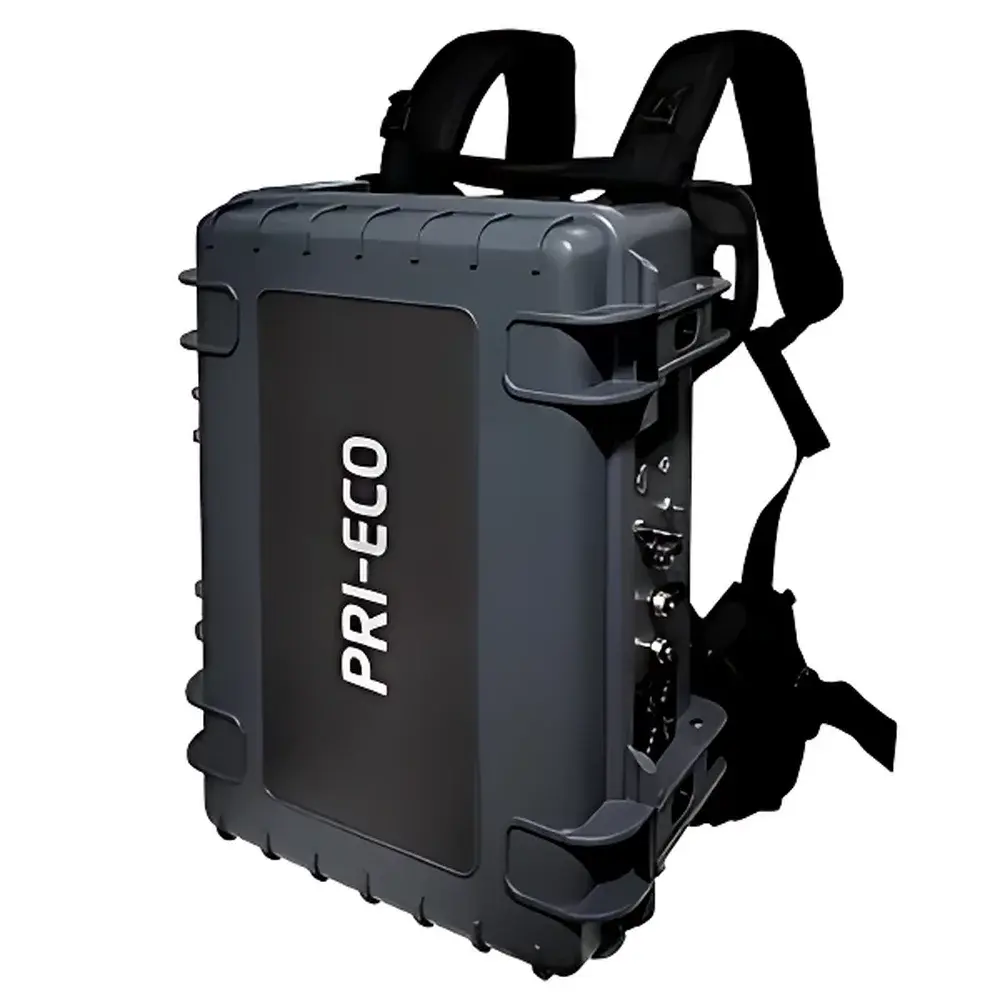
Pri-eco PRI-8630 Portable CO₂/N₂O/H₂O Soil Respiration Measurement System
| Brand | Pri-eco |
|---|---|
| Origin | Beijing, China |
| Manufacturer | Yes |
| Country of Origin | China |
| Model | PRI-8630 |
| Instrument Type | Multi-Gas Soil Respiration Analyzer |
| Power Consumption (Steady State) | <28 W |
| Power Supply | 12 V Rechargeable Lithium Battery |
| Dimensions | 475 × 372 × 192 mm |
| Weight (Analyzer Unit) | 13 kg |
| Soil Chamber Weight | 1.8 kg |
| Chamber Diameter | 220 mm |
| Chamber Height | 120 mm |
| Chamber Volume | 3718 cm³ |
| Soil Collar Area | 314 cm² |
| CO₂ Accuracy (5 min) | ±0.04 ppm (0–3500 ppm) |
| N₂O Accuracy (5 min) | ±0.03 ppb (0–500 ppb) |
| H₂O Accuracy (5 min) | ±10 ppm (0–3 %v/v) |
| Sampling Rate | 1 Hz |
| Sample Flow Rate | 800 mL/min (adjustable) |
| Air Pressure Range | 150–1150 mbar |
| Air Pressure Accuracy | ±2 mbar |
| Soil Temperature Range | −20 to +85 °C |
| Soil Temperature Accuracy | ±0.2 °C |
| Soil Moisture Range | 0–100 % |
| Soil Moisture Accuracy | ±3 % |
| Relative Humidity Tolerance | <99 % RH (non-condensing) |
| Dynamic Pressure Compensation | Yes (Patent ZL201420354126.4) |
| Detection Principle | Mid-Infrared Laser Absorption Spectroscopy (MIRLAS) |
Overview
The Pri-eco PRI-8630 Portable CO₂/N₂O/H₂O Soil Respiration Measurement System is an engineered field-deployable platform designed for high-fidelity, in situ quantification of soil-atmosphere gas exchange fluxes. It employs tunable mid-infrared laser absorption spectroscopy (MIRLAS), a first-principle optical technique that enables simultaneous, real-time, and interference-free detection of carbon dioxide (CO₂), nitrous oxide (N₂O), and water vapor (H₂O) at sub-ppb sensitivity levels. Unlike non-dispersive infrared (NDIR) or electrochemical sensors, MIRLAS delivers inherent selectivity by targeting fundamental vibrational absorption lines in the 4–12 µm spectral region—minimizing cross-sensitivity from co-occurring atmospheric gases (e.g., CH₄, CO, NH₃) and eliminating drift associated with optical fouling or detector aging. The analyzer integrates active temperature and pressure stabilization (<±0.05 °C, <±0.1 mbar), ensuring metrological traceability across variable ambient conditions—from alpine tundra to tropical rainforest understories. Its design adheres to the physical principles outlined in ISO 16633:2022 (Soil quality — Determination of CO₂ evolution — Static chamber method) and supports compliance with IPCC Tier 2/3 inventory reporting requirements for agricultural and forest soils.
Key Features
- Simultaneous, high-resolution measurement of CO₂, N₂O, and H₂O at 1 Hz sampling frequency with <0.04 ppm (CO₂), <0.03 ppb (N₂O), and <10 ppm (H₂O) precision over 5-minute averaging intervals
- Dynamically pressure-balanced soil chamber (patented ZL201420354126.4) maintains internal pressure equivalence with ambient atmosphere—reducing advective flux errors induced by wind shear or chamber insertion artifacts
- Integrated environmental monitoring suite: calibrated soil temperature probe (−20 to +85 °C, ±0.2 °C), volumetric soil moisture sensor (0–100 %, ±3 %), and absolute air pressure transducer (150–1150 mbar, ±2 mbar)
- Low-power architecture: steady-state power draw 8 hours of continuous operation per charge
- Ergonomic, tablet-based human-machine interface with intuitive touch workflow—supporting parameter configuration, real-time gas concentration visualization, automated flux calculation (Fick’s law, Hsieh model), and manual correction protocols
- Modular expandability: optional CH₄ measurement module (via additional MIR laser channel); compatible with motorized auto-chamber systems for unattended diurnal or multi-point campaigns
Sample Compatibility & Compliance
The PRI-8630 is validated for use across diverse pedological and ecological contexts—including cropped fields, peatlands, forest floors, grasslands, and restored wetlands. Its 314 cm² collar footprint and 3718 cm³ chamber volume conform to ASTM D6723-21 (Standard Practice for Measuring Soil Respiration Using Closed Dynamic Chambers) and facilitate direct comparison with eddy covariance and gradient-based reference methods. All gas concentration outputs are referenced to dry mole fraction where appropriate, with integrated H₂O correction applied per ISO 18500-2:2021. The system meets electromagnetic compatibility (EMC) Class B requirements per IEC 61326-1 and operates reliably under humidity conditions up to 99 % RH (non-condensing). Data acquisition firmware supports audit-trail logging and time-stamped metadata embedding—enabling alignment with GLP and GMP documentation practices where required.
Software & Data Management
Field data are captured and processed via the proprietary Pri-eco FieldLink™ software suite running on the included ruggedized Android tablet. The application implements ISO/IEC 17025-aligned uncertainty propagation models for flux calculation, incorporating chamber geometry, diffusion coefficients, and boundary layer corrections. Raw spectra, calibrated concentrations, environmental parameters, and user annotations are stored in open-format CSV and NetCDF 4.0 files—ensuring interoperability with R, Python (Pandas/Xarray), MATLAB, and GIS platforms. Optional cloud synchronization enables remote project management, version-controlled dataset archiving, and role-based access control. Software updates are delivered via secure OTA channels and include full changelogs compliant with FDA 21 CFR Part 11 electronic record requirements.
Applications
- Quantifying climate-relevant greenhouse gas fluxes in long-term ecosystem monitoring networks (e.g., NEON, ICOS, LTER)
- Evaluating agronomic interventions—tillage regimes, cover cropping, biochar amendment, and nitrogen fertilizer optimization—on net soil carbon balance
- Validating biogeochemical models (e.g., DAYCENT, DNDC, CENTURY) through high-temporal-resolution chamber measurements
- Supporting carbon credit verification under Verra VM0042 (Improved Forest Management) and Plan Vivo standards
- Conducting controlled incubation studies with intact soil cores under regulated temperature/moisture conditions
- Calibrating and ground-truthing airborne and satellite-based GHG retrieval algorithms (e.g., OCO-3, GOSAT-2, CO2M)
FAQ
What calibration protocols are recommended for field deployment?
Primary calibration uses certified NIST-traceable gas standards (CO₂ in N₂, N₂O in air, H₂O vapor generators) at ambient pressure and temperature. Daily zero/span checks are advised; full multi-point calibration every 30 days or after transport-induced shock.
Can the system operate autonomously for unattended measurements?
Yes—when paired with the optional PRI-AutoChamber and external solar charging kit, the PRI-8630 supports scheduled, multi-day chamber closure cycles with local data buffering and configurable telemetry (LoRaWAN or cellular).
Is the MIRLAS analyzer susceptible to interference from methane or ammonia?
No—the selected mid-IR absorption lines (e.g., CO₂ at 4.26 µm, N₂O at 4.53 µm) exhibit negligible spectral overlap with CH₄ (3.3 µm) or NH₃ (10.4 µm), confirmed by laboratory cross-sensitivity testing per ISO 17025 Annex A.3.
How is soil moisture measured, and what is its role in flux interpretation?
Volumetric water content is derived from time-domain reflectometry (TDR) using a calibrated 3-rod probe inserted adjacent to the chamber collar. Moisture data are used to normalize respiration rates to soil water-filled pore space (WFPS), a key driver of microbial activity and diffusional limitation.
Does the system support custom flux modeling beyond built-in algorithms?
Yes—raw time-series concentration data (with synchronized T/P/H₂O/soil-T/moisture timestamps) are fully exportable, enabling implementation of user-defined models including non-steady-state diffusion, isotopic partitioning, or machine-learning-based flux gap-filling.
Related Products







