
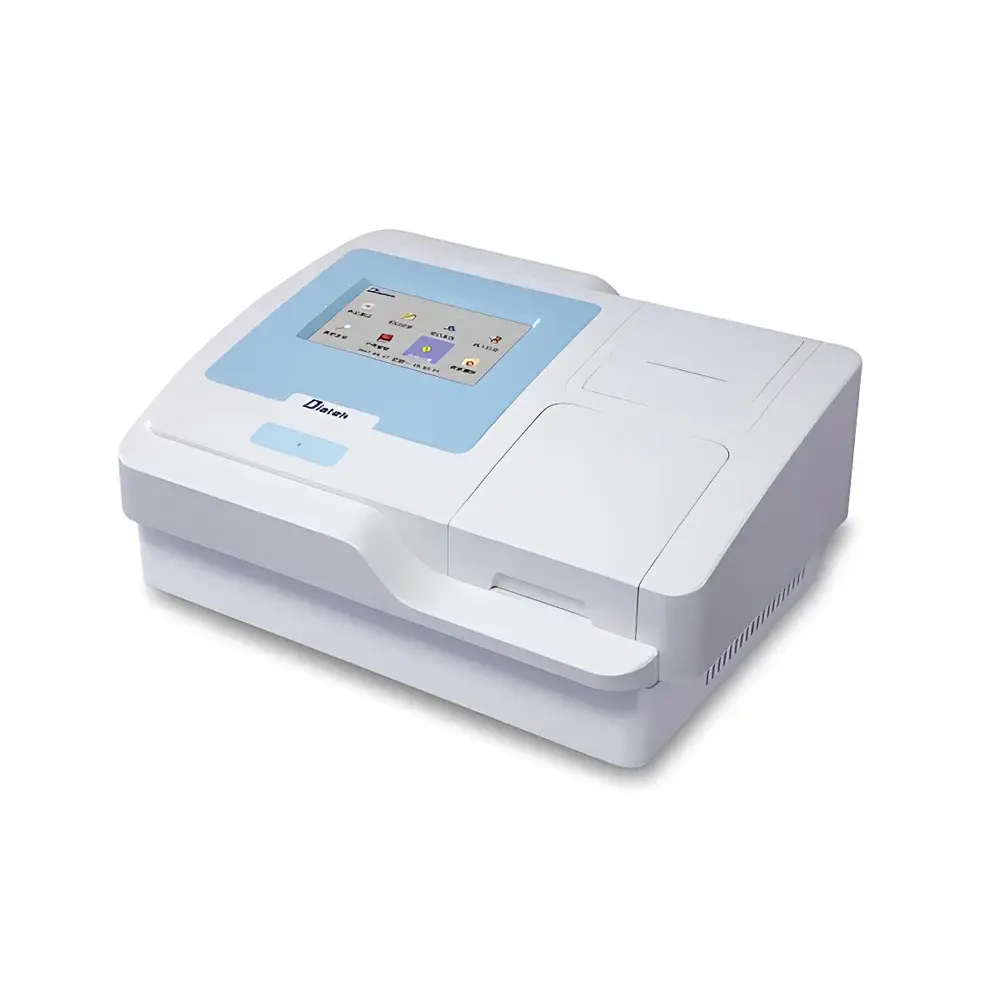
Pribolab DR-3500 Microplate Reader
| Brand | Pribolab |
|---|---|
| Model | DR-3500 |
| Wavelength Range | 400–800 nm |
| Absorbance Range | 0.000–4.000 A |
| Detection Channels | 8-channel |
| Measurement Modes | Single-wavelength, Dual-wavelength, Two-point, Kinetic |
| Data Processing | Log-logit, Linear/Log/Exponential/Power/Double-logarithmic Regression, Cut-off Qualitative Analysis |
| Plate Format | Standard 96-well microplates |
| Throughput | ≤10 seconds per plate |
| Interface | Embedded touchscreen OS (Chinese), Optional PC connectivity via USB/Ethernet |
| Compliance | Designed for GLP-compliant laboratories |
Overview
The Pribolab DR-3500 Microplate Reader is a dedicated absorbance-based optical detection instrument engineered for high-throughput quantitative and qualitative analysis in life science, food safety, and quality control laboratories. Operating on the principle of photometric absorbance measurement—where light transmission through liquid-phase samples in standardized 96-well microplates is quantified—the DR-3500 employs a stable tungsten-halogen light source coupled with precision optical filters to deliver accurate monochromatic illumination across the visible spectrum (400–800 nm). Each sample’s optical density is converted into an analog electrical signal by a high-stability photodiode array, digitized via 16-bit ADC, and processed in real time by an embedded ARM-based microcontroller. Unlike spectrophotometers requiring cuvette-based manual handling, the DR-3500 integrates automated plate positioning logic (X/Y stepping motor control) and eight parallel optical channels, enabling full-plate reading in under 10 seconds with inter-channel reproducibility <±0.003 A at 1.0 A.
Key Features
- Self-contained embedded system: No external PC required for operation, data storage (up to 500 user-defined assay protocols), or thermal printing—ideal for regulated environments with restricted network access.
- Full-plate visualization interface: Real-time 96-well layout display with color-coded well assignment (blank, standard, control, sample, QC) and drag-and-drop well mapping via capacitive touchscreen.
- Multi-mode measurement architecture: Supports single-wavelength endpoint, dual-wavelength background subtraction, two-point calibration, and kinetic time-course profiling (up to 999 readings per well).
- Comprehensive curve-fitting engine: Implements 10 algorithmic models—including linear, log-logit, four-parameter logistic (4PL), double-logarithmic, and power regression—validated against reference standards per ISO/IEC 17025 method verification guidelines.
- Flexible assay configuration: Up to 12 independent assays per plate; simultaneous qualitative (cut-off threshold) and quantitative (concentration interpolation) analysis within one run.
- Intelligent optical management: Automatic lamp power modulation based on measurement duration and wavelength selection, extending source lifetime beyond 2,000 hours.
- Maintenance diagnostics suite: Built-in self-test routines for optical path alignment, detector linearity, and temperature drift compensation—generates printable diagnostic logs for internal QA audits.
Sample Compatibility & Compliance
The DR-3500 is optimized for aqueous and buffered solutions in standard polystyrene, polypropylene, or UV-transparent microplates (flat-bottom, clear or black-walled). It accommodates common ELISA, enzyme activity (e.g., β-galactosidase, LDH), endotoxin (LAL), and mycotoxin immunoassay formats used in food safety testing—particularly aligned with Pribolab’s portfolio of certified reference materials for aflatoxins, ochratoxin A, and deoxynivalenol. While not pre-certified to FDA 21 CFR Part 11, the instrument supports ALCOA+ data integrity principles: all measurements are timestamped, user-ID logged, and stored with immutable metadata (wavelength, gain setting, plate ID). Exported CSV or PDF reports include traceable instrument parameters, facilitating compliance with ISO/IEC 17025, GB/T 27404 (China), and internal GLP procedures.
Software & Data Management
Onboard firmware provides full assay lifecycle control—from protocol creation and plate layout definition to result calculation and report generation. Data is retained in non-volatile flash memory with optional backup via USB mass storage. For networked deployment, the optional PC software (DR-Link Suite v3.x) enables remote monitoring, centralized database synchronization, role-based user permissions, and automated export to LIMS via HL7 or ASTM E1384-compliant interfaces. All software modules undergo version-controlled validation; change logs and installation records are maintained per GAMP5 guidance. Audit trails capture operator actions, parameter modifications, and calibration events—exportable as encrypted PDFs with digital signature support.
Applications
The DR-3500 serves as a core analytical platform in food testing laboratories performing regulatory screening per GB 5009 series standards (e.g., GB 5009.22 for aflatoxin B₁), AOAC Official Methods®, and EU Commission Regulation (EC) No 401/2006. Typical use cases include: quantification of mycotoxin immunoassay signals in cereal extracts; kinetic monitoring of glucose oxidase activity in vitamin C stability studies; endpoint absorbance measurement in allergen lateral flow strip validation; and high-volume QC release testing of enzyme reagents in diagnostic kit manufacturing. Its 8-channel design ensures consistent inter-well comparability critical for multi-analyte panels in multiplexed food contaminant assays.
FAQ
Does the DR-3500 support wavelength scanning or spectral acquisition?
No. The DR-3500 is a filter-based fixed-wavelength reader. It uses interchangeable interference filters (not supplied standard) for discrete wavelength selection—optimized for routine ELISA and colorimetric assays rather than full-spectrum characterization.
Can assay protocols be transferred between instruments?
Yes. Protocol files (.prb format) are portable across DR-3500 units via USB drive and retain all calculation settings, well mapping, and threshold definitions.
Is the thermal printer integrated or optional?
A built-in thermal printer is standard. It supports customizable report templates—including bilingual (English/Chinese) headers—and complies with laboratory record retention requirements for raw data output.
What maintenance intervals are recommended?
Optical path cleaning every 6 months; lamp replacement every 2,000 operational hours; annual performance verification using NIST-traceable neutral density filters (recommended but not included).
Does Pribolab provide IQ/OQ documentation?
Yes. Installation Qualification (IQ) and Operational Qualification (OQ) protocols—including test scripts, acceptance criteria, and blank execution forms—are available upon request for GMP-regulated users.




