
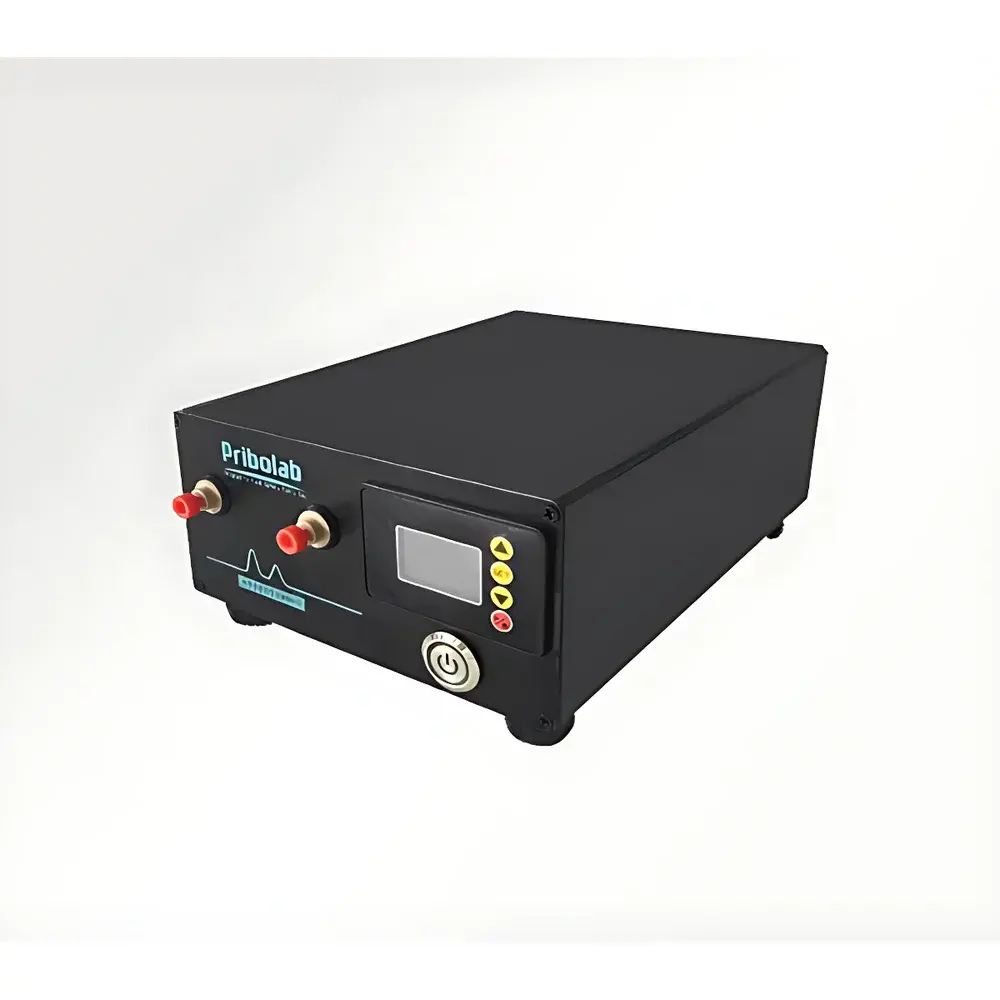
Pribolab MDU-200 Photochemical Post-Column Derivatization System
| Brand | Pribolab |
|---|---|
| Model | MDU-200 |
| Origin | Shandong, China |
| Derivatization Fluid Flow Rate | 1–2 mL/min |
| Reaction Coil Volume | 1 mL |
| Operating Temperature | Ambient |
| Compliance | AOAC Official Method 2005.08, AOCS Aa11-05, Ph. Eur. 2.8.18, Chinese Pharmacopoeia (2020 Ed.) & GB Standards |
Overview
The Pribolab MDU-200 Photochemical Post-Column Derivatization System is an engineered solution for the selective, reagent-free photochemical activation of aflatoxins following chromatographic separation in high-performance liquid chromatography (HPLC) and ultra-high-performance liquid chromatography (UHPLC) platforms. Unlike conventional chemical derivatization methods that rely on hazardous oxidants such as bromine or iodine solutions, the MDU-200 employs controlled UV irradiation (typically at 365 nm) to induce structural rearrangement of aflatoxin B₁ and G₁ into highly fluorescent derivatives—specifically, the corresponding 2′-hydroxy-aflatoxins—without altering the native integrity of B₂, G₂, M₁, or M₂. This principle enables direct, real-time fluorescence detection with enhanced sensitivity (LOD ≤ 10 pg on-column for AFB₁), improved signal-to-noise ratio, and minimal matrix interference. Designed for seamless integration into existing HPLC/UHPLC workflows, the MDU-200 operates at ambient temperature and requires no thermal regulation, eliminating risks associated with heated reaction zones or pressure fluctuations common in thermochemical systems.
Key Features
- Reagent-free photochemical derivatization: Eliminates use of corrosive bromine, chlorine, or acidic reagents—reducing operator exposure, system corrosion, and waste disposal complexity.
- Optimized UV reactor coil: 1 mL transparent fused-silica reaction coil with uniform irradiance distribution ensures consistent photolysis efficiency across flow rates from 0.5 to 2.0 mL/min.
- Plug-and-play interface: Standard 1/16″ stainless steel or PEEK tubing connections compatible with Agilent 1290/1260, Shimadzu Nexera/UFLC, Waters Acquity/UPLC, Hitachi Chromaster, Thermo Scientific Vanquish, and IDEX Health & Science systems.
- UHPLC-optimized performance: Enables complete aflatoxin B₁/B₂/G₁/G₂ separation and detection within ≤5 minutes using sub-2 µm particle columns (e.g., C18, phenyl-hexyl), maintaining peak symmetry and resolution under high linear velocity conditions.
- Robust architecture: Solid-state UV LED source (365 ± 5 nm) with >10,000-hour operational lifetime; no mercury lamps, no warm-up time, no spectral drift.
- No post-run rinsing required: Continuous operation without solvent flush cycles reduces downtime and mobile phase consumption; validated for >3,000 hours of uninterrupted service under GLP-compliant laboratory conditions.
Sample Compatibility & Compliance
The MDU-200 is validated for quantitative analysis of aflatoxins in complex matrices including cereals (corn, rice, wheat), nuts (peanuts, pistachios), spices (chili, black pepper), dairy products (milk powder, cheese), and herbal medicines. It supports extraction protocols compliant with AOAC 2005.08 (immunoaffinity column cleanup), AOCS Aa11-05 (solid-phase extraction), and European Pharmacopoeia monograph 2.8.18. All derivatization outcomes meet the equivalence criteria defined in Chinese Pharmacopoeia Volume IV (2020 Edition) and GB 5009.22–2016 for total aflatoxin determination. The system maintains linearity (r² ≥ 0.999) over 0.05–50 ng/mL for AFB₁ and demonstrates inter-day precision (RSD ≤ 3.2%, n = 6) across three independent laboratories participating in CNAS-accredited proficiency testing.
Software & Data Management
As a hardware-only derivatization module, the MDU-200 does not include proprietary software but fully interoperates with standard chromatography data systems (CDS) including OpenLab CDS, LabSolutions LCMS, Empower 3, Chromeleon 7.3, and Analyst TF. All derivatization events are synchronized via TTL trigger output (optional) or retention-time-based annotation, enabling automated peak identification and calibration curve generation. Audit trails, electronic signatures, and instrument control logs adhere to FDA 21 CFR Part 11 requirements when deployed within validated CDS environments operating under GLP or GMP frameworks. Raw fluorescence response data remain fully exportable in .csv or .cdf formats for third-party statistical validation (e.g., JMP, R, Python SciPy).
Applications
- Regulatory compliance testing for aflatoxin contamination in food and feed commodities per EU Commission Regulation (EC) No 1881/2006 and FDA Action Levels (20 ppb total aflatoxin in human food).
- Pharmaceutical raw material screening in accordance with ICH Q5C stability guidelines and WHO TRS 1019 Annex 4 for mycotoxin risk assessment.
- Contract laboratory accreditation (ISO/IEC 17025:2017) for accredited methods requiring photochemical derivatization as specified in SANTE/11312/2021.
- Method transfer between QC labs using different HPLC vendors—demonstrated equivalency of quantitation results versus electrochemical (bromine-based) derivatization per ISO 5725-2 precision criteria.
- Research applications in toxicokinetics and metabolic profiling where preservation of native aflatoxin M₁/M₂ structure is essential for subsequent enzymatic or immunochemical characterization.
FAQ
Does the MDU-200 require calibration or periodic lamp intensity verification?
No. The UV LED source exhibits negligible intensity decay over its rated lifetime; however, users may perform optional annual verification using a NIST-traceable radiometer (e.g., ILT950UV) at the coil inlet port.
Can the MDU-200 be used with gradient elution methods?
Yes. The photochemical reaction is flow-rate and solvent-composition independent within standard acetonitrile/water or methanol/water gradients (up to 80% organic); no baseline drift or photoproduct instability has been observed.
Is the 1 mL reaction coil compatible with UHPLC backpressures up to 15,000 psi?
Yes. Constructed from 316L stainless steel with Vespel® ferrules and rated to 20,000 psi, the coil assembly maintains dimensional stability and leak integrity under sustained high-pressure operation.
How is method equivalence to bromine derivatization demonstrated?
Through collaborative studies per ISO 13528, showing slope ratios of 0.98–1.02 and bias ≤ ±1.7% for AFB₁ recovery across five certified reference materials (CRM), confirming metrological equivalence per EURACHEM/CITAC Guide CG4.




