
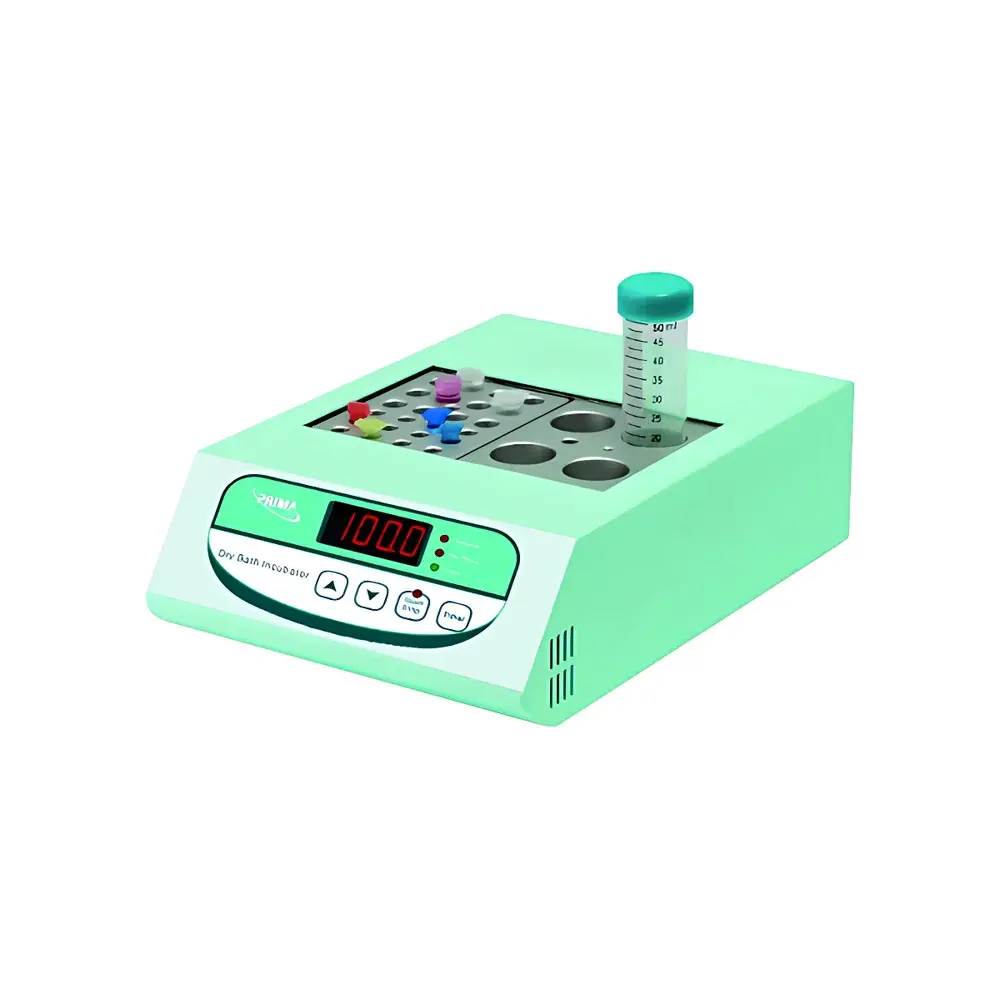
PRIMA (Gop) PMD Series Precision Metal Block Heater with Digital Temperature Control
| Brand | PRIMA (UK) |
|---|---|
| Origin | Taiwan |
| Model | PMD1 / PMD2 |
| Temperature Range | +5°C to 150°C |
| Temperature Accuracy | ±0.1°C |
| Heating Time | ≤25 min (20°C → 100°C) |
| Block Uniformity (within block @37°C) | ≤±0.1°C |
| Inter-block Uniformity (between slots @37°C) | ≤±0.2°C |
| Timer Range | 1–999 min |
| Display Resolution | 0.1°C |
| Power Consumption | 125 W (PMD1), 200 W (PMD2) |
| Dimensions (W×D×H) | 200 × 295 × 80 mm |
| Net Weight | 2.1 kg (PMD1), 2.8 kg (PMD2) |
| Slot Dimensions (per slot) | 80 × 105 × 50 mm |
| Safety Features | Over-temperature cutoff, auto-fault detection with audible alarm, calibration offset adjustment |
Overview
The PRIMA (Gop) PMD Series is a high-stability digital metal block heater engineered for precise, repeatable thermal control of sample tubes in molecular biology, clinical diagnostics, and pharmaceutical quality control laboratories. Unlike traditional water baths or dry baths with poor thermal inertia, the PMD employs solid aluminum heating blocks with optimized thermal mass and embedded Pt100 sensors to deliver rapid heat-up, minimal overshoot, and exceptional spatial uniformity across each module. Its core operating principle relies on closed-loop PID temperature regulation, where real-time feedback from multiple sensor points ensures dynamic compensation for ambient fluctuations and load-dependent thermal drift. Designed for compliance-critical workflows, the system maintains stable setpoints within ±0.1°C at biologically relevant temperatures (e.g., 37°C, 65°C, 95°C) and supports extended incubation up to 150°C for enzyme inactivation or solvent evaporation—making it suitable for applications governed by ISO/IEC 17025, CLIA, and GLP-aligned SOPs.
Key Features
- Dual-configurable platform: PMD1 (single-slot base) and PMD2 (dual-slot base) accommodate interchangeable aluminum modules without tools—enabling rapid reconfiguration between assay formats.
- High-resolution 4-digit LED display with 0.1°C resolution and viewing angle optimization—readable from ≥2 m distance under standard lab lighting.
- Programmable timer (1–999 minutes) with dual alert modes: audible buzzer + gentle vibration—critical for unattended endpoint detection during PCR setup or antigen retrieval.
- On-device temperature offset calibration (±5.0°C range) allows traceable correction against NIST-traceable reference thermometers—supporting internal instrument qualification per FDA 21 CFR Part 11 Annex 11 requirements.
- Integrated safety architecture includes over-temperature cut-off (155°C hardware limit), automatic fault diagnosis (e.g., sensor open-circuit, heater short), and visual/audible alarm escalation.
- Modular block design facilitates autoclaving (121°C, 20 min) and chemical disinfection (70% ethanol, 1% SDS); all contact surfaces are anodized aluminum with corrosion-resistant finish.
Sample Compatibility & Compliance
The PMD series accepts a standardized family of interchangeable aluminum blocks—including PM-13 (13 mm × 47 mm), PM-17 (17 mm × 45 mm), PM-20 (20 mm × 48 mm), PM-25 (25 mm × 45 mm), PM-29 (29 mm × 45 mm), and EP-tube specific inserts (PM-E06 for 0.2 mL, PM-E120 for 0.5 mL, PM-E220 for 1.5/2.0 mL). Each block undergoes thermal mapping per ASTM E2251-22 to verify intra-block uniformity ≤±0.1°C at 37°C and inter-block deviation ≤±0.2°C—data available in Certificate of Conformance shipped with each unit. The device complies with IEC 61010-1:2010 (Safety Requirements for Electrical Equipment for Measurement, Control, and Laboratory Use) and carries CE marking for EMC and LVD directives. No firmware updates require regulatory revalidation; configuration changes are non-invasive and documented via user-accessible log files.
Software & Data Management
While the PMD operates as a standalone benchtop instrument with no mandatory software dependency, optional USB data logging (via PRIMA LabLink Utility v2.1) enables time-stamped export of temperature profiles, timer events, and alarm logs in CSV format. All logged data include UTC timestamps, operator ID fields (configurable), and digital signatures compliant with ALCOA+ principles. Audit trail functionality records every parameter change—including calibration offsets, timer resets, and power cycle events—with immutable timestamps. Data exports meet FDA 21 CFR Part 11 requirements when used with validated Windows OS environments and controlled user access protocols.
Applications
- Enzyme reaction incubation (restriction digests, ligations, kinase assays)
- Cell culture sample warming (serum, media, trypsin)
- Antigen retrieval in immunohistochemistry (IHC) protocols
- DNA/RNA denaturation and hybridization steps
- Standard curve preparation in ELISA and qPCR workflows
- Solvent evaporation pre-concentration (e.g., chloroform, ethanol)
- Calibration of thermocouples and RTDs using fixed-point reference blocks
FAQ
What is the maximum recommended continuous operating temperature?
The PMD is rated for sustained operation up to 150°C; however, prolonged use above 120°C may accelerate thermal aging of O-rings in certain tube types—consult tube manufacturer specifications before exposure.
Can the same block be used interchangeably between PMD1 and PMD2 units?
Yes—all PRIMA PMD-compatible modules (e.g., PM-20, PM-E220) are mechanically and thermally identical and fully cross-compatible across both base models.
Is validation documentation provided for GxP environments?
Each unit ships with a Factory Calibration Report (traceable to UKAS-accredited standards), IQ/OQ templates, and a Risk Assessment Matrix aligned with ISO 14971 for laboratory equipment.
How often should temperature uniformity be verified in routine use?
Per ISO/IEC 17025:2017 Clause 6.4.10, verification is recommended before first use, after relocation, following maintenance, and at defined intervals—typically daily for critical assays or weekly for general use.
Does the PMD support external temperature probes for independent monitoring?
No—the system does not feature analog or digital probe inputs; however, third-party calibrated probes can be inserted into unused wells for parallel verification without affecting block performance.



