
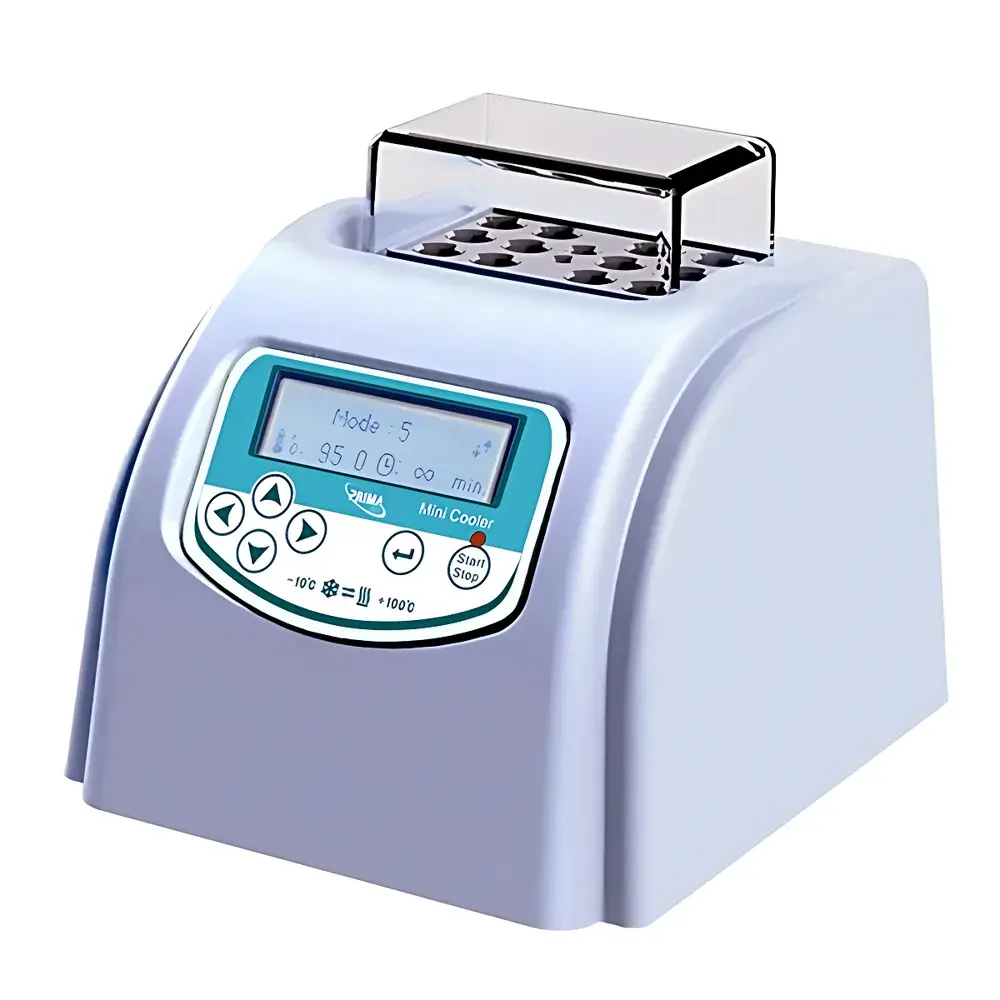
PRIMA PMC Programmable Peltier-Based Metal Block Thermostat
| Brand | PRIMA |
|---|---|
| Origin | Taiwan |
| Model | PMC |
| Temperature Range | -10 to 100 °C |
| Temperature Accuracy | ±0.1 °C |
| Temperature Uniformity @37 °C | ±0.2 °C |
| Temperature Stability @37 °C | ±0.2 °C |
| Max Cooling Rate | 5.5 °C/min |
| Max Heating Rate | 6.0 °C/min |
| Timer Range | 1–9999 min or Continuous |
| Programmable Steps | Up to 4 steps per program, 9 cycles max |
| Power Consumption | 60 W |
| Dimensions (W×D×H) | 185 × 150 × 135 mm |
| Net Weight | 0.6 kg |
| Interface | USB + Bluetooth |
| Safety Features | Over-temperature cutoff, integrated safety lid, auto-shutdown on lid open |
| Module Compatibility | Single interchangeable block (standard footprint: 47 × 71 mm |
| height options | 32 mm or 75 mm) |
| Optional Accessory | 12 V DC car adapter |
Overview
The PRIMA PMC Programmable Peltier-Based Metal Block Thermostat is an engineered thermal control platform designed for precise, repeatable, and rapid temperature management of small-volume biological samples in molecular biology, clinical diagnostics, and pharmaceutical research laboratories. Unlike conventional heating-only metal baths or water baths, the PMC leverages solid-state Peltier thermoelectric modules to deliver bidirectional thermal control—enabling both active cooling down to –10 °C and heating up to 100 °C within a single compact unit. Its core architecture centers on a high-conductivity aluminum heating/cooling block with optimized thermal mass and low thermal inertia, ensuring fast response times (≤6.0 °C/min heating; ≤5.5 °C/min cooling) and exceptional stability (±0.2 °C at 37 °C over time). The device operates without refrigerants or moving parts—eliminating maintenance overhead and enabling silent, vibration-free operation critical for sensitive enzymatic reactions and nucleic acid handling.
Key Features
- Programmable multi-step thermal profiles: Supports up to four user-defined temperature setpoints per cycle, with up to nine repeat cycles—ideal for complex protocols such as touchdown PCR preparation, enzyme restriction-digestion incubation, or hybridization ramping.
- Peltier-based bidirectional temperature control: Delivers true sub-ambient cooling capability (–10 °C) alongside precise heating, eliminating reliance on external chillers or ice baths.
- High-precision digital control system: 0.1 °C resolution display with real-time feedback loop regulation; factory-calibrated and field-adjustable via built-in calibration mode.
- Compact footprint (185 × 150 × 135 mm) and lightweight design (0.6 kg net weight): Optimized for benchtop use in space-constrained environments including biosafety cabinets and mobile lab setups.
- Dual communication interface: Integrated USB and Bluetooth connectivity enable remote parameter configuration, real-time temperature logging, and firmware updates using the PRIMA LabControl Suite (Windows/macOS compatible).
- Comprehensive safety architecture: Includes over-temperature cutoff, automatic shutdown upon lid removal, and a hinged safety lid with silicone gasket to prevent sample contamination and operator contact with hot surfaces.
- Modular block system: Accepts standardized interchangeable aluminum blocks (47 × 71 mm base) in six configurations—including 0.2 mL, 0.5 mL, 1.5/2.0 mL, 15 mL, and 50 mL tube formats—supporting sterilization via autoclaving (121 °C, 20 min) or chemical disinfection.
Sample Compatibility & Compliance
The PMC is validated for consistent thermal performance across common laboratory consumables including microcentrifuge tubes (EP tubes), PCR strips, and conical centrifuge tubes. Its temperature uniformity (±0.2 °C at 37 °C) meets requirements for ISO/IEC 17025-accredited testing labs performing routine QC of enzymatic activity, DNA denaturation, or protein solubilization. While not certified to IEC 61010-1 as a standalone medical device, its electrical safety design complies with EN 61010-1:2010 for laboratory equipment. The unit supports GLP-compliant workflows through audit-trail-capable software logging (via optional PRIMA LabControl Suite v3.2+), and its programmable timer with audible/vibratory alert aligns with USP guidelines for analytical instrument qualification.
Software & Data Management
The PRIMA LabControl Suite provides secure, traceable instrument management via USB or Bluetooth pairing. Users can define, store, and recall thermal programs; export timestamped temperature logs in CSV format; and generate PDF reports with operator ID, date/time stamps, and deviation flags. Software features include password-protected administrator mode, electronic signature support (21 CFR Part 11 compliant when deployed with validated IT infrastructure), and version-controlled firmware update capability. All data files are stored locally—no cloud transmission—ensuring compliance with institutional data sovereignty policies.
Applications
- Enzyme reaction incubation: Restriction digests, ligations, phosphatase treatments, and kinase assays requiring strict thermal fidelity between 4 °C and 65 °C.
- Nucleic acid processing: DNA denaturation (95 °C), annealing (55–65 °C), and storage at –10 °C for cold-sensitive restriction enzymes.
- Protein biochemistry: PAGE sample preparation, SDS solubilization, and antibody incubation during Western blotting.
- Clinical sample handling: Stabilization of whole blood, serum, or plasma prior to centrifugation or ELISA setup.
- Hybridization protocols: Stringent temperature control for Northern/Southern blotting and in situ hybridization pre-wash steps.
- Field-deployable QC: Enabled by optional 12 V DC car adapter for mobile diagnostic units or point-of-care validation.
FAQ
What is the maximum number of temperature steps supported in a single program?
The PMC supports up to four sequential temperature setpoints per program, with up to nine full-cycle repetitions.
Can the heating/cooling block be autoclaved?
Yes—the aluminum blocks are rated for autoclaving at 121 °C for 20 minutes. Ensure complete drying before reinstallation.
Is temperature calibration traceable to NIST standards?
Factory calibration is performed using NIST-traceable reference thermometers; users may perform two-point field calibration using certified RTD probes.
Does the device meet electromagnetic compatibility (EMC) requirements for shared lab environments?
Yes—it conforms to EN 61326-1:2013 for EMC emission and immunity in laboratory settings.
What happens if the safety lid is opened during operation?
The unit immediately halts heating/cooling and displays a “LID OPEN” warning until the lid is fully closed and acknowledged.



