
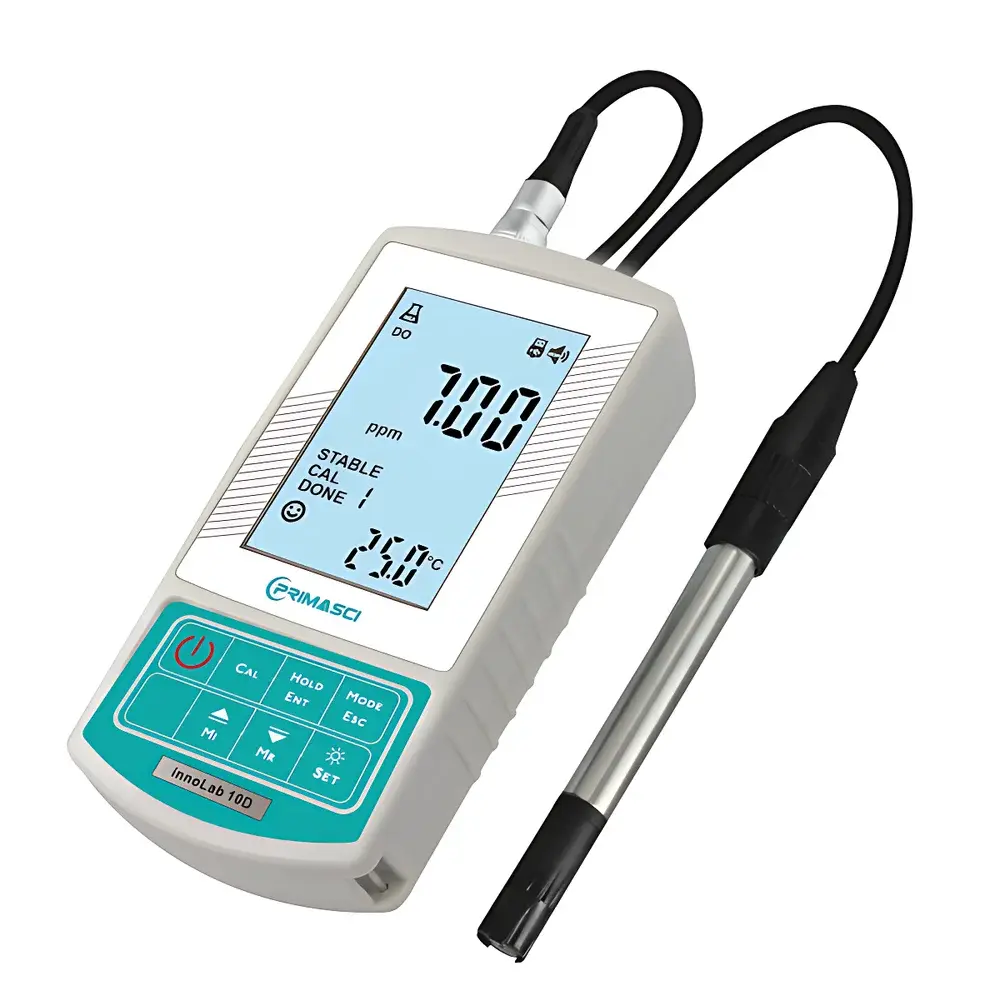
PRIMASCI innoLab 10D Portable Dissolved Oxygen Meter
| Brand | PRIMASCI |
|---|---|
| Origin | Taiwan |
| Model | innoLab 10D |
| Instrument Type | Portable/Handheld Water Quality Analyzer |
| Measuring Parameter | Dissolved Oxygen (DO) |
| Measurement Range | 0.00–40.00 mg/L & 0–400.0% saturation |
| Resolution | 0.01 mg/L, 0.1%, 0.1 °C / 0.1 °F |
| Accuracy | ±1.5% of full scale, ±0.3 °C / ±0.5 °F |
| Temperature Compensation Range | 0.0–60.0 °C (auto/manual) |
| Calibration | 1- or 2-point automatic calibration |
| Salinity Compensation | 0.0–45.0 ppt |
| Atmospheric Pressure Compensation | 450–800 mmHg (0.600–1.100 bar) |
| Hydrostatic Pressure Compensation | 0.00–1.00 kg/cm² |
| Depth Compensation | 0.0–10.0 m |
| Data Storage | 100 measurement records |
| Auto Power-Off | Selectable (10 min inactivity) |
| Power Supply | 2 × 1.5 V AA batteries (>500 h operation) |
| Electrode Options | Clark-type polarographic or galvanic cell DO sensor |
| IP Rating | IP67 |
| Dimensions | 73 × 152 × 42 mm (W × L × H) |
| Weight | 250 g |
Overview
The PRIMASCI innoLab 10D Portable Dissolved Oxygen Meter is an engineered field and laboratory instrument designed for precise, real-time quantification of dissolved oxygen (DO) concentration and saturation percentage in aqueous media. It operates on electrochemical sensing principles—supporting either Clark-type polarographic or galvanic cell oxygen electrodes—both of which generate a current proportional to the partial pressure of molecular oxygen diffusing across a gas-permeable membrane. The device integrates differential signal circuitry to minimize electromagnetic interference, ensuring stable output in electrically noisy environments such as wastewater treatment plants or aquaculture facilities. Its dual-mode measurement capability (mg/L and % saturation), combined with comprehensive environmental compensation algorithms—including temperature, salinity, atmospheric pressure, hydrostatic pressure, and depth—enables traceable, context-aware DO reporting aligned with ISO 5814:2012 (water quality — determination of dissolved oxygen — electrochemical probe method) and ASTM D888-22 (standard test methods for dissolved oxygen in water). Designed for routine compliance monitoring and process verification, the innoLab 10D meets functional requirements for GLP-aligned data integrity when used with documented electrode calibration and parameter logging.
Key Features
- IP67-rated enclosure for dust-tight and immersion-resistant operation (up to 1 m for 30 min), suitable for outdoor and industrial deployment.
- 43 × 70 mm high-contrast LCD display with 120° viewing angle and backlight for readability under variable ambient lighting conditions.
- Differential analog front-end architecture minimizes noise coupling from pumps, motors, or RF sources during field measurements.
- Configurable unit selection: dissolved oxygen expressed as mg/L (ppm) or % saturation relative to air-saturated water at user-defined temperature, salinity, and pressure.
- Multi-parameter compensation engine: automatic correction for temperature (0.0–60.0 °C), salinity (0.0–45.0 ppt), barometric pressure (450–800 mmHg), pipeline pressure (0.00–1.00 kg/cm²), and liquid depth (0.0–10.0 m).
- Comprehensive electrode diagnostics: real-time display of offset, slope, number of calibration points, and electrode health indicator based on polarization stability and response time.
- HOLD function with STABLE visual confirmation ensures recording only after signal convergence (±0.02 mg/L over 3 s).
- On-device storage of up to 100 timestamped measurements, exportable via optional USB interface (not included) for post-processing in Excel or LIMS-compatible formats.
- Ergonomic handheld chassis with textured grip surface, optimized weight distribution (250 g), and recessed electrode/temperature probe bay for secure transport.
- User-configurable auto-power-off (10 min inactivity) and extended battery life (>500 h on two AA alkaline cells) support multi-shift field campaigns without recharging infrastructure.
Sample Compatibility & Compliance
The innoLab 10D is validated for use with freshwater, seawater, wastewater effluents, aquaculture ponds, drinking water distribution systems, and bioreactor broths. Its galvanic and polarographic electrode options accommodate differing maintenance protocols and zero-oxygen baseline stability requirements: galvanic sensors offer rapid startup and no warm-up delay; Clark-type electrodes provide higher long-term precision in low-oxygen environments (<1 mg/L) when maintained per ISO 15839:2018 (water quality — sensors for measuring physico-chemical parameters — specifications and performance testing). All calibrations follow a documented 1- or 2-point procedure using air-saturated water (100% saturation) and zero-oxygen solution (sodium sulfite), satisfying internal QA/QC protocols and supporting audit readiness under ISO/IEC 17025:2017 clause 7.7 (ensuring validity of results). Device firmware logs calibration events, operator ID (if entered), and environmental parameters—facilitating traceability in regulated settings including municipal water utilities compliant with EPA Method 360.1 and EU Directive 2000/60/EC.
Software & Data Management
While the innoLab 10D operates as a standalone instrument, its memory module supports sequential recall and manual transcription into laboratory notebooks or digital logbooks. For structured data governance, optional PC software (available separately) enables CSV export of stored records with metadata: date/time stamp, DO value, temperature, salinity, pressure input, electrode type, and calibration status flags. Audit trail features include immutable timestamps and operator annotation fields. When deployed in GxP environments, users may configure the device within a broader data integrity framework consistent with FDA 21 CFR Part 11 requirements—leveraging external validation documentation, change control procedures, and electronic signature workflows implemented at the organizational level.
Applications
- Drinking water treatment: verification of DO levels post-aeration and pre-distribution to prevent microbial regrowth.
- Aquaculture management: continuous monitoring of pond and tank oxygenation to optimize feed conversion ratios and reduce mortality.
- Wastewater process control: tracking DO gradients in activated sludge basins to maintain nitrification/denitrification balance.
- Environmental field surveys: profiling DO stratification in lakes, rivers, and estuaries alongside temperature and conductivity.
- Research laboratories: kinetic studies of oxygen consumption in BOD incubations or respirometry assays.
- Industrial cooling water systems: detecting hypoxic zones indicative of biofilm formation or corrosion risk.
FAQ
What electrode types are compatible with the innoLab 10D?
The instrument supports both Clark-type polarographic and galvanic cell dissolved oxygen sensors. Electrode selection depends on application-specific needs: galvanic sensors require no polarization time and are ideal for rapid field checks; Clark-type sensors deliver superior accuracy below 1 mg/L and are preferred for regulatory-grade reporting.
Does the device meet international calibration standards?
Yes—the innoLab 10D implements calibration routines aligned with ISO 5814:2012 and ASTM D888-22. Two-point calibration (zero and air-saturated) is recommended for critical applications, and all calibration parameters—including temperature, salinity, and pressure—are recorded in device memory.
Can the innoLab 10D be used in seawater?
Yes, provided salinity is manually entered (0.0–45.0 ppt) prior to measurement. The built-in salinity compensation algorithm adjusts the saturation coefficient according to Weisbach’s empirical model, improving accuracy in marine and brackish environments.
Is temperature compensation automatic?
Temperature compensation is configurable as either automatic (using integrated NTC thermistor) or manual entry. Automatic mode is enabled by default and operates across 0.0–60.0 °C, covering most natural and engineered aquatic systems.
How is data integrity ensured during field use?
Each stored record includes embedded environmental context (T, S, P), electrode identification, and calibration verification flags. Combined with IP67 ruggedization and stable electronics design, this ensures reproducible measurements across operators and locations—essential for inter-laboratory comparability and regulatory submissions.







