
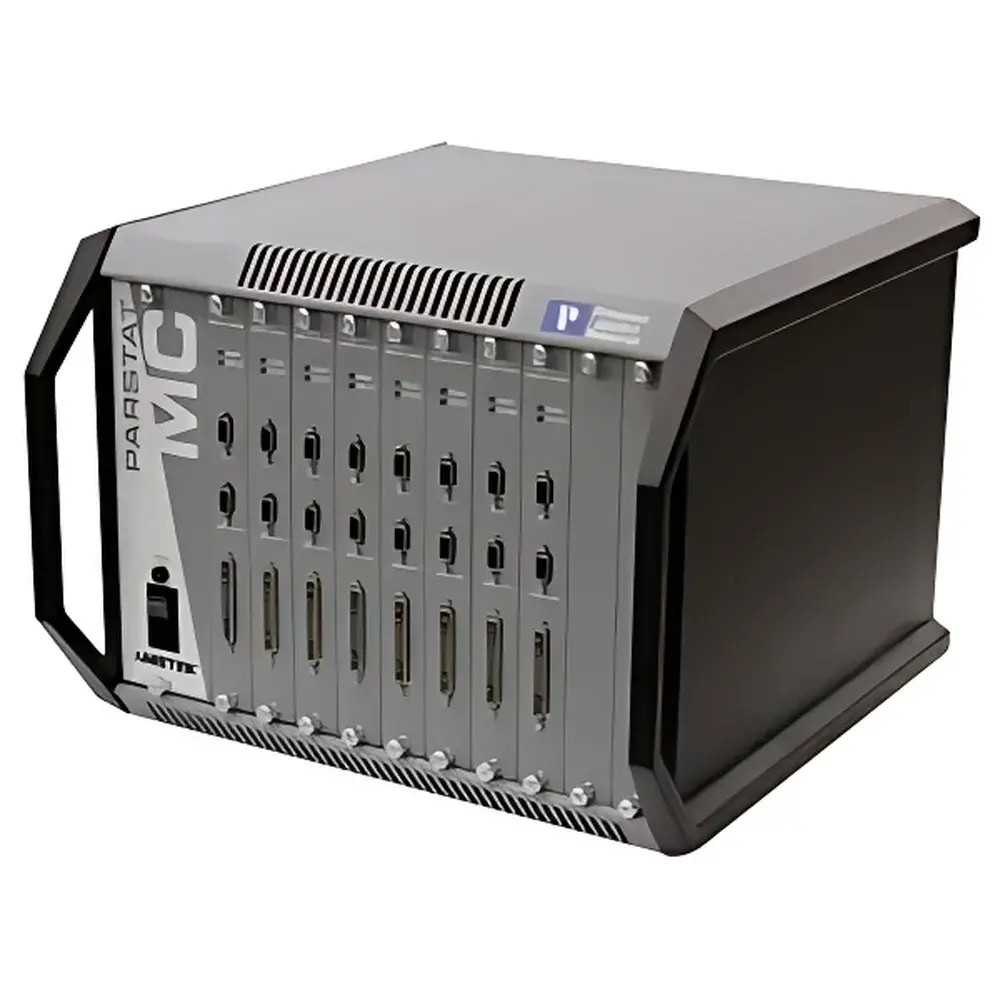
Princeton Applied Research PARSTAT MC Multi-Channel Electrochemical Workstation
| Brand | Princeton Applied Research |
|---|---|
| Origin | USA |
| Model | PMC2000 / PMC1000 / PMC200 |
| Instrument Type | Multi-Channel Electrochemical Workstation |
| Number of Channels | Up to 8 independent, hot-swappable channels per mainframe |
| Current Range | ±2 A |
| Current Accuracy | ±0.2% |
| Potential Accuracy | ±0.2% |
| Potentiostatic Range | ±30 V |
| EIS Frequency Range | 10 MHz to 10 µHz |
| Data Acquisition Rate | up to 500 kS/s (per channel) |
| Auxiliary Voltage Input | 6-wire Kelvin sensing |
| Resolution (PMC1000) | 120 fA |
| Impedance Scan Range | 10 µHz – 7 MHz (with PMC2000 module) |
| Floating Ground Architecture | Standard |
Overview
The Princeton Applied Research PARSTAT MC is a modular, multi-channel electrochemical workstation engineered for high-fidelity, parallel electrochemical characterization in research and industrial laboratories. Built upon over five decades of expertise in potentiostat/galvanostat design and electrochemical instrumentation, the PARSTAT MC implements a true distributed architecture—each channel operates as an autonomous, fully functional electrochemical measurement unit with independent control, timing, and signal conditioning. Its core measurement principle adheres to the three-electrode potentiostatic/galvanostatic configuration, supporting standard DC techniques (cyclic voltammetry, chronoamperometry, chronopotentiometry), pulsed methods (pulse voltammetry, square-wave voltammetry), and frequency-domain analysis via electrochemical impedance spectroscopy (EIS). The system’s floating ground design enables simultaneous measurements across multiple working electrodes within a single electrochemical cell—critical for battery electrode screening, corrosion coupon arrays, or sensor array validation—without galvanic coupling or shared reference interference.
Key Features
- Modular scalability: Up to eight independent channels per mainframe; channels can be added incrementally without system downtime.
- Hot-swap capability: Individual channel modules (PMC2000, PMC1000, PMC200) may be installed or removed during active experiments on other channels—no interruption to ongoing measurements.
- Wide dynamic range: PMC1000 module delivers 120 fA current resolution and ±2 A full-scale range; PMC2000 extends potentiostatic control to ±30 V with EIS coverage from 10 µHz to 7 MHz.
- High-speed acquisition: Synchronized data capture at up to 500 kS/s per channel, enabling transient analysis of fast electrochemical processes such as nucleation events or double-layer charging kinetics.
- Kelvin-connected auxiliary inputs: Six-wire voltage sensing supports accurate potential monitoring across series-connected cells or segmented electrodes—essential for battery pack diagnostics and fuel cell stack testing.
- Floating ground architecture: Eliminates ground-loop constraints, permitting concurrent measurements on electrically isolated electrodes in shared electrolyte environments.
Sample Compatibility & Compliance
The PARSTAT MC accommodates standard three-electrode configurations (working, counter, reference) as well as two-electrode and four-terminal setups. It supports aqueous, non-aqueous, and molten salt electrolytes, and is routinely deployed in battery R&D (Li-ion, solid-state, Na-ion), corrosion science (ASTM G5/G59/G102), electrocatalysis (HER/OER/ORR), and biosensor development. Hardware and firmware comply with IEC 61010-1 safety standards for laboratory electrical equipment. When operated with VersaStudio software under configured audit trails and user access controls, the system supports GLP and GMP-aligned workflows—including 21 CFR Part 11-compliant electronic signatures and immutable experiment logs—making it suitable for regulated quality control and pharmaceutical electrochemical method validation.
Software & Data Management
VersaStudio is the native, Windows-based application for instrument control, experiment sequencing, real-time visualization, and post-acquisition analysis. It provides hierarchical project management, scriptable experiment templates (via Python API integration), and built-in models for EIS fitting (e.g., Randles, transmission line, constant phase elements). Raw data are stored in vendor-neutral binary format (.par) with embedded metadata (timestamp, calibration ID, hardware configuration), exportable to CSV, MATLAB (.mat), or ASCII. Version-controlled experiment protocols, automated calibration logging, and role-based user permissions ensure traceability and reproducibility—key requirements for ISO/IEC 17025-accredited testing laboratories.
Applications
- Battery material screening: Parallel cycling of multiple cathode/anode composites under identical thermal and SOC conditions.
- Corrosion mapping: Simultaneous polarization resistance and EIS on spatially distributed coupons in a single tank.
- Electrocatalyst evaluation: High-throughput comparison of turnover frequency (TOF) and stability metrics across catalyst libraries.
- Electrochemical sensor development: Real-time response profiling of arrayed biosensors under varying analyte concentrations.
- Fuel cell membrane testing: Independent monitoring of local potential gradients across MEA segments using auxiliary voltage inputs.
- Electrodeposition process optimization: Synchronized chronoamperometric monitoring of nucleation onset across substrate zones.
FAQ
Can the PARSTAT MC perform EIS on all channels simultaneously?
Yes—each channel executes independent, time-synchronized EIS scans with user-defined frequency lists and amplitude parameters.
Is external synchronization (e.g., with a potentiostat trigger or DAQ system) supported?
The system includes TTL-compatible trigger I/O ports for hardware-level synchronization with auxiliary equipment such as optical spectrometers or temperature controllers.
Does the floating ground architecture require special cabling or shielding?
No—standard coaxial or triaxial cables are used; however, proper star-grounding practices and separation of analog/digital grounds are recommended for optimal noise rejection.
How is calibration maintained across multiple channels?
Each channel undergoes factory calibration with NIST-traceable references; user-accessible calibration verification routines are available in VersaStudio, and recalibration can be performed per-module without affecting others.
Can the system interface with third-party automation platforms (e.g., LabVIEW, Python, MATLAB)?
Yes—COM and .NET APIs are provided, along with documented SCPI command sets, enabling integration into robotic sample-handling systems or custom data pipelines.
Related Products





