
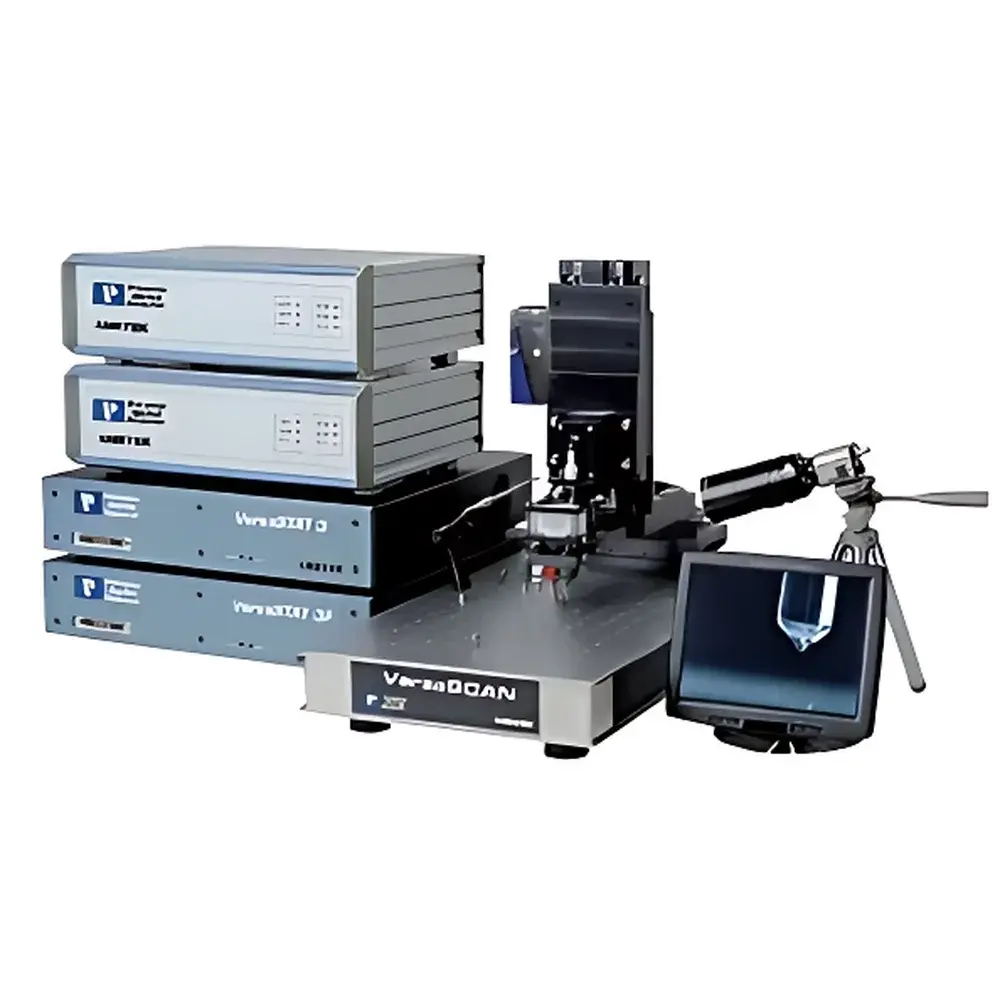
Princeton Applied Research VersaSCAN Micro-Region Electrochemical Scanning System
| Brand | Princeton Applied Research |
|---|---|
| Origin | USA |
| Manufacturer Type | Authorized Distributor |
| Origin Category | Imported |
| Model | VersaSCAN |
| Instrument Type | Electrochemical Workstation |
| Channel Count | Single-Channel |
| Current Range | ±2 A |
| Current Accuracy | ±0.2% |
| Potential Accuracy | ±0.2% |
| Potentiostatic Range | ±10 V |
| EIS Frequency Range | 10 µHz – 1 MHz |
Overview
The Princeton Applied Research VersaSCAN Micro-Region Electrochemical Scanning System is a precision-engineered platform for spatially resolved electrochemical characterization at the microscale. Built upon scanning probe electrochemistry principles, it enables non-contact, high-resolution mapping of local electrochemical activity—including current, impedance, surface potential, and topography—without physical contact between probe and sample. The system integrates a closed-loop, high-accuracy XYZ positioning stage with sub-micrometer repeatability, mounted on a vibration-isolated optical table to ensure measurement stability during long-duration scans. At its core, the VersaSCAN couples the VersaSTAT potentiostat/galvanostat with the Signal Recovery 7230 lock-in amplifier via Ethernet-based real-time control, enabling low-noise detection of weak faradaic and capacitive signals across ultra-low frequencies (down to 10 µHz). Its modular architecture supports multiple standardized scanning probe techniques, each requiring specific probe configurations and signal conditioning pathways, all coordinated through unified software control.
Key Features
- Modular scanning probe platform supporting SECM, AC-SECM, SVET, SKP, LEIS, SDC, OSP, and ISP methodologies
- Closed-loop XYZ nanopositioning stage with ≤100 nm step resolution and thermal drift compensation
- Integrated VersaSTAT potentiostat (±2 A current range, ±0.2% accuracy) and 7230 lock-in amplifier for phase-sensitive detection
- Non-contact operation: probes operate in proximity mode (typically 1–100 µm above sample), eliminating mechanical wear and surface perturbation
- Ethernet-based synchronization ensures deterministic timing between position updates and electrochemical acquisition
- Configurable auxiliary modules: piezoelectric vibration units for SVET, Kelvin probe tips for work function mapping, laser displacement sensors for OSP, and ion-selective microelectrodes for surface ion concentration profiling
Sample Compatibility & Compliance
The VersaSCAN accommodates flat or gently curved conductive and semiconductive samples up to 150 mm in diameter, including metals (e.g., stainless steel, aluminum, zinc-coated steel), coated substrates (epoxy, polyurethane, sol-gel), semiconductor wafers, and functionalized monolayers (e.g., silane L-B films). Sample mounting is compatible with standard electrochemical cells (e.g., three-electrode configuration) and custom environmental chambers for humidity, gas, or thin-electrolyte film control. The system complies with ASTM G102 (calculation of corrosion rates), ASTM G59 (potentiodynamic polarization), ASTM G106 (electrochemical impedance spectroscopy), and ISO 16773 (localized corrosion assessment). Data acquisition and instrument control support audit trails and electronic signatures per FDA 21 CFR Part 11 requirements when deployed in GLP/GMP-regulated environments.
Software & Data Management
Control and analysis are performed using VersaStudio software, a Windows-based application offering scriptable experiment sequencing, real-time 2D/3D visualization, and post-acquisition spectral fitting (e.g., equivalent circuit modeling for LEIS data). Raw position-synchronized datasets are stored in HDF5 format with embedded metadata (timestamp, calibration parameters, hardware configuration). Export options include CSV, MATLAB .mat, and ImageJ-compatible TIFF stacks. The software supports batch processing for multi-region mapping and includes built-in tools for baseline correction, noise filtering, and spatial derivative computation (e.g., current gradient maps for anodic/cathodic site identification). All user actions—including method loading, parameter changes, and data export—are logged with timestamps and operator IDs for traceability.
Applications
- In situ monitoring of pitting initiation and propagation on stainless steel and aluminum under simulated atmospheric conditions
- Quantitative assessment of coating defect density, delamination kinetics, and interfacial degradation at metal/polymer boundaries
- Mechanistic study of filiform corrosion on aluminum alloys via localized pH and oxygen activity mapping
- Distribution analysis of Volta potential across heat-affected zones of welded stainless steels using SKP
- Mapping of cathodic and anodic domains on carbon steel during wet-dry cycling using SVET
- Characterization of oxygen reduction reaction (ORR) heterogeneity beneath thin electrolyte layers via LEIS and AC-SECM
- Performance evaluation of vapor-phase corrosion inhibitors by tracking time-resolved changes in local corrosion potential
- Stress corrosion cracking (SCC) susceptibility screening via micro-scale potential gradient analysis at notch tips or grain boundaries
- Surface cleanliness verification of semiconductor substrates and precision-machined metallic components using ion-selective probe imaging
- Electrochemical sensor development and validation through spatially resolved sensitivity and selectivity profiling
FAQ
What scanning probe techniques does the VersaSCAN support out-of-the-box?
SECM, AC-SECM, SVET, SKP, LEIS, SDC, OSP, and ISP—all require appropriate probe hardware and calibration but share the same positioning and control infrastructure.
Can the system perform simultaneous multi-technique mapping?
Yes; dual-probe configurations (e.g., SKP + LEIS) are supported via synchronized scan routines and time-multiplexed signal acquisition.
Is the VersaSCAN compatible with corrosive or high-temperature environments?
Standard operation is ambient temperature and aqueous/non-aqueous electrolytes; optional environmental chambers extend capability to controlled humidity, gas composition, and temperatures from −20 °C to +80 °C.
How is positional accuracy verified and maintained over extended measurements?
The closed-loop stage incorporates capacitive position feedback and automatic thermal drift compensation; NIST-traceable calibration artifacts enable routine verification of XY linearity and Z repeatability.
Does the system meet regulatory requirements for pharmaceutical or medical device testing?
When configured with 21 CFR Part 11-compliant software settings and documented validation protocols, it supports electrochemical characterization in regulated quality control laboratories.
Related Products





