
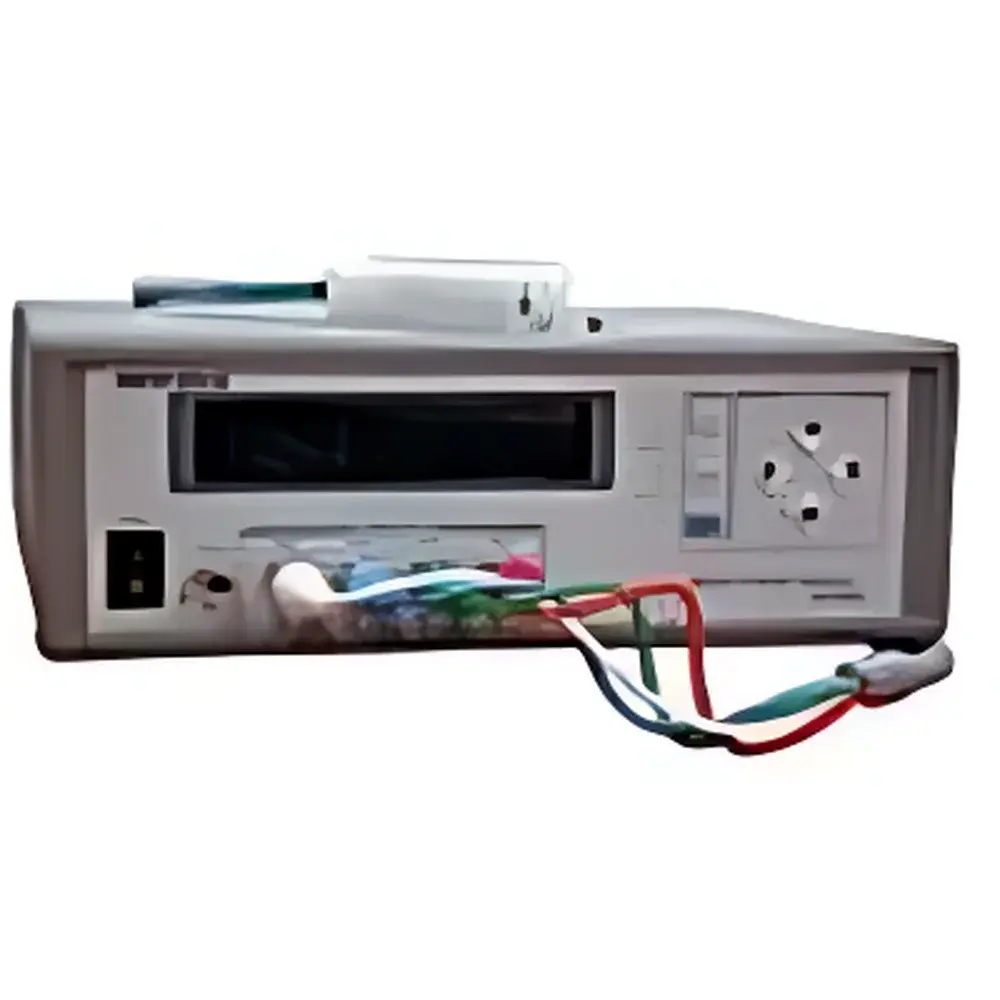
Princeton Instruments QCM 922 Quartz Crystal Microbalance
| Brand | Princeton Instruments |
|---|---|
| Origin | USA |
| Model | QCM 922 |
| Frequency Range | 1–10 MHz |
| Frequency Resolution | 0.1 Hz |
| Resonance Resistance Range | 10–16 kΩ (0.1 Ω resolution) |
| Electrode Area | 0.2 cm² |
| Electrode Material | Sputtered Au or Pt (300 nm thickness) |
| Crystal Fundamental Frequency | 9 MHz |
| Operating Temperature | 0–40 °C |
| Power Supply | 100–120 VAC / 230–240 VAC, 50–60 Hz, 15 W |
| Interface | IEEE-488 (GPIB), RS-232 |
| Analog Outputs | ±10 V (12-bit), selectable impedance scaling (1/2/4/8/16 kΩ) |
| Display | 40-character × 2-line LCD |
| Dimensions | 26 × 88 × 230 mm |
| Weight | 3.3 kg |
| Software Compatibility | Windows 95/98, ≥100 MHz CPU, 32 MB RAM, 10 MB HDD, GPIB interface card required |
Overview
The Princeton Instruments QCM 922 Quartz Crystal Microbalance is a precision electrochemical transduction instrument engineered for real-time, label-free monitoring of nanogram-level mass changes at solid–liquid or solid–gas interfaces. It operates on the principle of piezoelectric resonance: when a thin-film quartz crystal (typically 9 MHz fundamental frequency) is excited in its thickness-shear mode, its resonant frequency shifts linearly with mass loading on the electrode surface—governed by the Sauerbrey equation: ΔF = −2.6 × 10⁶ × F₀² × ΔM / A, where ΔF is frequency shift (Hz), F₀ is the fundamental resonant frequency (MHz), ΔM is mass change (g), and A is the active electrode area (cm²). This physical relationship enables quantitative tracking of electrochemical deposition, desorption, intercalation/deintercalation, polymer film growth, and adsorption kinetics—without optical or radioactive labeling. The QCM 922 integrates seamlessly into electrochemical workstations, supporting simultaneous acquisition of electrochemical signals (e.g., current, potential) and mass-sensitive frequency/resistance data—making it indispensable for mechanistic studies in battery materials, corrosion science, biosensor development, and functional polymer synthesis.
Key Features
- Simultaneous dual-parameter measurement: real-time tracking of both resonance frequency (ΔF) and motional resistance (Rm)—enabling discrimination between purely mass-driven shifts and viscoelastic contributions.
- High-resolution frequency detection (0.1 Hz) over a broad operational range (1–10 MHz), calibrated at 9 MHz for optimal sensitivity with standard AT-cut quartz crystals.
- Dual analog outputs: ±10 V (12-bit) for both frequency deviation and resonance resistance, compatible with external data acquisition systems and lock-in amplifiers.
- Front-panel LCD display (40 × 2 characters) for immediate readout of f0, Δf, Rm, and system status—minimizing reliance on host PC during preliminary setup or troubleshooting.
- Robust mechanical architecture: compact benchtop design (26 × 88 × 230 mm; 3.3 kg) with thermally stable housing, suitable for integration into gloveboxes, environmental chambers, or standard electrochemical cells.
- Flexible connectivity: IEEE-488 (GPIB) and RS-232 interfaces support automated control in regulated laboratory environments compliant with GLP/GMP documentation requirements.
Sample Compatibility & Compliance
The QCM 922 accommodates standard 9 MHz AT-cut quartz crystals with sputtered gold or platinum electrodes (300 nm thickness, 0.2 cm² active area), available in both standard and mirror-polished finishes to minimize scattering artifacts in high-viscosity or particulate-containing media. Its acid- and alkali-resistant crystal holder permits direct immersion in aggressive electrolytes (e.g., concentrated H₂SO₄, KOH, LiPF₆-based carbonate solutions) without degradation. The instrument meets IEC 61010-1 safety standards for laboratory electrical equipment and supports audit-ready data capture when used with compliant software (e.g., WinEchem with timestamped metadata logging). While not intrinsically certified for hazardous-area use, its low-power design (15 W) and isolated analog outputs facilitate safe operation in Class I, Division 2 environments when integrated with appropriate enclosures.
Software & Data Management
The QCM 922 supports two primary software environments: (1) WinEchem, a dedicated platform enabling standalone QCM operation—including real-time plotting of Δf(t) and Rm(t), baseline drift correction, and batch export to CSV or ASCII formats; and (2) PowerSuite, which enables synchronized control of PAR potentiostats/galvanostats alongside QCM data acquisition—critical for correlating charge transfer (Q) with mass uptake (ΔM) in Faradaic processes. Both packages generate time-stamped datasets with embedded instrument configuration parameters (e.g., crystal ID, calibration constants, temperature), satisfying traceability requirements under ISO/IEC 17025 and FDA 21 CFR Part 11 when deployed with electronic signature-enabled workflows. Raw frequency and resistance values are stored at user-defined sampling intervals (down to 100 ms), with no internal data compression or interpolation applied—preserving full fidelity for post-acquisition Fourier analysis or model fitting.
Applications
- Electrodeposition kinetics of metals (Cu, Ni, Zn) and alloys in aqueous and non-aqueous electrolytes.
- In situ monitoring of solid-electrolyte interphase (SEI) formation on lithium-ion battery anodes and cathodes.
- Quantification of protein adsorption, DNA hybridization, and antibody–antigen binding on functionalized sensor surfaces.
- Real-time characterization of conducting polymer growth (e.g., polyaniline, PEDOT) during electropolymerization.
- Corrosion inhibitor film formation and breakdown dynamics on steel or aluminum substrates.
- Gas-phase sensing of volatile organic compounds (VOCs) using coated quartz resonators in controlled humidity environments.
FAQ
What is the minimum detectable mass change for the QCM 922?
Under ideal conditions (9 MHz crystal, 0.2 cm² electrode, low-noise environment), the theoretical mass resolution is ~0.1 ng/cm²—corresponding to sub-monolayer coverage of small molecules.
Can the QCM 922 be used in non-aqueous electrochemical systems?
Yes—provided the quartz crystal and electrode coating are chemically compatible with the solvent/electrolyte (e.g., Au-coated crystals are stable in acetonitrile, propylene carbonate, and DME-based Li-salt solutions).
Is temperature control supported natively?
The QCM 922 does not include integrated thermal regulation, but its operating range (0–40 °C) allows coupling with external Peltier stages or thermostatted cells; frequency drift compensation algorithms are available in WinEchem.
How is calibration performed?
Calibration relies on the Sauerbrey relationship and requires prior knowledge of the crystal’s fundamental frequency (F₀) and active area (A); certified reference crystals with traceable F₀ and A values are recommended for quantitative work.
Does the instrument support multi-harmonic QCM (e.g., 3rd, 5th overtone) measurements?
No—the QCM 922 is optimized for fundamental-mode (1st harmonic) operation at 9 MHz; overtone analysis requires specialized broadband impedance analyzers or network analyzers.




