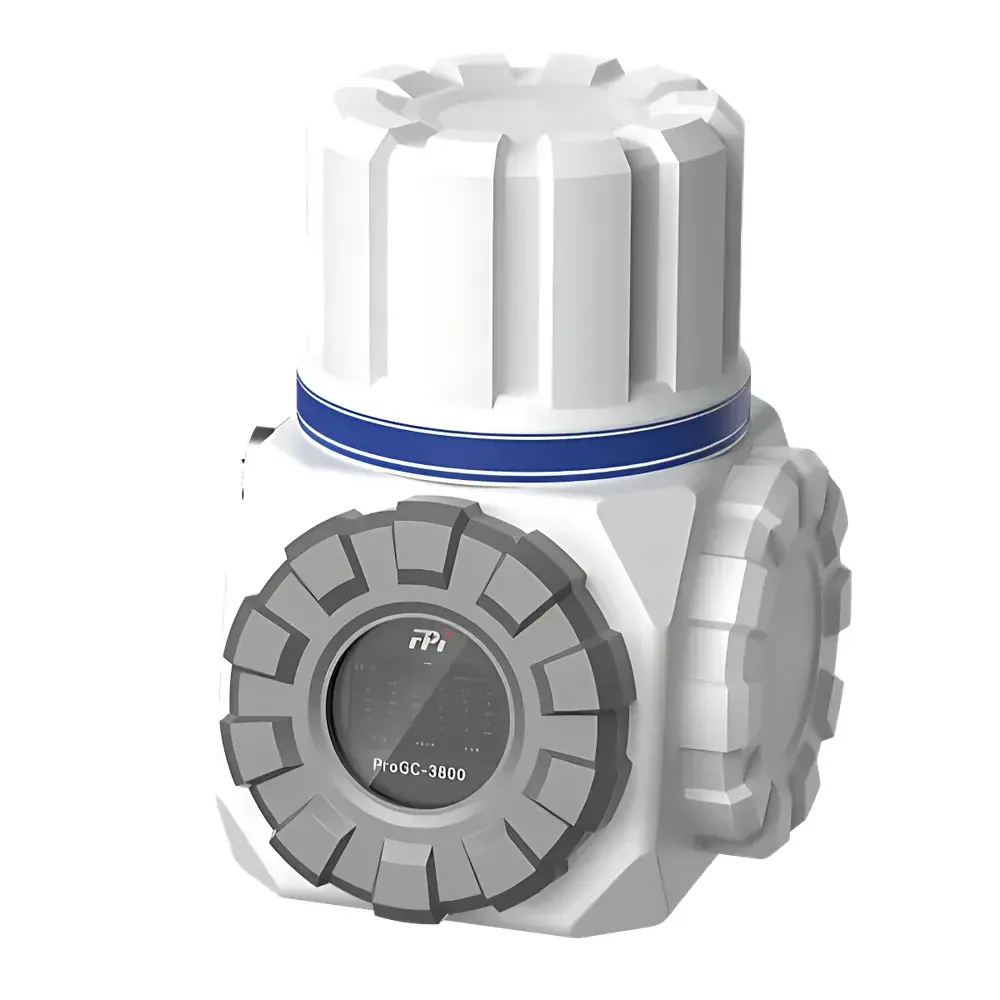
ProGC-3800 Online Gas Chromatograph by FPI (Hangzhou Focus Photonics)
| Brand | FPI (Focus Photonics Inc.) |
|---|---|
| Origin | Zhejiang, China |
| Manufacturer Type | Original Equipment Manufacturer (OEM) |
| Country of Origin | China |
| Model | ProGC-3800 |
| Pricing | Available Upon Request |
| Explosion Protection Rating | Ex d IIC T6 Gb |
| Ingress Protection Rating | IP65 |
| Column Oven Thermal Stability | ±0.01 °C |
| Detector Compatibility | TCD, FID, FPD, PDD |
| Primary Application Domain | Natural Gas Process Monitoring |
Overview
The ProGC-3800 Online Gas Chromatograph is an industrial-grade, continuous-process analytical instrument engineered for real-time compositional analysis of gaseous streams in demanding production environments. Based on proven gas chromatography (GC) separation principles—where sample components are partitioned between a mobile gas phase (carrier gas) and a stationary phase coated inside fused-silica capillary or packed columns—the ProGC-3800 delivers high-resolution, repeatable quantification of hydrocarbons (C1–C6+), permanent gases (H₂, O₂, N₂, CO, CO₂), sulfur compounds (H₂S, COS, mercaptans), and trace impurities in natural gas, refinery off-gas, syngas, and biogas applications. Its fully integrated design eliminates external sampling interfaces prone to condensation or adsorption losses, enabling direct installation at process taps with minimal dead volume and sub-minute cycle times. The system operates under continuous unattended mode, meeting the operational rigor required for ISO 8573-5-compliant gas quality assurance and custody transfer verification.
Key Features
- Fully domesticated critical GC subsystems—including micro-machined valves, precision pressure controllers, thermally stabilized detectors, and column oven assemblies—with 100% indigenous intellectual property and zero reliance on imported core components.
- Intrinsically robust mechanical architecture featuring full flameproof enclosure (Ex d IIC T6 Gb per IEC 60079-1), certified for Zone 1 hazardous areas; combined with IP65-rated ingress protection, enabling direct outdoor deployment without auxiliary shelters or climate-controlled enclosures.
- Modular detector bay supporting hot-swappable configurations of thermal conductivity (TCD), flame ionization (FID), flame photometric (FPD), and pulsed discharge helium ionization (PDD) detectors—enabling method-specific optimization for sulfur speciation, hydrocarbon group-type analysis, or ultra-trace impurity detection down to sub-ppb levels.
- Vacuum-insulated column oven with dual-zone PID control and active thermal mass compensation, achieving long-term temperature stability of ±0.01 °C across a 35–200 °C operating range—critical for retention time reproducibility and calibration longevity in fluctuating ambient conditions.
- Integrated carrier gas management with electronic pressure control (EPC), automated leak-check routines, and optional zero-air/purified helium generation modules to ensure consistent elution kinetics and minimize downtime from gas supply interruptions.
Sample Compatibility & Compliance
The ProGC-3800 accepts pressurized gas samples within 0.1–1.0 MPa(g) range, conditioned via stainless-steel sample loops, heated transfer lines (up to 180 °C), and particulate/moisture filtration stages compliant with ISO 8573-1 Class 2 purity requirements. It supports ASTM D1945, D1946, D6299, ISO 6974-1/2/5, and GPA 2261 methodologies for natural gas analysis. All firmware and data handling protocols adhere to GLP/GMP-aligned audit trail requirements, with optional 21 CFR Part 11 compliance packages available for regulated utility and LNG export facilities.
Software & Data Management
Control and data acquisition are managed through FPI’s proprietary ChromoView™ SCADA-integrated software platform, running on a ruggedized embedded Linux controller. The interface provides real-time chromatogram visualization, automatic peak integration using iterative Gaussian deconvolution, multi-point calibration curve management with R² validation, and configurable alarm thresholds tied to process safety limits. Raw data and metadata—including instrument status logs, maintenance timestamps, and detector response factors—are stored in vendor-neutral HDF5 format and exportable to LIMS via OPC UA or Modbus TCP. Remote diagnostics, firmware updates, and method push-down are supported over secure TLS-encrypted Ethernet or 4G LTE.
Applications
- Natural gas transmission and distribution: Continuous monitoring of calorific value (Wobbe index), hydrocarbon dew point, hydrogen sulfide, and total sulfur content per EN 16726 and ISO 14111.
- Refinery fuel gas and flare gas analysis: Real-time quantification of H₂, CH₄, C₂H₆, C₃H₈, i-C₄, n-C₄, and benzene for combustion efficiency optimization and environmental reporting.
- LNG liquefaction plants: Feed gas composition verification prior to cryogenic processing; post-liquefaction boil-off gas (BOG) characterization.
- Biogas upgrading facilities: Tracking CO₂ removal efficiency, siloxane contamination, and methane purity during membrane/amine scrubbing cycles.
- Chemical synthesis off-gas streams: Reaction endpoint detection, catalyst deactivation monitoring, and byproduct accumulation tracking in ethylene, methanol, or ammonia plants.
FAQ
What certifications does the ProGC-3800 hold for hazardous area installation?
It carries ATEX and IECEx certification for Ex d IIC T6 Gb, validated for use in gas Group IIC environments with surface temperature ≤85 °C.
Can the system operate without external air conditioning or sheltering?
Yes—its IP65-rated housing and vacuum-insulated oven enable stable operation across −30 °C to +55 °C ambient temperatures.
Is method transfer from lab-based GC possible?
Column dimensions, carrier gas type, flow rates, and temperature programs are fully configurable; retention time alignment with Agilent or Thermo lab systems is achievable via retention index calibration.
How frequently does the system require maintenance?
With scheduled quarterly checks (valve actuation verification, detector filament inspection, and filter replacement), mean time between failures exceeds 12 months under continuous operation.
Does FPI provide application support for method development?
Yes—dedicated application engineers offer remote method optimization, SOP documentation, and on-site commissioning support aligned with ISO/IEC 17025 traceability frameworks.