
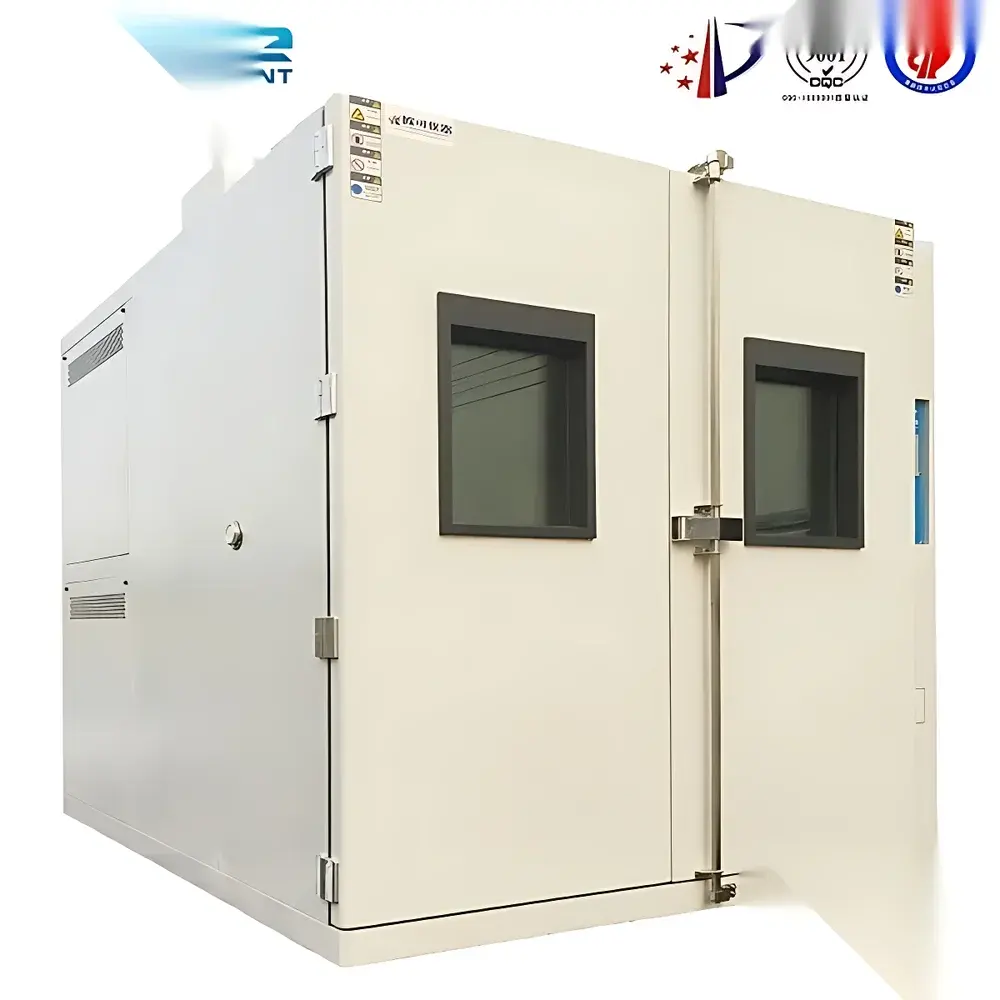
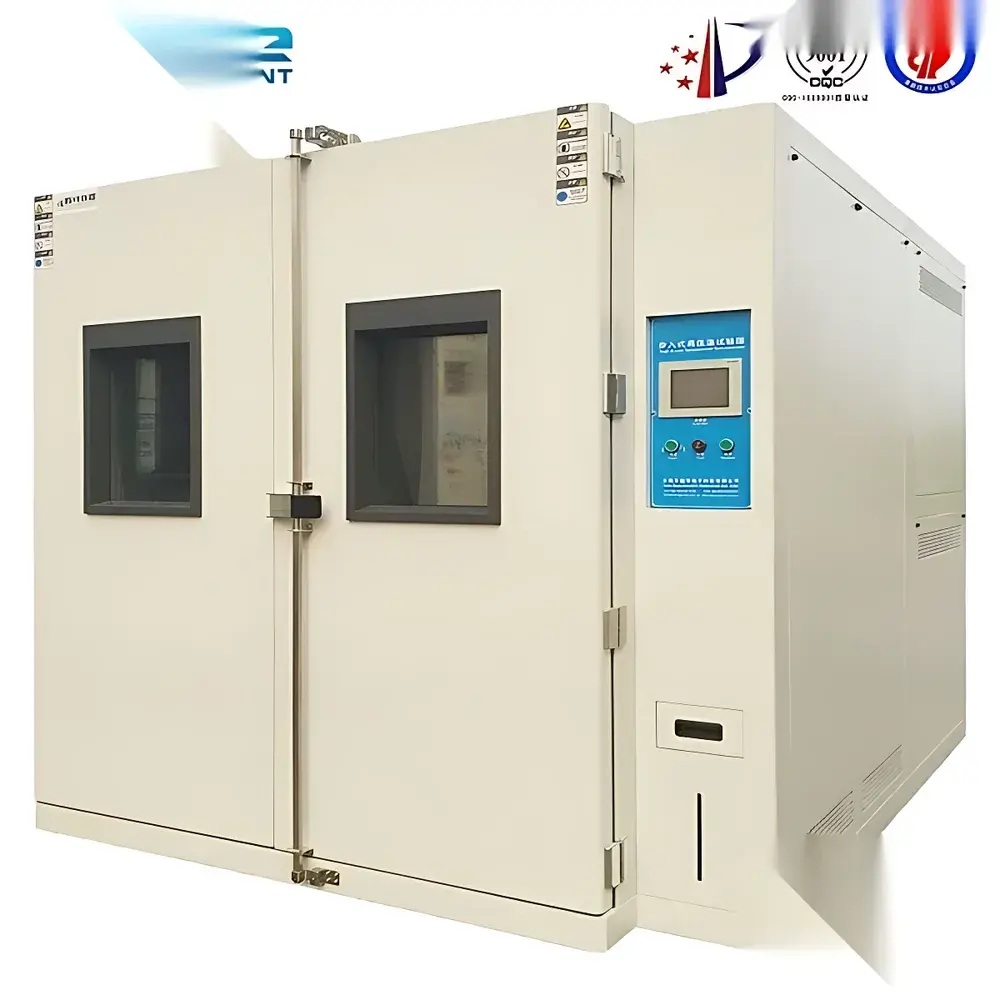
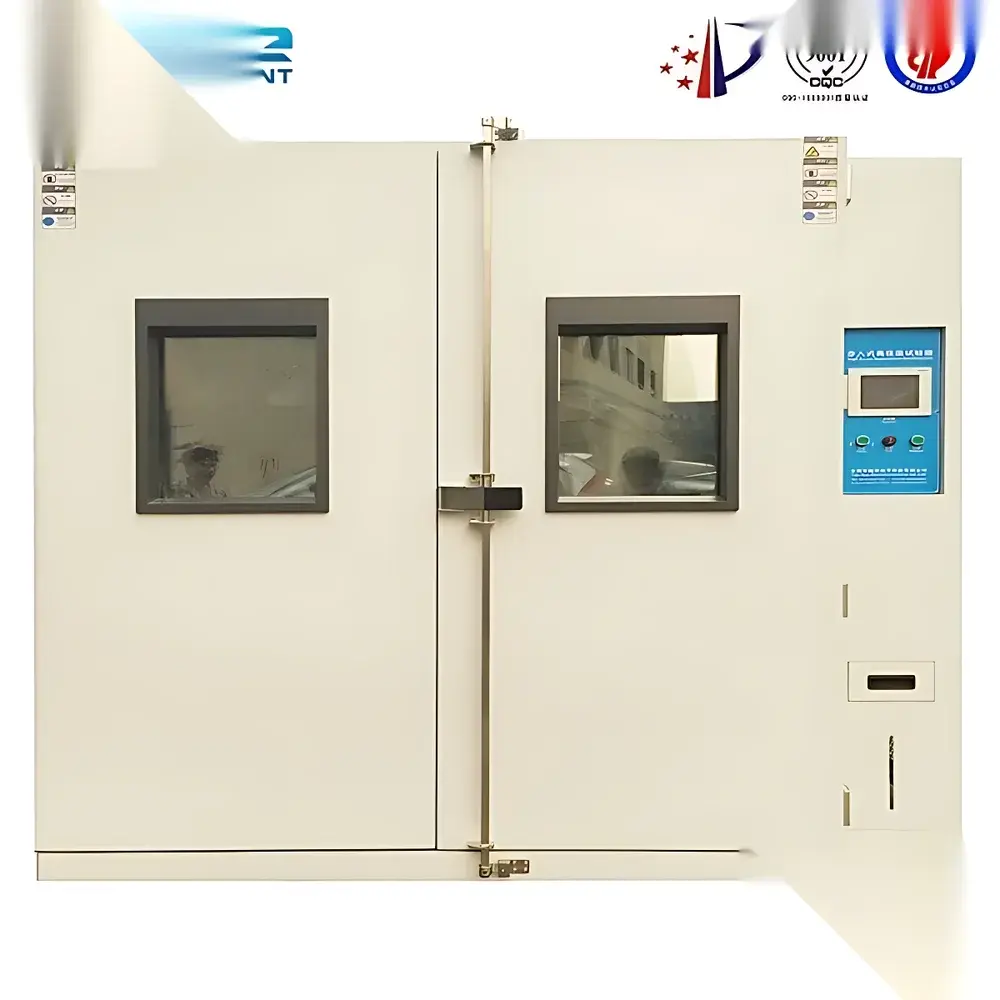
Programmable Walk-in Environmental Stress Chamber – Other Brands
| Key | Internal Dimensions: 400 × 400 × 500 mm (L×W×H) |
|---|---|
| Temperature Range | −40 °C to +150 °C |
| Humidity Range | 20–98 %RH |
| Temp. Stability | ±0.5 °C |
| Humidity Stability | ±2.5 %RH |
| Temp. Uniformity | ±1.0 °C |
| Humidity Uniformity | ±3.0 %RH |
| Heating Rate | +20 °C to +150 °C in ≈30 min |
| Cooling Rate | +20 °C to −40 °C in ≈50 min |
| Controller | TEMI880 Touchscreen HMI (Bilingual English/Chinese) |
| Refrigeration System | Hermetic Compressor, R404A/R23 Refrigerants |
| Air Circulation | Multi-wing Centrifugal Fan (Oriental Motor), Horizontal Diffusion + Vertical Thermal Exchange |
| Water Supply | Integrated 25 L Stainless Steel Reservoir with Auto-Replenishment & Low-Water Alarm |
Overview
The Programmable Walk-in Environmental Stress Chamber is a precision-engineered environmental simulation system designed for accelerated aging, reliability validation, and long-term stability testing of electronic components, automotive modules, medical devices, and polymer-based materials. It operates on the principle of controlled thermal-hygrometric cycling—precisely regulating temperature and relative humidity within a walk-in enclosure to replicate real-world operational stresses or extreme storage conditions. Unlike benchtop chambers, this unit provides ample internal volume (400 × 400 × 500 mm) to accommodate full assemblies, multi-unit test batches, or fixtures requiring spatial freedom for sensor placement and airflow optimization. Its dual-range capability—from deep freeze (−40 °C) to high-temperature bake (+150 °C), combined with wide humidity coverage (20–98 %RH), enables execution of IEC 60068-2-1, IEC 60068-2-2, IEC 60068-2-30, MIL-STD-810H Method 507.6, and JEDEC JESD22-A104D test profiles without hardware modification.
Key Features
- High-fidelity TEMI880 touchscreen controller with bilingual (English/Chinese) interface, supporting up to 99 programmable segments, 999 cycles, and automatic fault logging with timestamped event history.
- Advanced PID+SSR control architecture with auto-tuning function ensures stable setpoint maintenance under dynamic load conditions and minimizes overshoot during ramp transitions.
- Hermetically sealed refrigeration circuit utilizing environmentally compliant R404A and R23 refrigerants (DuPont certified), integrated with Danfoss dry filters, HTSR solenoid valves, Emerson oil separators, and fin-tube evaporator geometry optimized for low-temperature dehumidification efficiency.
- Uniform airflow distribution achieved via a multi-wing centrifugal fan (Oriental Motor, Japan), stainless steel extended shaft, aluminum impeller, and FLONTHROW directional ducting—ensuring horizontal diffusion and vertical thermal exchange across the entire chamber volume.
- Robust structural design includes wave-fin forced-air condenser with dedicated cooling motor, K-type copper refrigerant tubing with internal spiral configuration, and corrosion-resistant stainless steel interior chamber walls with seamless welding.
- Integrated water management system featuring a 25 L internal stainless steel reservoir, auto-recirculating pump, sediment-trap drainage assembly, and fail-safe low-water alarm with visual and audible notification.
Sample Compatibility & Compliance
This chamber accommodates samples ranging from PCB subassemblies and lithium-ion battery packs to encapsulated sensors and elastomeric gaskets. Its uniformity specifications (±1.0 °C temperature, ±3.0 %RH humidity) meet minimum requirements for ISO/IEC 17025-accredited laboratories performing environmental qualification per IPC-9701, AEC-Q200, or UL 746C. The system supports GLP-compliant operation through audit-ready controller logs, user-access-level password protection, and non-volatile memory retaining program data for ≥2 years—even after power interruption. While not pre-certified to FDA 21 CFR Part 11, its data integrity framework—including immutable timestamped records and configurable operator ID tagging—facilitates validation documentation for regulated industries.
Software & Data Management
The TEMI880 controller provides native USB export of runtime data (temperature/humidity vs. time, alarm events, output power traces) in CSV format for post-processing in MATLAB, Python, or statistical analysis platforms. Real-time monitoring is available via optional Ethernet/IP interface (not included), enabling integration into centralized lab monitoring systems using Modbus TCP or BACnet MS/TP protocols. All parameter changes are logged with operator ID, timestamp, and pre-/post-value comparison—supporting traceability in QA/QC workflows. Firmware updates are performed via SD card, with version rollback capability and checksum-verified installation packages.
Applications
- Accelerated life testing of consumer electronics under thermal shock and humidity soak conditions.
- Validation of conformal coating adhesion and dielectric integrity for aerospace-grade printed circuit boards.
- Stress screening of automotive ECUs prior to field deployment (per GM W3177 or Ford EMV-12100).
- Long-term hygrothermal aging of polymeric insulators and cable jacketing materials per ASTM D4329.
- Pre-conditioning of calibration standards and reference materials prior to metrological evaluation.
- Environmental stress screening (ESS) of medical device housings and sterilization packaging per ISO 11607-1.
FAQ
What safety certifications does this chamber carry?
Unit complies with IEC 61000-6-2 (immunity) and IEC 61000-6-4 (emissions). CE marking applies to the EU market; UL/cUL listing requires site-specific evaluation due to regional electrical infrastructure dependencies.
Can the chamber operate continuously at −40 °C and 98 %RH simultaneously?
No. At extreme low temperatures, maximum achievable humidity is physically constrained by dew point limitations. The specified humidity range is valid only within the overlapping operational envelope (e.g., 0–85 °C at 20–98 %RH; −40 to 0 °C limited to ≤70 %RH).
Is remote monitoring supported out-of-the-box?
Standard configuration includes local touchscreen and USB data export. Ethernet connectivity, SNMP alerting, or cloud-based dashboard integration require optional communication modules and custom firmware provisioning.
How often does the refrigeration system require preventive maintenance?
Compressor oil and refrigerant charge verification recommended every 24 months under continuous operation; condenser coil cleaning advised quarterly in dust-prone environments. Full service intervals align with ISO 5171 maintenance schedules for industrial climatic chambers.



