
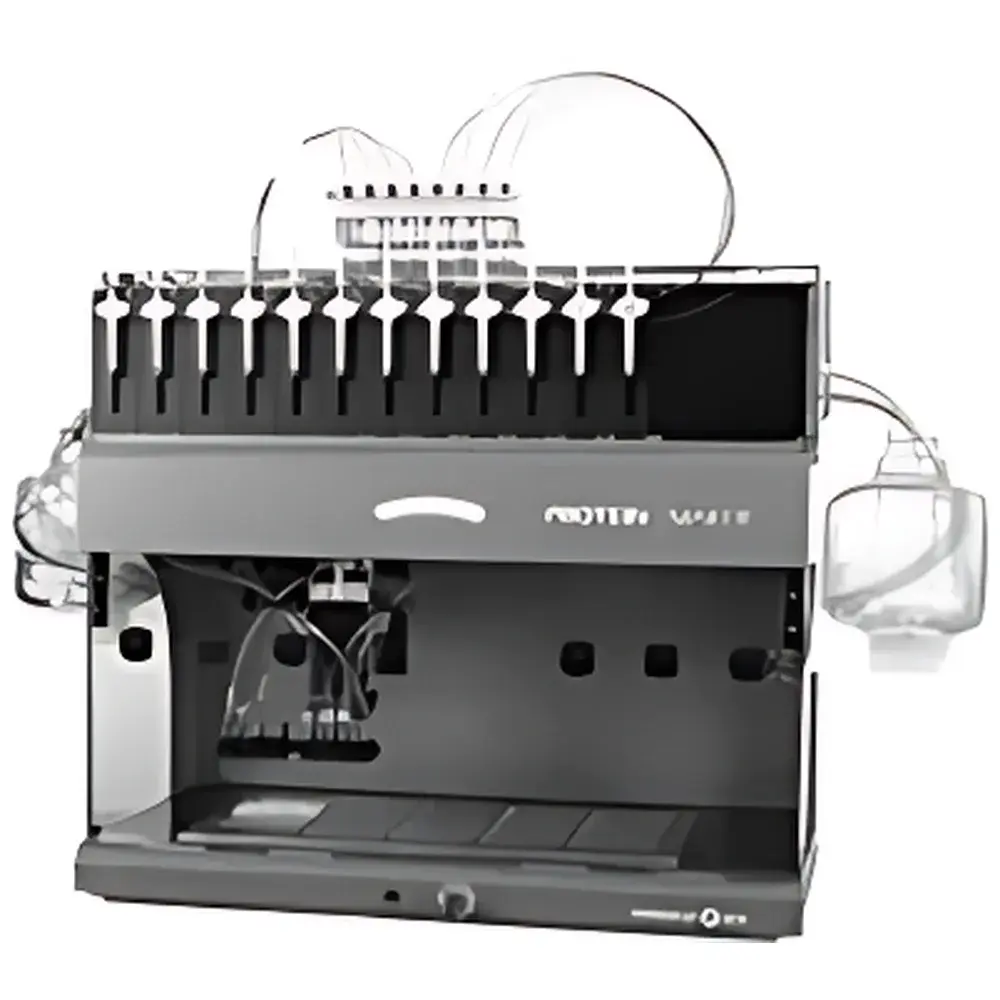
Protein Maker High-Throughput Protein Purification System
| Brand | Protein Maker |
|---|---|
| Origin | USA |
| Manufacturer Type | Authorized Distributor |
| Origin Category | Imported |
| Model | Protein Maker |
| Pricing | Available Upon Request |
| Purification Principle | Parallel Liquid Chromatography with Programmable Peristaltic/Injection Pump Architecture |
| Detector Type | Integrated 24-Channel UV-Vis Absorbance Detector (280 nm, 260 nm) |
| Throughput Capacity | 2–10 mg per sample (typical yield), up to 192 purifications per day |
Overview
The Protein Maker High-Throughput Protein Purification System is an engineered platform for parallel, automated liquid chromatography-based protein isolation and polishing. Unlike conventional single-column FPLC or AKTA-style systems, this instrument implements a modular, multi-channel syringe-pump-driven architecture—enabling simultaneous operation of up to 24 independent purification channels under identical or individually programmable gradient, flow, and valve-switching conditions. Each channel integrates a precision syringe pump (1–50 mL capacity), a 9-position programmable selection valve, and a dedicated UV-Vis optical path calibrated at 280 nm and 260 nm. The system operates on the principle of controlled displacement chromatography, where precise volumetric delivery ensures reproducible binding, wash, and elution kinetics across all channels—critical for comparative studies, condition screening, and scalable process development.
Key Features
- 24 independent parallel purification channels, each equipped with a digitally controlled syringe pump (flow range: 0.25–20 mL/min with 5 mL syringes)
- Integrated 24-channel UV-Vis absorbance detection (dual-wavelength, real-time monitoring at 260 nm and 280 nm)
- 20-position SBS-compliant deck layout (19 sample/column positions + 1 waste reservoir)
- Support for pre-packed columns (1–10 mL bed volume), including Ni-NTA, Protein A, GST, and ion-exchange formats
- Simultaneous two-step purification capability: e.g., IMAC capture followed by Protein A affinity polishing in 12 parallel workflows
- Programmable 9-port selection valves per channel—enabling automated buffer switching, gradient formation, and multi-step elution without manual intervention
- Modular hardware design: pump rack, tube rack, and control unit are physically separable for serviceability and lab-space optimization
Sample Compatibility & Compliance
The system accommodates clarified lysates from bacterial (E. coli), insect (Sf9), and mammalian (HEK293, CHO) expression systems. It supports direct loading of up to 1 L crude supernatant per channel when using large-bed columns (e.g., 10 mL resins), with integrated pressure monitoring to prevent column overloading. All fluidic pathways are constructed from biocompatible, low-binding PEEK and stainless-steel components compliant with USP Class VI standards. The software architecture supports ALCOA+ data integrity principles and provides full audit trails, electronic signatures, and user-access controls aligned with FDA 21 CFR Part 11 requirements for regulated environments. Method files and run logs are exportable in CSV and PDF formats for GLP/GMP documentation and internal quality review.
Software & Data Management
The Protein Maker Control Software is a Windows-based application offering intuitive graphical workflow builder, real-time chromatogram overlay, and batch method sequencing. Users define individual channel parameters—including flow rate, valve sequence, UV threshold triggers, and fraction collection logic—via drag-and-drop protocol templates. All runs generate timestamped, metadata-rich .pkm files containing raw absorbance traces, pump position logs, valve state history, and system diagnostics. Data export supports integration with third-party analysis tools (e.g., Python/Pandas, GraphPad Prism) via standardized CSV schema. Optional add-on modules include peak integration with baseline correction algorithms and automated yield calculation based on extinction coefficient and dilution factor inputs.
Applications
- Antibody discovery & screening: Parallel purification of 24 monoclonal antibodies (IgG, Fab, scFv) from transient transfection supernatants, yielding 2–10 mg per batch with consistent purity (>95% by SDS-PAGE)
- Structural biology pipeline acceleration: Simultaneous purification of multiple protein variants (e.g., domain truncations, point mutants) for crystallization trials—reducing cycle time from weeks to days
- Process development de-risking: Direct scale-down correlation studies using identical resin chemistry and buffer conditions across micro-, pilot-, and production-scale operations
- Biomarker enrichment: Immunodepletion of high-abundance serum proteins (e.g., albumin, IgG) from plasma or CSF prior to mass spectrometry analysis
- Lysis condition optimization: Empirical testing of 12 distinct lysis buffers (pH, salt, detergent, protease inhibitors) in parallel, followed by IMAC capture to identify optimal recovery and solubility profiles
FAQ
What column formats are supported?
Standard pre-packed 1–10 mL cartridges compatible with S1/Tricorn/HiTrap footprints; custom column adapters available upon request.
Can the system perform gradient elution?
Yes—gradient formation is achieved via timed valve switching between up to 9 different buffers per channel, enabling linear, step, or custom nonlinear gradients.
Is method transfer to larger-scale FPLC systems possible?
Absolutely—the system’s flow dynamics, residence time distribution, and binding capacity scaling are mathematically traceable to ÄKTA platforms, supporting seamless tech transfer.
How is system cleaning and maintenance performed?
Automated CIP (Clean-in-Place) protocols are programmable per channel; all wetted parts are autoclavable or solvent-rinsable, with recommended maintenance intervals documented in the ISO 9001-certified service manual.
Does the software support remote monitoring?
Yes—via secure HTTPS interface with role-based access; live chromatograms and system status can be viewed on desktop or mobile browsers during active runs.




