
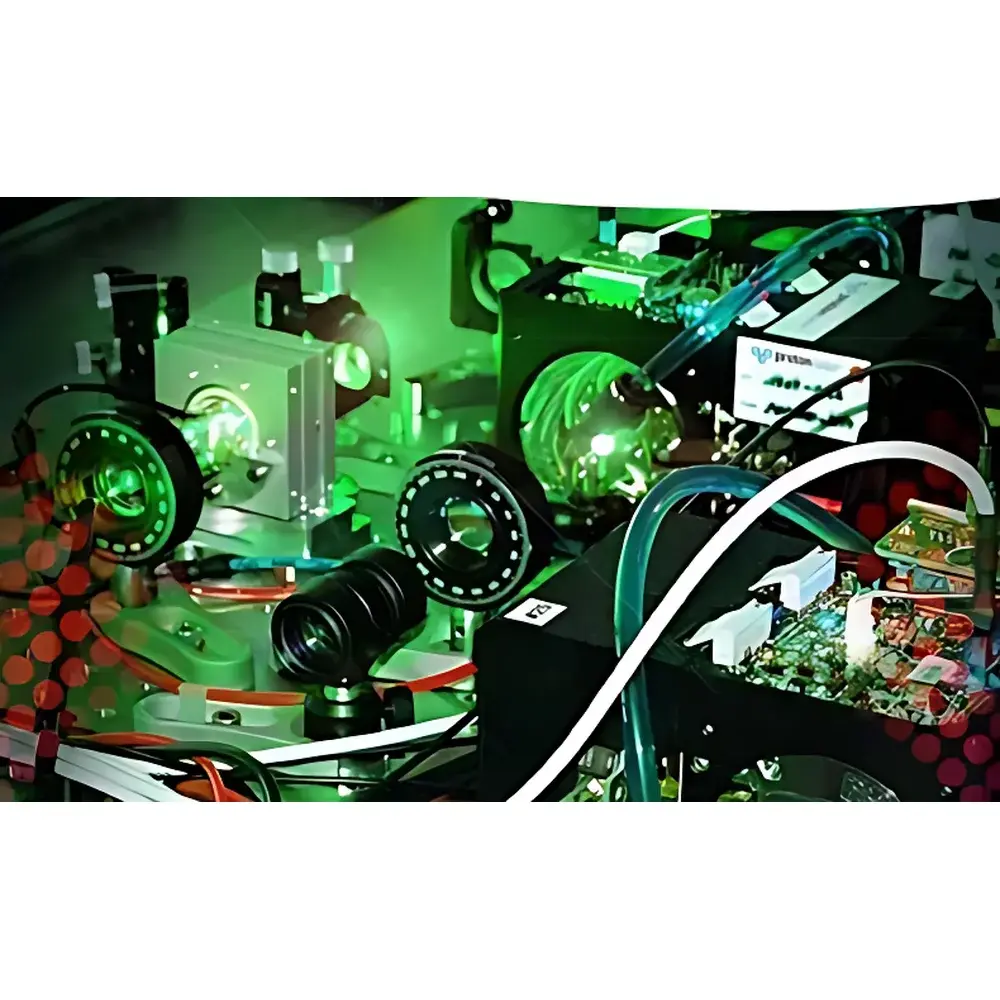
Proton Olser Series High-Energy, High-Repetition-Rate Nd:YAG Laser System
| Origin | Spain |
|---|---|
| Manufacturer Type | Authorized Distributor |
| Origin Category | Imported |
| Model | Olser |
| Pricing | Upon Request |
| Core Configuration | Solid-State Laser System (Diode-Pumped Nd:YAG/Nd:YLF) |
Overview
The Proton Olser Series is a family of industrial-grade, diode-pumped solid-state (DPSS) Q-switched lasers engineered for demanding scientific and applied photonics applications requiring high pulse energy, stable temporal performance, and reliable kHz-class repetition rates. Based on Nd:YAG or Nd:YLF gain media, these lasers operate fundamentally via stimulated emission in a longitudinally pumped, actively Q-switched cavity architecture. The core design emphasizes thermal management, beam quality preservation, and long-term amplitude stability—critical for time-resolved pump-probe spectroscopy, laser-induced breakdown spectroscopy (LIBS), and precision laser ablation. With standard repetition rates up to 500 Hz and optional kHz variants available upon customization, the Olser platform bridges the performance gap between low-repetition laboratory oscillators and high-average-power amplifier systems.
Key Features
- Diode-pumped architecture ensuring superior wall-plug efficiency, reduced thermal lensing, and extended operational lifetime compared to flashlamp-pumped counterparts.
- Three scalable configurations: OLSER2 (entry-level), OLSER4 (mid-power), and OLSER5 (high-energy)—each optimized for distinct pulse energy vs. repetition rate trade-offs.
- Wavelength flexibility: fundamental output at 1064 nm with intracavity frequency-doubling capability to 532 nm; optional harmonics generation paths (355 nm, 266 nm) supported via external nonlinear crystals.
- Q-switched operation delivering nanosecond-scale pulse widths (typically <10 ns FWHM) with excellent temporal contrast and minimal pre-/post-pulse leakage.
- High pulse-to-pulse energy stability (<±1.5% RMS over 8 hours) enabled by active cavity-length stabilization and closed-loop diode current regulation.
- TEM00-dominant spatial mode (M² <1.3) with low beam divergence (100:1 extinction ratio).
Sample Compatibility & Compliance
The Olser Series is compatible with standard optical tables, motorized translation stages, and vacuum-compatible experimental chambers. Its mechanical footprint and cooling interface (water or air, depending on model) conform to ISO 10110-7 mounting standards for laser sources. All units comply with IEC 60825-1:2014 Class 4 laser safety requirements and are supplied with integrated interlock circuits, key-controlled enable switches, and beam shutter interfaces. For regulated environments—including pharmaceutical process development and medical device manufacturing—the system supports integration into GLP/GMP workflows through optional analog/digital trigger synchronization (TTL/RS-422) and hardware-based emission logging.
Software & Data Management
Laser operation is managed via Proton’s proprietary Olser Control Suite—a Windows-based application supporting real-time monitoring of diode current, cavity temperature, Q-switch delay, pulse energy (via integrated photodiode feedback), and repetition rate. The software exports timestamped datasets in HDF5 and CSV formats, enabling traceable calibration records compliant with FDA 21 CFR Part 11 when deployed with audit-trail-enabled network licensing. Remote control via Ethernet (TCP/IP) and LabVIEW/VISA drivers allow seamless integration into automated test benches and custom DAQ platforms.
Applications
- LIDAR transmitter source for atmospheric sensing and wind profiling (1064 nm eye-safe configurations available).
- Pump source for Ti:sapphire ultrafast amplifier systems requiring high-energy, low-jitter seeding pulses.
- Material processing: laser marking, micro-machining, and selective laser sintering of ceramics and thin-film coatings.
- Biomedical research: optoacoustic imaging excitation, photodynamic therapy dose calibration, and laser-induced forward transfer (LIFT) of biomaterials.
- Mechanical surface enhancement: laser shock peening (LSP) of aerospace alloys and turbine blades using high-peak-power 1064 nm pulses.
- Time-resolved spectroscopy: pump-probe experiments requiring precise inter-pulse timing synchronization and sub-nanosecond jitter.
FAQ
What is the typical pulse width in Q-switched mode?
Pulse duration is typically ≤8 ns FWHM at 1064 nm, with minor variation depending on model and operating point.
Can the laser be operated in continuous-wave (CW) mode?
No—this is a strictly Q-switched pulsed laser system; CW operation is not supported by design.
Is external triggering supported?
Yes—all models feature TTL-compatible external trigger input (negative edge, 5 V logic) with adjustable delay from 0–100 µs relative to internal clock.
What cooling method is required?
OLSER2 uses forced-air cooling; OLSER4 and OLSER5 require recirculating chiller systems with flow rate ≥2 L/min and temperature stability ±0.5 °C.
Are OEM integration kits available?
Yes—Proton provides mechanical mounting flanges, electrical harnesses, and API documentation for turnkey integration into larger subsystems.




