
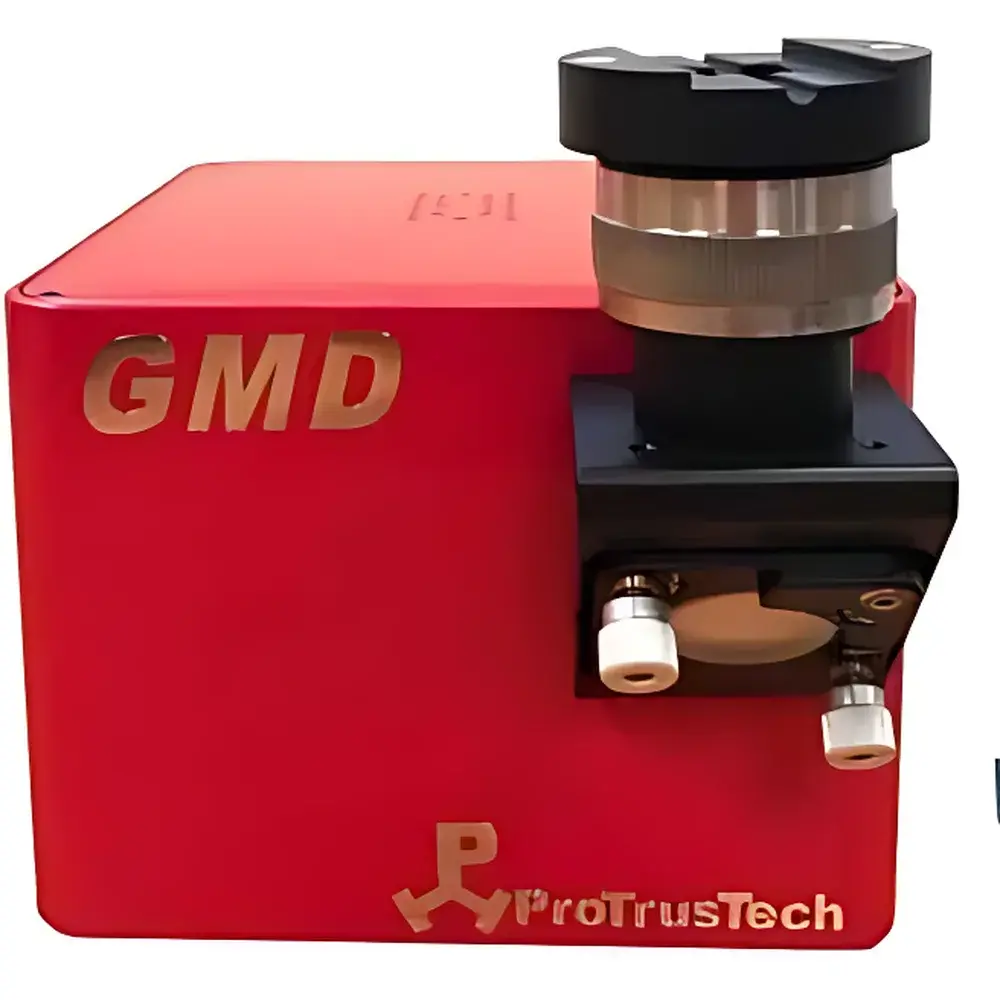
ProTrusTech GMDX Portable Raman Spectrometer
| Brand | ProTrusTech |
|---|---|
| Origin | Taiwan |
| Model | GMDX |
| Excitation Wavelengths | 532 nm & 785 nm |
| Dimensions (L×W×H) | 200 × 300 × 300 mm |
| Detector | High-Performance CCD |
| Laser Temperature Stabilization | Integrated |
| Safety Enclosure | Interlocked Laser-Safe Chamber with Shutter Control |
| Sample Stage | Motorized XYZ Translation Stage |
| Integrated Components | Coaxial Observation Camera, White LED Illumination, Rayleigh Calibration Source |
| Software | RAMSpec v3.x (Windows 7/8/10, 32/64-bit) |
| Data Export Formats | CSV, SPC, TXT, XLSX |
| Compliance | CE Marked, FDA 21 CFR Part 11–Ready Audit Trail (via optional software license), GLP/GMP-Compatible Workflow Logging |
Overview
The ProTrusTech GMDX Portable Raman Spectrometer is an engineered solution for field-deployable and benchtop macro-Raman spectroscopy. Built upon a robust optomechanical architecture, it employs confocal-free direct-coupling laser excitation—eliminating alignment drift and enabling rapid spectral acquisition across heterogeneous sample surfaces. Unlike conventional micro-Raman systems requiring precise focusing on micron-scale regions, the GMDX is optimized for macroscopic sampling (spot size ~50–100 µm at focal plane), delivering high signal-to-noise ratio spectra from bulk materials without destructive contact or vacuum requirements. Its dual-wavelength capability (532 nm for high-resolution fluorescence-sensitive analysis and 785 nm for reduced photodegradation in organic/biological matrices) ensures broad applicability across pharmaceutical raw material identification, gemological authentication, polymer degradation assessment, and forensic trace evidence screening. The fully enclosed, interlocked optical chamber meets IEC 60825-1 Class 1 laser safety standards, permitting unrestricted operation in non-dedicated laboratory environments—including cleanrooms, manufacturing floors, customs checkpoints, and geological field sites.
Key Features
- Integrated motorized XYZ sample stage with 10 µm repeatability, enabling precise spatial mapping and multi-point spectral acquisition without manual repositioning.
- Dual-laser excitation module with thermoelectrically stabilized diode lasers (532 nm ± 0.5 nm, 785 nm ± 1.0 nm), each independently switchable via software-controlled shutter.
- Coaxial high-resolution CMOS observation camera (1920 × 1080, 30 fps) with white LED illumination for real-time sample visualization and region-of-interest targeting.
- High-quantum-efficiency back-illuminated CCD detector (2048-pixel linear array, >90% peak QE at 785 nm), cooled to –15 °C for dark-current suppression.
- Automatic background subtraction and electronic noise correction using reference dark-frame acquisition prior to each measurement cycle.
- Real-time saturation monitoring with dynamic integration time adjustment to prevent pixel well overflow and spectral distortion.
- Onboard Rayleigh line calibration using internal reference source, ensuring wavenumber accuracy within ±1 cm⁻¹ over full spectral range (e.g., 200–3200 cm⁻¹).
Sample Compatibility & Compliance
The GMDX accommodates diverse physical forms without sample preparation: solids (crystals, tablets, ores), liquids (solutions, suspensions), powders (APIs, catalysts), gels, pastes, thin films, and gemstones—including mounted or loose specimens. Standard accessories include cuvette holders, microscope slide clamps, capillary tubes, SERS substrate stages, and gemstone cradles with adjustable tilt. All mechanical interfaces comply with ISO 17025-recommended traceability protocols for instrument calibration verification. The system supports GLP-compliant data integrity through timestamped audit logs, user access control (role-based permissions), and electronic signature capability (when paired with RAMSpec’s 21 CFR Part 11 add-on module). It conforms to CE Directive 2014/30/EU (EMC) and 2014/35/EU (LVD), and has been validated per ASTM E1840-22 for Raman instrument performance verification.
Software & Data Management
RAMSpec v3.x provides a deterministic, workflow-driven interface designed for QC technicians and field analysts—not just spectroscopists. Core functions—including live spectral preview, auto-exposure optimization, baseline correction (asymmetric least squares), peak detection (Gaussian/Lorentzian fitting), and quantitative ratio analysis—are accessible from the primary dashboard without nested menus. Spectral libraries (user-defined or NIST-compatible) support rapid match-and-identify operations with confidence scoring. Data export adheres to FAIR principles: all spectra are saved with embedded metadata (laser power, integration time, ambient temperature, operator ID, GPS coordinates if enabled via external module). Batch processing scripts enable automated QA/QC reporting for pharmaceutical release testing or incoming raw material verification. Raw data files retain native detector format for third-party analysis (e.g., Python SciPy, MATLAB, GRAMS/AI).
Applications
- Pharmaceutical: Identification of polymorphs, counterfeit drug detection, blend uniformity assessment in solid dosage forms.
- Gemology & Mining: Non-destructive differentiation of natural vs. synthetic diamonds, ruby/sapphire origin tracing, mineral phase mapping in ore samples.
- Materials Science: In-situ monitoring of polymer crosslinking, carbon nanotube functionalization, battery electrode degradation.
- Forensics: Trace-level identification of explosives residues, illicit drugs, ink dyes, and paint chips.
- Academic Research: Teaching platform for vibrational spectroscopy fundamentals; field-deployable tool for environmental soil/water contaminant screening.
FAQ
Is the GMDX suitable for quantitative analysis?
Yes—when used with certified reference standards and calibrated against NIST-traceable Raman intensity standards, the GMDX supports semi-quantitative concentration estimation (RSD < 5% for repeat measurements under controlled conditions).
Can the system be operated without a laptop?
No—the GMDX requires connection to a Windows PC via USB 3.0 for control, data acquisition, and real-time display; no standalone touchscreen or embedded OS is provided.
What is the typical spectral resolution achievable?
Resolution is configuration-dependent: ≤ 8 cm⁻¹ FWHM at 785 nm (with 1200 grooves/mm grating) and ≤ 4 cm⁻¹ at 532 nm (with 1800 grooves/mm grating), verified using neon lamp emission lines.
Does the system support fiber-optic coupling for remote sampling?
Not natively—the GMDX uses free-space optics only; however, custom OEM fiber adapters (e.g., 400 µm core, SMA 905) can be integrated upon request with recalibration.
How is laser power stability maintained during extended field use?
Thermoelectric coolers maintain laser diode junction temperature within ±0.1 °C; combined with closed-loop current regulation, this ensures output power drift < ±1.5% over 8 hours at ambient temperatures from 10–35 °C.




