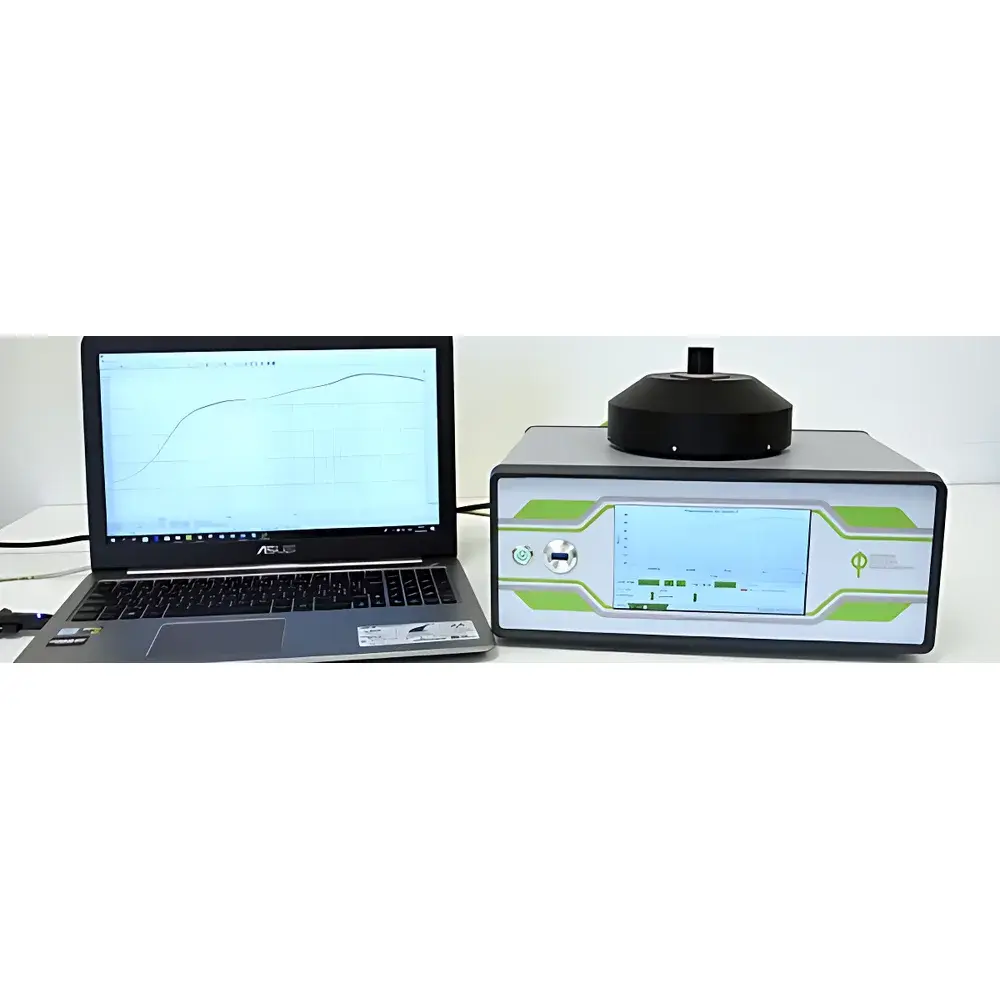
PSI FL6000 Dual-Modulation Chlorophyll Fluorometer
| Brand | PSI |
|---|---|
| Origin | Czech Republic |
| Model | FL6000 |
| Time Resolution | 4 µs (standard), 1 µs (high-speed option) |
| Detection Limit | 1 µg Chl a/L |
| Excitation Wavelengths | 455 nm (blue), 617 nm & 630 nm (red/orange), optional 735 nm (far-red) |
| Measurement Chamber | 4 mL cuvette, 10×10 mm base |
| AD Converter | 500 kHz / 16-bit |
| Software | FluorWin v5.x |
| Compliance | ASTM E2912-22 (Fluorescence Instrumentation), ISO 10265:2021 (Photosynthetic Performance Testing), GLP-ready audit trail support |
Overview
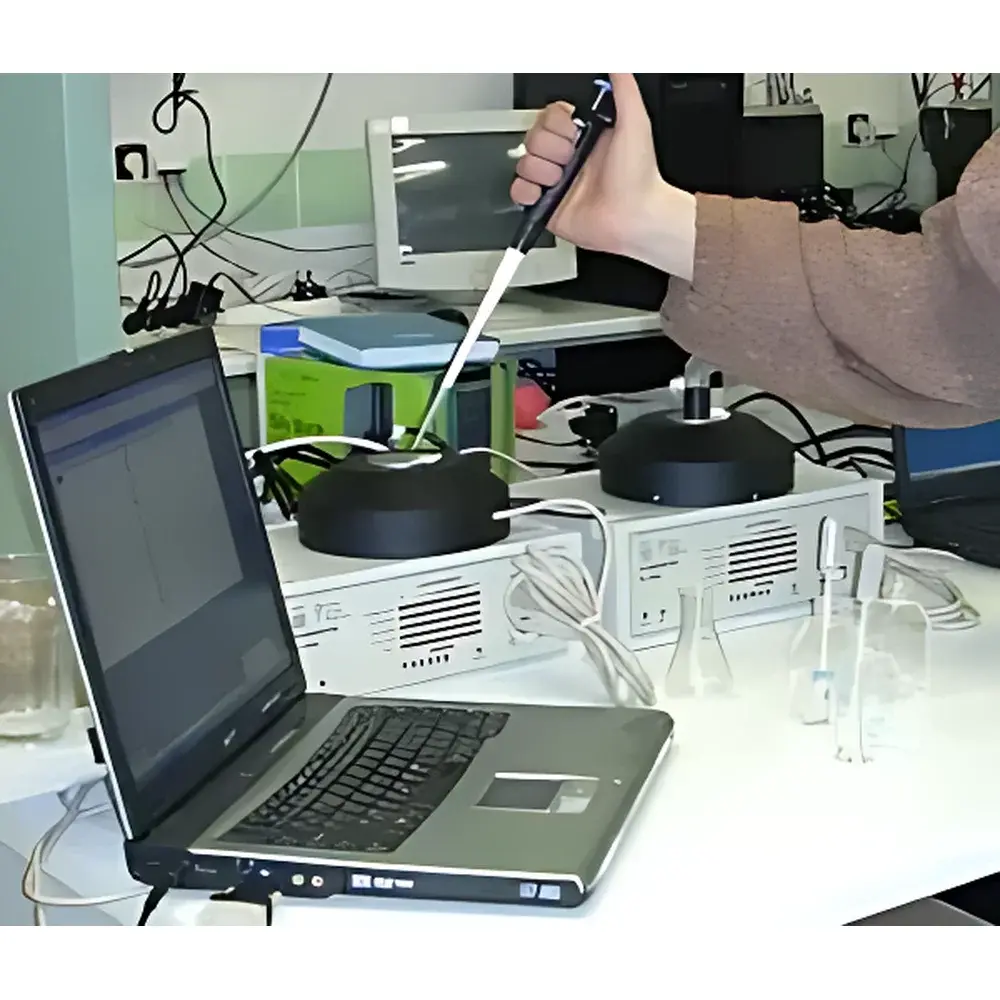
The PSI FL6000 Dual-Modulation Chlorophyll Fluorometer is a high-precision, research-grade instrument engineered for quantitative interrogation of photosynthetic electron transport dynamics in oxygenic phototrophs. Based on the dual-modulation principle—simultaneous control of actinic illumination and saturating flash delivery—the FL6000 enables time-resolved detection of chlorophyll a fluorescence transients with sub-microsecond resolution. Its optical head integrates three independently controllable LED light sources (455 nm, 617 nm, 630 nm), a high-bandwidth PIN photodiode detector (500 kHz sampling, 16-bit ADC), and programmable gain/integration timing to resolve rapid kinetic phases including OJIP rise, QA⁻ reoxidation, and S-state transitions. Designed for suspension-based samples—including cyanobacteria, green algae, isolated thylakoids, chloroplasts, and plant tissue homogenates—the system supports both cuvette-based kinetic assays and integrated environmental parameter control (temperature, O₂, stirring), making it suitable for mechanistic studies under controlled physiological conditions.
Key Features
- Dual-modulation architecture enabling independent regulation of measuring light, actinic light, and saturating single-turnover flashes (STF), double-turnover flashes (TTF), and multi-turnover flashes (MTF)
- Time-resolved fluorescence detection at 4 µs (standard configuration) or 1 µs (high-speed option), among the highest temporal resolutions available for commercial chlorophyll fluorometers
- Comprehensive built-in protocols: PAM-based quenching analysis (ΦPSII, NPQ, qP, qN, ETR), OJIP transient kinetics (VJ, M0, Area, ABS/RC, TR0/RC), QA⁻ reoxidation modeling (A1/T1, A2/T2, A3/T3), S-state testing for PSII reaction center quantification, and custom FRR (Fast Repetition Rate) sequences
- User-definable experimental protocols supporting advanced analyses such as PSII antenna heterogeneity (PSIIα vs. PSIIβ), effective PSII absorption cross-section (σPSII), and donor-side/side-chain redox kinetics
- Integrated SuperHead measurement chamber with configurable excitation spectra (blue, amber, red, far-red at 735 nm) and emission bandpass selection (Chl a, Chl b) via optional spectral filters
- Real-time visualization via embedded color touchscreen; full remote operation and data acquisition via USB interface and FluorWin software
Sample Compatibility & Compliance
The FL6000 is validated for use with aqueous suspensions of unicellular and filamentous cyanobacteria (e.g., Synechocystis sp. PCC 6803), eukaryotic microalgae (e.g., Chlorella vulgaris), isolated thylakoid membranes, intact chloroplasts, and fragmented leaf tissues. Sample volume requirements are standardized at 4 mL in a quartz cuvette with 10 × 10 mm optical path. Optional accessories—including the TR2000 temperature controller (0–70 °C, ±0.1 °C stability), magnetic stirrer (100–1000 rpm, IP64-rated), and dissolved O₂ module—extend operational validity to dynamic physiological assays such as Hill reaction kinetics and thermal stress response profiling. The system conforms to ASTM E2912-22 for fluorescence instrumentation performance verification and ISO 10265:2021 for standardized photosynthetic capacity assessment. FluorWin software supports GLP-compliant data integrity through timestamped audit trails, user access logs, and electronic signature capability per FDA 21 CFR Part 11 requirements.
Software & Data Management
FluorWin v5.x provides an integrated environment for protocol definition, hardware synchronization, real-time curve visualization, batch processing, and publication-ready export. Users may construct hierarchical measurement sequences combining dark adaptation steps, actinic ramping, flash trains, and post-illumination relaxation phases. All raw fluorescence traces are stored in HDF5 format with embedded metadata (excitation settings, sample ID, operator, timestamp, instrument calibration IDs). Advanced analysis modules include nonlinear curve fitting for QA⁻ reoxidation decay models, derivative-based OJIP parameter extraction, and multivariate statistical export for PCA or cluster analysis. Data interoperability is ensured via CSV, MATLAB .mat, and Excel-compatible outputs. Remote scripting via Python API enables integration into automated screening pipelines for ecotoxicology or mutant phenotyping workflows.
Applications
The FL6000 serves as a core analytical platform in photosynthesis research laboratories investigating biotic and abiotic stress responses, including heavy metal toxicity (Cd²⁺, Cu²⁺), herbicide mode-of-action (e.g., DCMU, atrazine), salinity-induced photoinhibition, antibiotic-induced electron transport disruption, and oxidative damage mechanisms. Its high temporal fidelity allows discrimination between early donor-side impairments (e.g., impaired water-splitting complex) and acceptor-side limitations (e.g., plastoquinone pool over-reduction). Published applications span peer-reviewed studies on quinoa salt tolerance (Manaa et al., Environ Exp Bot 2019), circadian regulation of PSII in Cyanothece (Sicora et al., Photosynth Res 2019), and non-target effects of agrochemicals on freshwater phytoplankton (Smythers et al., Chemosphere 2019). It is routinely deployed in conjunction with complementary techniques—including thermoluminescence (TL), P700⁺ absorbance, and oxygen evolution polarography—to resolve multi-scale regulatory events across the photosynthetic apparatus.
FAQ
What sample types are compatible with the FL6000?
The instrument is optimized for liquid-phase samples: cyanobacterial cultures, green algal suspensions, isolated thylakoids or chloroplasts, and homogenized plant tissues. Solid leaf discs require grinding and centrifugation to obtain clarified supernatants.
Can the FL6000 measure Photosystem I activity?
Yes—via optional 735 nm far-red illumination to preferentially excite PSI and induce P700⁺ accumulation, enabling concurrent PSII/PSI redox kinetics when paired with appropriate absorbance detectors.
Is the system compliant with regulatory data integrity standards?
FluorWin supports audit trail logging, electronic signatures, and role-based access control aligned with FDA 21 CFR Part 11 and EU Annex 11 requirements for regulated environments.
How does the dual-modulation design improve measurement accuracy?
By decoupling measuring light intensity from actinic background irradiance, the system eliminates cross-talk between signal acquisition and photochemical perturbation—ensuring precise quantification of fluorescence yield under physiologically relevant light regimes.
What is the minimum detectable chlorophyll concentration?
The system achieves a detection limit of 1 µg Chl a/L in standard cuvette geometry, verified using serial dilutions of purified Chlorella extracts and calibrated against spectrophotometric reference methods.
Related Products