
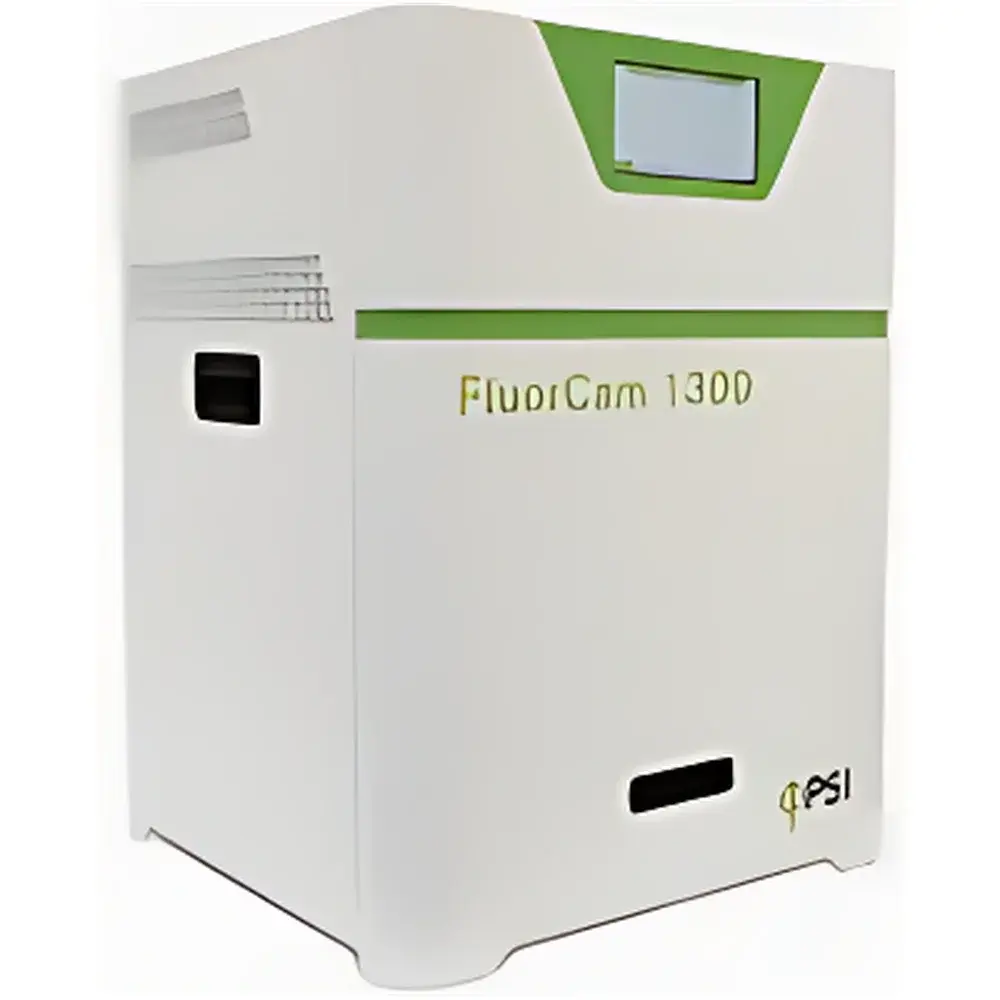
PSI FluorCam-96 High-Throughput Algal Photosynthesis Measurement System
| Brand | PSI (Czech Republic) |
|---|---|
| Origin | Czech Republic |
| Model | FluorCam-96 |
| Measurement Principle | Dual-modality chlorophyll fluorescence imaging + fiber-optic dissolved oxygen sensing |
| Throughput | 96 parallel samples |
| Fluorescence Parameters | >50 including Fo, Fm, Fv/Fm, ΦPSII, NPQ, qL, ETR, Rfd, QY_Ln |
| Oxygen Measurement | Fiber-optic sensor, ±0.1% O₂ @ 1% O₂, 0.01% O₂ resolution, 10–20 Hz sampling rate |
| Chamber Material | Sterilizable transparent polystyrene |
| Dimensions (O₂ module) | 162 × 102 × 32 mm |
| Weight (O₂ module) | 670 g |
| Temperature Sensor | 0–50 °C, ±0.5 °C accuracy, 0.012 °C resolution |
| Pressure Sensor | 300–1100 mbar, ±6 mbar accuracy, 0.11 mbar resolution |
| Software | FluorCam v7.x with GLP-compliant audit trail, protocol editor, ROI-based kinetic analysis, signal averaging mode for low-biomass samples |
Overview
The PSI FluorCam-96 High-Throughput Algal Photosynthesis Measurement System is an integrated dual-modality platform engineered for quantitative, non-invasive assessment of photosynthetic performance in microalgal cultures. It combines spatially resolved chlorophyll a fluorescence imaging with high-fidelity, real-time dissolved oxygen (DO) evolution and consumption kinetics—enabling simultaneous evaluation of photochemical efficiency (via PSII quantum yield and energy partitioning) and net gas exchange (photosynthetic O₂ production and mitochondrial respiration). The system operates on the principles of pulse-amplitude modulated (PAM) fluorometry and phase-fluorometric oxygen sensing, both calibrated to traceable standards and validated under controlled environmental conditions. Designed for reproducible screening across large-scale mutant libraries or environmental treatment arrays, the FluorCam-96 delivers standardized, instrument-independent metrics compliant with ISO 10260 (chlorophyll fluorescence measurement) and ASTM D882-22 (oxygen sensor performance verification). Its architecture supports GLP-aligned experimental workflows, including timestamped metadata logging, user authentication, and full audit trail generation.
Key Features
- Dual-sensor architecture: Synchronized acquisition of chlorophyll fluorescence transients and dissolved oxygen concentration at up to 20 Hz per channel, with temporal alignment precision ≤10 ms.
- 96-well compatible imaging chamber: Optimized optical path for uniform excitation and emission collection across all wells; accommodates standard microtiter plates (flat-bottom or round-bottom) and custom culture vessels.
- Programmable fluorescence protocols: Predefined and user-editable sequences for Fv/Fm, Kautsky induction kinetics, light-response curves (LC), and multiphase quenching analysis (NPQ, qL, qN).
- Advanced signal processing: “Signal Averaging Re-calculation” mode enhances detection sensitivity for low-density algal suspensions (<10⁴ cells/mL) by suppressing stochastic noise without compromising temporal resolution.
- Flexible region-of-interest (ROI) definition: Automatic multi-sample detection or manual delineation using rectangular, circular, polygonal, or sector-shaped ROIs—each quantified independently for fluorescence decay kinetics and O₂ flux rates.
- Fiber-optic oxygen sensing: Immune to electromagnetic interference, zero oxygen consumption, no drift over 72 h continuous operation, and minimal cross-sensitivity to CO₂, pH, or salinity (±0.3% signal variation under 0–50 ppt NaCl gradient).
Sample Compatibility & Compliance
The FluorCam-96 accommodates a broad spectrum of freshwater and marine microalgae—including Nannochloropsis gaditana, Scenedesmus obliquus, Chlamydomonas reinhardtii, and cyanobacterial strains—in liquid suspension, biofilm, or immobilized formats. Culture volumes range from 100 µL to 2 mL per well, with optical density (OD730) adaptability from 0.05 to 1.5. All measurement chambers are fabricated from medical-grade, autoclavable polystyrene (ISO 10993-5 cytotoxicity certified) and support pre-sterilization via gamma irradiation or ethylene oxide. Data integrity complies with FDA 21 CFR Part 11 requirements through electronic signatures, role-based access control, and immutable audit logs. Instrument validation documentation includes IQ/OQ/PQ templates aligned with ISO/IEC 17025 and EU GMP Annex 11 guidelines.
Software & Data Management
FluorCam v7.x software provides a unified interface for experiment design, real-time monitoring, and post-acquisition analysis. Core modules include Live View (live fluorescence/O₂ overlay), Protocol Editor (drag-and-drop sequence builder with conditional branching), Pre-processing (background subtraction, flat-field correction, motion stabilization), and Result Explorer (parameter heatmaps, kinetic curve overlays, statistical comparison across groups). All datasets are stored in HDF5 format with embedded metadata (instrument ID, operator, ambient T/P, calibration timestamps). Export options include CSV, MATLAB .mat, and MIAME-compliant XML for integration with Galaxy, PhytoBiosphere, or PlantCV pipelines. Audit trails record every parameter change, ROI modification, or data export event—including IP address, timestamp, and user role—for regulatory submission readiness.
Applications
- Forward genetic screens: Identification of high-photoefficiency mutants in EMS or insertional mutagenesis libraries, as demonstrated in N. gaditana studies (Perin et al., 2015).
- Thermal plasticity assays: Quantification of acclimation thresholds in photosynthetic O₂ evolution and dark respiration across ecologically relevant temperature gradients (e.g., 12–18 °C in S. obliquus; Tseng et al., 2019).
- Biofuel strain optimization: Correlation of NPQ dynamics and ETR saturation points with lipid accumulation profiles under nitrogen-limited conditions.
- Phytotoxicity profiling: Detection of sublethal photoinhibitory effects from heavy metals, herbicides, or nanoplastics via early deviations in ΦPSII and Rfd kinetics.
- Bioremediation monitoring: Real-time tracking of photosynthetic recovery in wastewater-grown algae following nutrient or contaminant load adjustments.
- Mars analog research: Assessment of photosynthetic resilience under simulated regolith-derived growth media and reduced atmospheric pressure (Macário et al., 2022).
FAQ
Can the system measure both fluorescence and oxygen simultaneously on the same sample?
Yes. Each well is interrogated concurrently by the fluorescence excitation/emission optics and the fiber-optic oxygen probe, ensuring temporally aligned, co-localized physiological readouts.
Is calibration required before each experiment?
Fluorescence calibration is performed once per instrument lifetime using certified reference standards (NIST-traceable fluorescein solutions); oxygen sensors are factory-calibrated and require only zero-point verification in sodium sulfite solution prior to extended use.
Does the software support automated batch analysis of 96-well plates?
Yes. The Batch Processing module applies identical ROI definitions, normalization routines, and parameter calculations across all wells, generating consolidated reports with ANOVA-ready summary statistics.
What environmental controls are integrated?
The system does not include active climate control; however, it interfaces with third-party incubators and LED illumination systems via TTL/RS-232, enabling synchronized light intensity, spectral quality, and temperature ramping protocols.
How is data traceability ensured for regulatory submissions?
All raw data files contain embedded digital signatures, hardware serial numbers, and cryptographic hashes. The audit log records every user action with SHA-256 hashing and write-once storage—fully compliant with FDA 21 CFR Part 11 Subpart B and EU Annex 11 Annex II requirements.




