
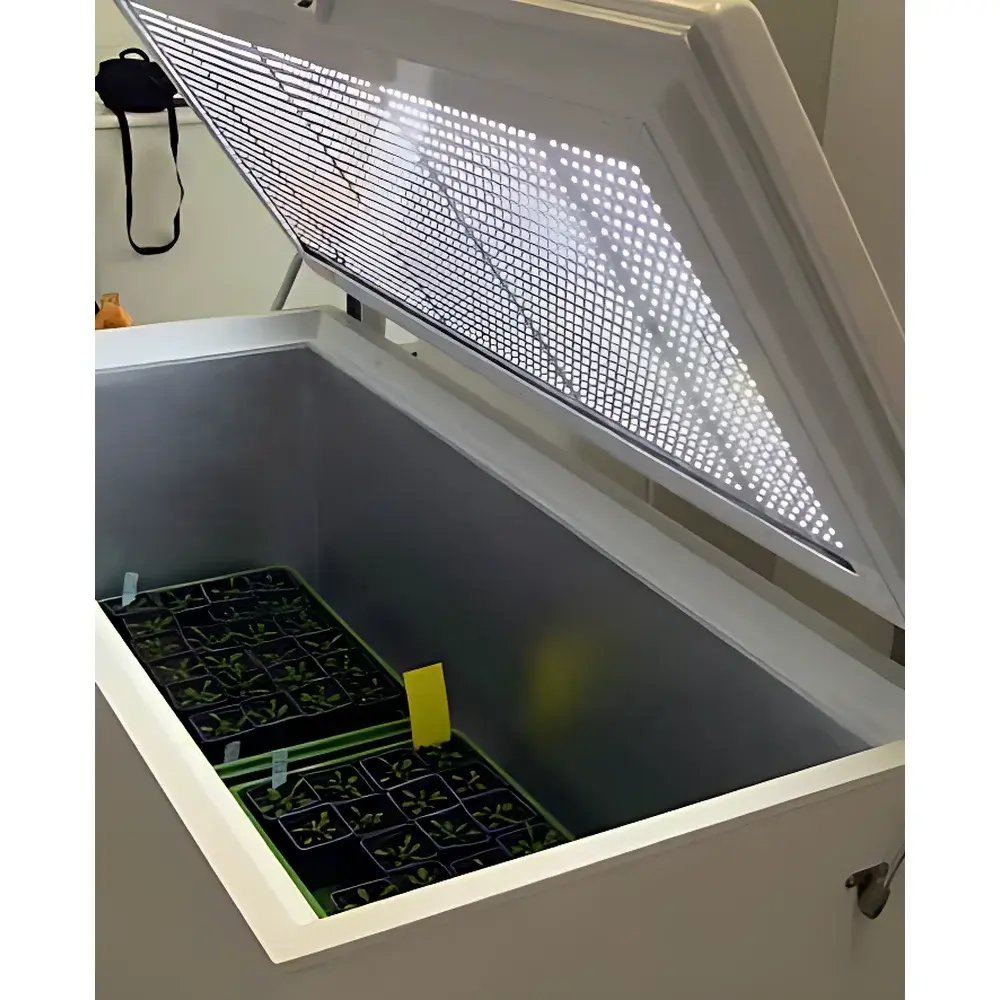
PSI FS Series Intelligent LED-Powered Plant Growth Chambers
| Brand | PSI |
|---|---|
| Origin | Czech Republic |
| Model | FS Series (FS130, FS360, FS-RI, LED Benchtop) |
| Temperature Range | 0–40°C (configurable to 7–55°C with optional upgrade) |
| Light Source | Cool White + IR (optional RGB + IR quad-channel) |
| Photosynthetic Photon Flux Density (PPFD) | 0–1500 µmol·m⁻²·s⁻¹ (model-dependent) |
| Humidity Control | 40–80% RH (FS-RI only) |
| Air Exchange Rate | 250–1200 L/hr |
| Touch Interface | 10.5-inch capacitive touchscreen (FS-RI) |
| Compliance | Designed for GLP-compliant plant phenotyping and circadian biology research |
Overview
The PSI FS Series Intelligent LED-Powered Plant Growth Chambers are precision-engineered environmental control systems designed for reproducible, long-term physiological studies in plant science, algal physiology, entomology, and chronobiology. These chambers integrate high-fidelity programmable LED lighting with tightly regulated temperature, humidity (in FS-RI), and gas composition (with optional O₂/CO₂ mixing modules) to replicate natural and experimentally defined photobiological conditions. Unlike conventional fluorescent or HID-based growth chambers, the FS Series employs spectrally tunable, thermally decoupled LED arrays—enabling precise control over photosynthetic photon flux density (PPFD), spectral quality (e.g., red:far-red ratio), and dynamic light regimes including circadian entrainment, cloud cover simulation, twilight transitions, and photoperiodic ramping. The system operates on a closed-loop PID-controlled architecture with real-time sensor feedback (PT100 temperature probes, capacitive RH sensors, quantum PAR meters), ensuring stability within ±0.3°C and ±3% RH (FS-RI) across extended experimental durations.
Key Features
- Multi-wavelength LED illumination: Standard cool white + infrared (730 nm) configuration; optional RGB + IR quad-channel array for spectral fine-tuning and phytochrome-specific stimulation
- Dynamic light programming: Onboard scheduler supports complex diel cycles, stochastic cloud cover patterns, sunrise/sunset gradients, and user-defined irradiance ramps
- Temperature control range: Standard 0–40°C; extended range of 7–55°C available via compressor upgrade (FS130/FS360) or dual-stage refrigeration (FS-RI)
- Uniform irradiance distribution: Optimized optical design ensures <±5% spatial PPFD homogeneity across active growth zones (validated per ISO 17025-accredited protocols)
- Low-thermal-load lighting: LED modules mounted externally or on reflective baffles eliminate radiant heating at sample level—critical for leaf surface temperature integrity
- Modular ventilation: Adjustable laminar airflow (250–1200 L/hr) with HEPA-filtered intake and passive exhaust dampers minimizes cross-contamination and thermal stratification
- Integrated human-machine interface: 10.5-inch industrial-grade touchscreen (FS-RI) with intuitive drag-and-drop protocol builder and real-time environmental overlay graphs
Sample Compatibility & Compliance
The FS Series accommodates diverse biological models—including Arabidopsis thaliana seedlings, rice tillers, microalgae cultures in flat-panel bioreactors, Drosophila vials, zebrafish larval trays, and murine metabolic cages—without compromising environmental fidelity. Chamber interiors feature corrosion-resistant stainless steel (AISI 304) construction, non-outgassing polymer shelving (FDA-compliant polypropylene), and UV-stabilized acrylic viewing windows. All models comply with IEC 61000-6-3 (EMC emissions) and IEC 61000-6-2 (immunity). The FS-RI variant meets ISO 14644-1 Class 8 cleanroom air standards when equipped with optional HEPA recirculation. Data logging adheres to ALCOA+ principles (Attributable, Legible, Contemporaneous, Original, Accurate, Complete, Consistent, Enduring, Available), supporting 21 CFR Part 11 readiness when paired with PSI’s validated firmware version 4.2+ and external audit trail servers.
Software & Data Management
Chambers operate under PSI ClimateControl™ v5.1 firmware—a deterministic real-time OS with dual redundant storage (onboard eMMC + removable SD card). Protocols are authored using a graphical workflow editor supporting nested loops, conditional triggers (e.g., “if PPFD drops below 200 µmol·m⁻²·s⁻¹, activate supplemental IR”), and inter-chamber synchronization. Raw sensor data (temperature, RH, PPFD, CO₂/O₂ if installed) is timestamped at 1 Hz resolution and exported in CF-NetCDF format compliant with FAIR data principles. Optional integration with LabArchives ELN or Thermo Fisher SampleManager enables automated metadata injection (e.g., genotype, treatment ID, harvest time). Remote monitoring and alarm escalation (SMS/email) are supported via TLS 1.3-secured MQTT broker connection.
Applications
- Phenotypic screening under controlled photoperiodic stress (e.g., short-day flowering induction in soybean)
- Circadian clock entrainment studies in model organisms using phase-shifted light pulses
- Algal biomass optimization via dynamic spectral tuning (e.g., enhancing astaxanthin yield in Haematococcus pluvialis)
- Insect eclosion timing assays under simulated seasonal photoperiods and temperature gradients
- Pre-clinical metabolic phenotyping: Coupling with indirect calorimetry systems (e.g., Sable Systems Promethion) for whole-animal energy expenditure under photobiologically defined conditions
- Seed dormancy release experiments using precisely modulated red/far-red light ratios
FAQ
What is the maximum PPFD achievable across FS Series models?
FS130 supports up to 1500 µmol·m⁻²·s⁻¹; FS360 up to 500 µmol·m⁻²·s⁻¹; FS-RI standard configuration delivers 400 µmol·m⁻²·s⁻¹ (upgradable to 1200 µmol·m⁻²·s⁻¹ via high-power LED retrofit kit).
Can multiple FS chambers be synchronized for large-scale replicate experiments?
Yes—via Ethernet-connected master-slave configuration using NTP time sync and shared protocol templates; latency <10 ms between chamber state updates.
Is humidity control available on all models?
Humidity regulation (40–80% RH, ±3%) is exclusive to the FS-RI model; other variants maintain ambient RH only.
Does the system support third-party gas analyzers for real-time CO₂/O₂ feedback control?
Yes—RS-485 Modbus RTU and analog 0–10 V inputs allow integration with Vaisala CARBOCAP® or Sable Systems O₂ analyzers for closed-loop gas modulation.
What validation documentation is provided for GxP-regulated environments?
Each unit ships with Factory Acceptance Test (FAT) report, IQ/OQ protocol templates, and calibration certificates traceable to NIST standards for temperature, RH, and PAR sensors.




