
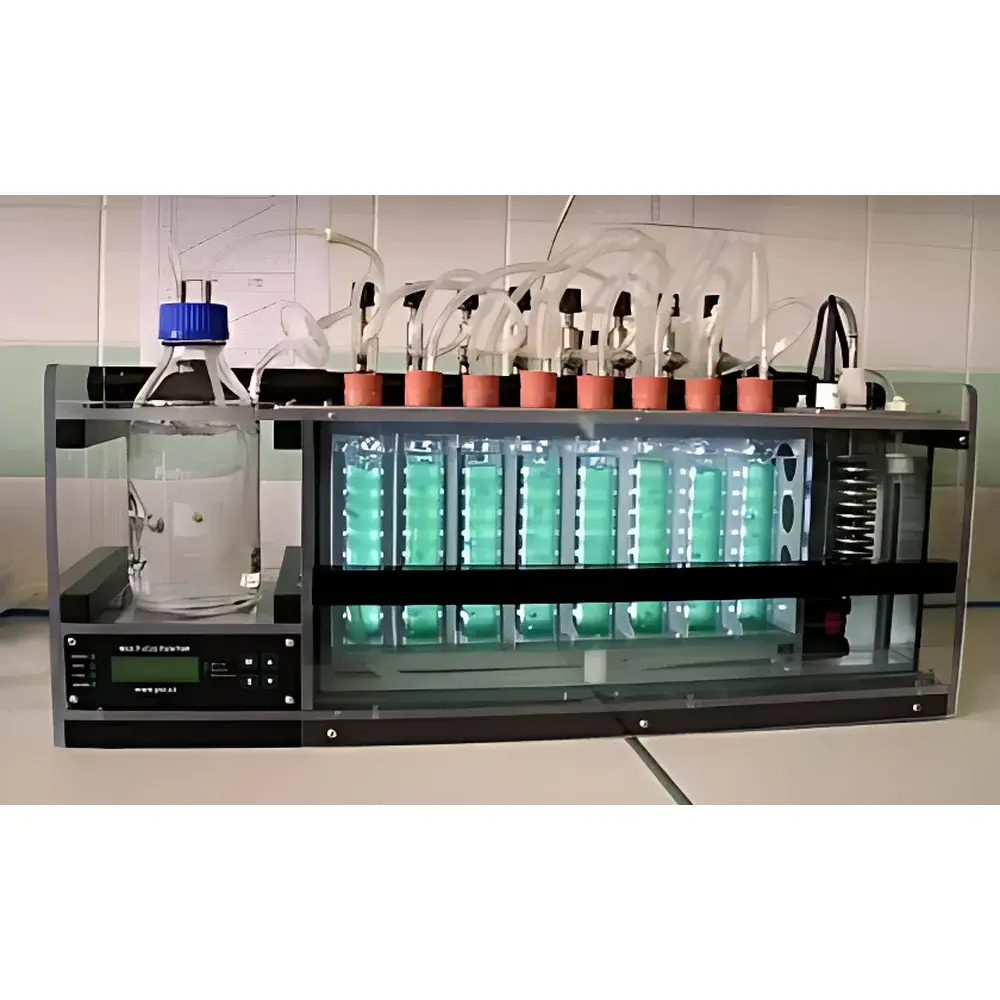
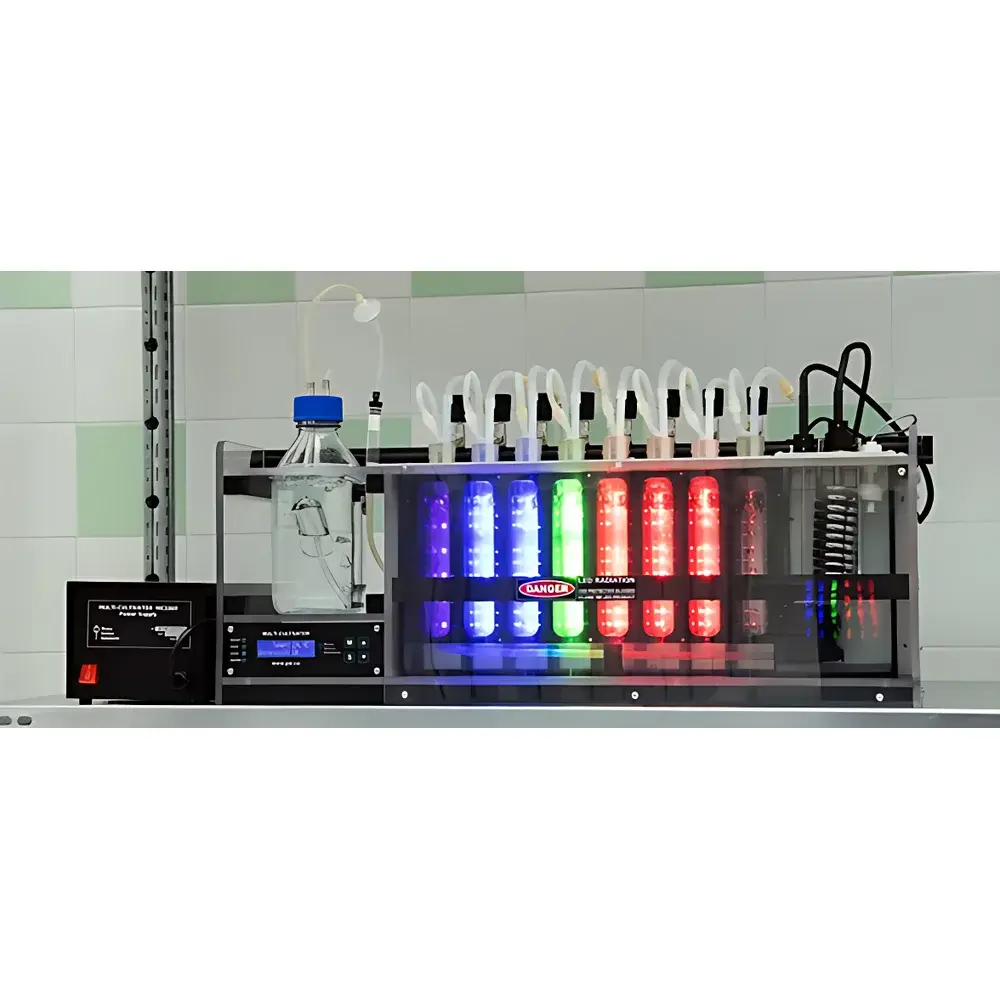
PSI MC1000 8-Channel Algal Cultivation and Real-Time Monitoring System
| Brand | PSI |
|---|---|
| Origin | Czech Republic |
| Model | MC1000 |
| Channel Count | 8 |
| Culture Vessel Capacity | 100 mL (max. 85 mL working volume) |
| Optical Density Monitoring | OD₆₈₀ & OD₇₂₀ per channel |
| Light Source | Tunable LED array (0–2500 µmol/m²/s), wavelength options include 405 nm, 450 nm, 470/475 nm, 530/540 nm, 590 nm, 615 nm, 660 nm, 730 nm |
| Temperature Control | Water-bath heating (150 W), standard range: ambient +5°C to 60°C |
| optional refrigerated range | 15–60°C |
| Water Bath Volume | 5 L |
| Gas Mixing | Optional GMS150 precision gas blending system (N₂/air/CO₂) |
| Dissolved O₂ & CO₂ Monitoring | Optional 8-channel electrochemical/O₂ sensor and NDIR CO₂ analyzer (0–5% or 0–15% range, resolution ≤1 ppm) |
| Fluorescence Module | Optional probe-based or cuvette-based measurement of Ft, QY, OJIP, NPQ, and light-response curves |
| Software | PBR Control Suite (Basic or Advanced Edition), supporting real-time regression analysis, database logging, GUI-based protocol scheduling, email alerts, and GLP-compliant audit trail (Advanced Edition) |
| Power Supply | 110–240 V AC |
| Dimensions | 71 × 33 × 21 cm |
| Weight | 13 kg |
Overview
The PSI MC1000 is an engineered platform for high-precision, multi-parameter algal physiology research under controlled environmental conditions. Designed around Couette-type photobioreactor principles, it integrates synchronized 8-channel cultivation with real-time optical density (OD680 and OD720) monitoring, programmable spectral LED illumination, water-bath temperature regulation, and optional dissolved gas (O2/CO2) and chlorophyll fluorescence quantification. Each 100 mL culture tube operates as an independent bioreactor unit, enabling parallel experimental designs—such as dose–response gradients, spectral quality comparisons, or time-series growth kinetics—under rigorously reproducible conditions. The system supports both batch and turbidostat modes (with optional恒浊 module), and its architecture conforms to fundamental requirements for GLP-compliant ecotoxicological and physiological studies, including traceable parameter logging, user-access control, and electronic record integrity per FDA 21 CFR Part 11 guidelines when used with the Advanced PBR Software Edition.
Key Features
- Eight independent 100 mL culture channels, each with dedicated OD680/OD720 detection using PIN photodiodes and 665–750 nm bandpass filters
- Programmable LED illumination per channel: intensity adjustable from 0 to 2500 µmol/m²/s; spectral configurations include single-wavelength (e.g., MC1000-OD-WW), multi-wavelength (MC1000-OD-MULTI), or mixed-spectrum (MC1000-OD-MIX) variants
- Dynamic light programming: sine-wave, circadian, pulse, and stepwise profiles supported via onboard controller or PBR software
- Water-bath thermal control (5 L volume) with 150 W heater; optional active cooling extends operational range to 15–60°C
- Manual multi-valve gas flow regulation for individual tube aeration; compatible with automated GMS150 high-precision gas mixing system (N₂/air/CO₂)
- Integrated touchscreen interface for local protocol setup, real-time data visualization, and memory-based data export (TXT/Excel)
- Modular expandability: optional O2/CO2 analyzers, fluorescence modules (Ft, QY, OJIP, NPQ), and turbidostat valves
Sample Compatibility & Compliance
The MC1000 accommodates standard suspension cultures of freshwater and marine microalgae—including Chlamydomonas reinhardtii, Nannochloropsis gaditana, Tisochrysis lutea, and Synechocystis sp. PCC 6803—without modification to vessel geometry or optical path. Its design aligns with ISO 8692:2012 (freshwater algal growth inhibition tests) and ASTM D5664-21 (standard guide for algal bioassays), facilitating regulatory submissions in ecotoxicology and environmental risk assessment. All firmware and PBR software editions support audit trail generation, electronic signatures, and role-based access control—meeting core requirements for GLP and GMP-aligned laboratories conducting OECD 201 or EPA OPPTS 850.4500-compliant studies.
Software & Data Management
The PBR Control Suite provides two deployment tiers: Basic Edition (supports up to two MC1000 units) and Advanced Edition (unlimited device integration). Both versions deliver real-time OD-derived growth rate regression, dynamic protocol scheduling, and CSV/TXT data export. The Advanced Edition adds SQL-based database logging, automated email notifications upon threshold breaches, user-defined script execution (Python-compatible API), scheduled experiment initiation, and full integration with the GMS150 gas mixing system. All software modules implement timestamped metadata tagging—including instrument ID, operator login, calibration history, and environmental setpoints—to satisfy 21 CFR Part 11 electronic record retention mandates.
Applications
- Multi-channel comparative studies of photosynthetic efficiency across light spectra and intensities
- Time-resolved monitoring of algal biomass accumulation during adaptive laboratory evolution (ALE) experiments
- Carbon-concentrating mechanism (CCM) characterization via concurrent CO2 uptake and O2 evolution kinetics
- Photoprotective response profiling using fluorescence induction (OJIP) and non-photochemical quenching (NPQ) assays
- Ecotoxicological screening under environmentally relevant stress gradients (e.g., nutrient limitation, pH shift, contaminant exposure)
- Strain selection and bioprocess optimization for lipid, carotenoid, or recombinant protein production
FAQ
Can the MC1000 operate in turbidostat mode?
Yes—when equipped with the optional恒浊 control module, the system maintains constant optical density across all eight channels via automated valve-regulated media exchange, enabling steady-state physiological analysis.
Is remote monitoring supported?
The Advanced Edition of PBR Software enables secure remote access via Ethernet/Wi-Fi, allowing real-time dashboard viewing, protocol updates, and alarm management from external workstations.
What calibration standards are recommended for OD measurements?
Users should perform daily zero-point calibration using sterile medium and reference against NIST-traceable polystyrene microsphere suspensions at known concentrations (e.g., 10⁶ cells/mL C. reinhardtii).
Does the system comply with FDA 21 CFR Part 11?
Full compliance requires use of the Advanced Edition PBR Software with enabled audit trail, electronic signature, and permission-level controls—validated per internal SOPs aligned with Part 11 Annex A guidance.
Can fluorescence and OD be measured simultaneously in the same tube?
Yes—the optional fluorescence module supports either fiber-optic probe insertion or cuvette-based sampling without interrupting continuous OD monitoring, provided the selected configuration avoids optical interference between excitation/emission bands and OD detection wavelengths.







