
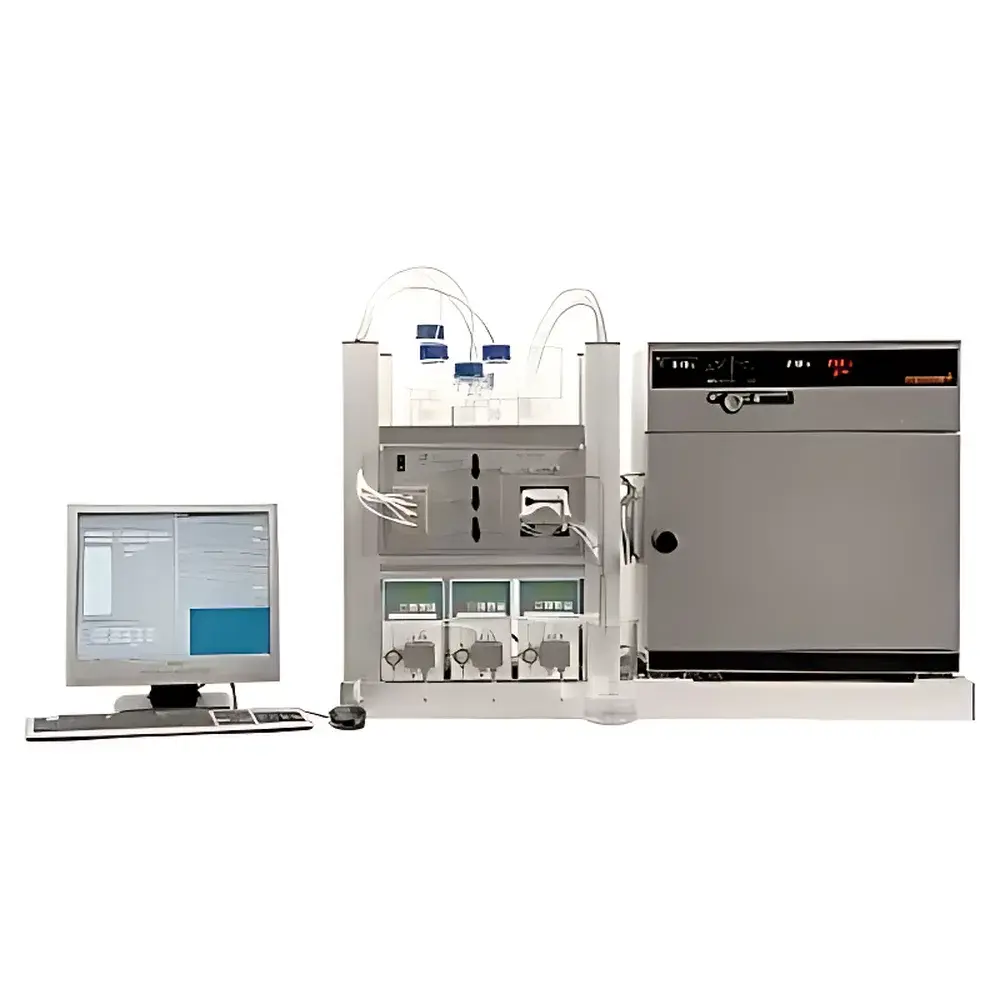
PSL DSL Differential Scale Loop Tester
| Origin | Germany |
|---|---|
| Manufacturer Type | Authorized Distributor |
| Origin Category | Imported |
| Model | DSL |
| Pricing | Available Upon Request |
Overview
The PSL DSL Differential Scale Loop Tester is a fully automated, benchtop-scale laboratory system engineered for quantitative evaluation of scale formation kinetics and antiscalant performance under dynamically controlled hydrothermal conditions. Based on the differential scale loop principle—a closed-loop recirculating flow configuration—the instrument replicates real-world scaling mechanisms observed in oilfield production tubing, desalination brine lines, geothermal injection systems, and industrial cooling circuits. It operates by precisely metering and mixing three independent aqueous streams—typically comprising calcium/barium sulfate–saturated brine (anionic), divalent cation solution (e.g., Ba²⁺ or Ca²⁺), and a titrated antiscalant formulation—into a thermally and hydraulically regulated model pipe segment. Scaling propensity is assessed via real-time pressure drop monitoring across the test section, complemented by post-test visual inspection, SEM-EDS surface analysis, and ICP-OES quantification of precipitated mass. The core measurement principle relies on differential pressure evolution as a proxy for incipient deposit accumulation, enabling detection of sub-micron crystallization onset and growth inhibition thresholds.
Key Features
- Triple high-precision HPLC-grade peristaltic pumps (0.001–9.99 mL/min each; total flow up to 29.97 mL/min) with independent programmable control for stoichiometric mixing of scaling and inhibitor solutions
- Thermally insulated stainless-steel model pipe section (standard: 2 m length, 0.88 mm ID, 1/16″ OD) rated for continuous operation from 30 °C to 250 °C (86–482 °F)
- Hydraulic pressure control range: 3.4–51.7 bar (49–750 psi), with integrated pressure transducers and safety relief valves compliant with PED 2014/68/EU
- Automated cleaning cycle using low-viscosity solvent flush and reverse-flow purge, minimizing manual intervention between tests
- Modular pipe geometry support: optional custom-length and diameter test sections (e.g., 0.5–5 m; ID 0.5–3.2 mm) to emulate field-specific Reynolds numbers and shear profiles
- Integrated temperature-compensated pressure differential sensors with <±0.5% FS accuracy and 10 Hz sampling rate
Sample Compatibility & Compliance
The DSL system accommodates aqueous brines containing sulfate, carbonate, phosphate, and oxalate anions, as well as multivalent cations (Ba²⁺, Sr²⁺, Ca²⁺, Mg²⁺) at concentrations up to saturation. Compatible antiscalants include phosphonates (e.g., ATMP, HEDP), polyacrylates, copolymers (e.g., AA/MA), and green inhibitors (e.g., polyaspartate). All wetted components are constructed from 316L stainless steel, Hastelloy C-276, or PEEK—ensuring chemical resistance per NACE MR0175/ISO 15156. The system supports GLP-compliant operation: full audit trail logging, user access levels, electronic signatures, and data integrity per FDA 21 CFR Part 11 requirements when used with WinDSL software v4.2 or later.
Software & Data Management
WinDSL software provides a deterministic test sequencing environment for method development, execution, and reporting. Users define multi-step protocols—including ramped temperature/pressure profiles, variable inhibitor dosing gradients (e.g., 0.5–10 ppm), and timed sampling intervals—with automatic synchronization of pump rates, thermal setpoints, and data acquisition. Raw differential pressure, temperature, and flow data are logged at configurable intervals (1 s–10 min) and exported in CSV or ASTM E1447-compliant .xdf format. Post-processing tools include derivative-based scaling onset detection, normalized pressure rise rate calculation (d(ΔP)/dt), and comparative efficacy ranking across antiscalant chemistries. All calibration records, method versions, and operator logs are stored in an encrypted SQLite database with SHA-256 hashing for traceability.
Applications
- Quantitative screening of antiscalant candidates against barium sulfate (BaSO₄), strontium sulfate (SrSO₄), and calcium carbonate (CaCO₃) scaling under reservoir-relevant T/P conditions
- Determination of minimum effective dosage (MED) and threshold inhibition concentration (TIC) per ISO 20630:2019
- Assessment of antiscalant thermal stability and hydrolytic degradation kinetics at elevated temperatures
- Validation of scaling risk models (e.g., STABCAL, ScaleSoftPitzer) using empirical kinetic datasets
- Support for regulatory submissions requiring experimental verification of scale control strategies (e.g., OSPR, BSEE, EU REACH Annex XI)
FAQ
What types of scaling minerals can be evaluated with the DSL system?
Barium sulfate (BaSO₄), strontium sulfate (SrSO₄), calcium carbonate (CaCO₃), calcium sulfate (CaSO₄·2H₂O), and mixed-salt scales formed in high-TDS brines.
Is the system suitable for testing biodegradable or “green” antiscalants?
Yes—WinDSL supports extended-duration tests (up to 168 h) required to assess time-dependent performance loss due to enzymatic or oxidative degradation.
Can the DSL generate data compliant with ISO 20630 or NACE TM0212?
Yes—the standardized test templates and reporting modules align with ISO 20630 Annex A and NACE TM0212 Section 5.3 for comparative antiscalant evaluation.
What maintenance is required between experiments?
After each run, the automated cleaning cycle executes a 30-min solvent flush followed by nitrogen purge; only periodic calibration of pressure transducers and pump volume verification is needed per ASTM D3487.
Does PSL provide method development support for new scaling chemistries?
Yes—application engineers offer remote protocol optimization services, including brine composition modeling, shear rate selection, and statistical design of experiments (DoE) for dose-response characterization.





