
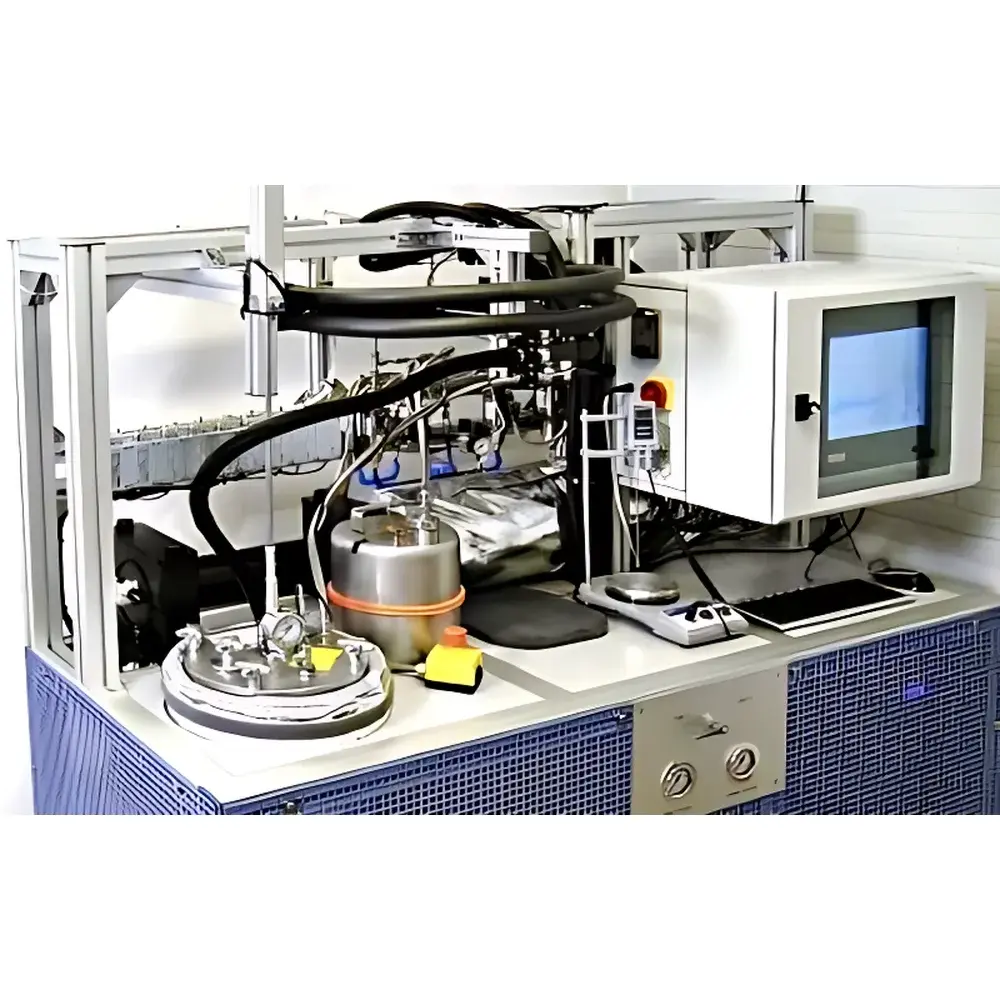
PSL TR Turbulence Rheometer for Drag Reducing Agent (DRA) Screening
| Origin | Germany |
|---|---|
| Manufacturer Type | Authorized Distributor |
| Origin Category | Imported |
| Model | TR |
| Pricing | Upon Request |
| Reynolds Number | up to 80,000 (with 5 mm capillary, water) |
| Temperature Range | −10 °C to 80 °C |
| Maximum Pressure | 35 bar |
| Capillary Diameters | 3 mm and 5 mm |
| Capillary Length | 3.5 m |
| Sample Volume Requirement | 0.5 L – 3.0 L |
Overview
The PSL TR Turbulence Rheometer is a purpose-built, high-precision instrument engineered for the quantitative evaluation of drag reducing agents (DRAs) under fully developed turbulent flow conditions. Unlike conventional rotational or capillary viscometers, the TR operates on a controlled-pressure, constant-flow capillary rheometry principle—leveraging hydrodynamic isolation between hydraulic drive fluid and test fluid via a dual-piston system. This architecture eliminates interfacial contamination and ensures strict thermodynamic and rheological control over the sample during measurement. The core measurement domain spans Reynolds numbers from transitional to fully turbulent regimes (up to Re = 80,000 using a 5 mm internal diameter capillary with water at 20 °C), enabling direct quantification of drag reduction efficiency (DRE) as defined by ASTM D6479 and ISO 13022. The instrument’s seamless, edge-free capillary geometry—free of diameter transitions or flow disturbances—guarantees laminar-to-turbulent transition fidelity and minimizes secondary flow artifacts, making it suitable for both R&D screening and formulation validation in pipeline transport, oilfield chemistry, and polymer additive development.
Key Features
- Hydraulically isolated dual-piston drive system: eliminates cross-contamination between drive medium and test fluid while enabling precise force transmission and inertial compensation
- Temperature-controlled measurement path: capillary tube, sample column, and reservoir are independently regulated within −10 °C to 80 °C (±0.1 °C stability), critical for evaluating thermally sensitive DRAs such as polyacrylamide or HPAM derivatives
- Modular capillary configuration: interchangeable 3 mm and 5 mm ID stainless steel capillaries (3.5 m length), each calibrated per ISO 11443 Annex B to support wide-range Reynolds number coverage and shear rate scalability
- High-fidelity pressure metrology: dual-sensor differential pressure measurement across capillary segments, traceable to NIST standards, supporting both direct ΔP recording and segmented pressure loss analysis
- Low sample consumption design: validated operation with only 0.5–3.0 L of test fluid—enabling rapid screening of expensive or low-yield candidate formulations
- Rigid, vibration-damped mechanical architecture: minimizes flow pulsation and acoustic coupling, ensuring signal integrity during high-Re turbulence characterization
Sample Compatibility & Compliance
The TR accommodates Newtonian and non-Newtonian fluids—including aqueous polymer solutions, hydrocarbon-based dispersants, and microemulsions—without requiring dilution or pre-shearing. Its contamination-free piston sealing mechanism and chemically resistant wetted path (316L SS capillary, FKM elastomers) ensure compatibility with aggressive solvents and high-salinity brines. The system meets structural and procedural requirements for GLP-compliant laboratories: full audit trail logging, user-access controls, and electronic signature support align with FDA 21 CFR Part 11. Test protocols conform to ASTM D6479 (Standard Test Method for Determining Drag Reduction Efficiency of Polymeric Additives in Turbulent Flow) and ISO 13022 (Plastics — Determination of the drag-reducing effect of additives in turbulent pipe flow). Calibration certificates include uncertainty budgets compliant with ISO/IEC 17025.
Software & Data Management
TR-Control Suite v4.x provides real-time acquisition, automated Reynolds number calculation (Re = ρVD/μ), and DRA performance metrics including % drag reduction, onset Reynolds number, and maximum efficacy concentration. Raw pressure, temperature, flow rate, and time-series data are stored in HDF5 format with embedded metadata (operator ID, ambient conditions, calibration epoch). Export options include CSV, MATLAB .mat, and ASTM E1975-compliant XML for LIMS integration. All software modules undergo annual verification against NIST-traceable reference datasets; version history and change logs are retained for regulatory review. Optional add-ons include automated concentration ramping, multi-capillary sequence scheduling, and comparative overlay analysis across historical batches.
Applications
- Screening and ranking of synthetic and biopolymeric DRAs for crude oil, refined products, and water injection systems
- Determination of optimal dosage concentration curves under varying temperature and salinity conditions
- Stability assessment of DRA solutions under thermal aging and shear degradation protocols
- Validation of computational fluid dynamics (CFD) models with experimentally derived turbulent friction factor data
- Supporting API RP 14E and ISO 13703 pipeline design calculations through empirical f–Re–DRA correlations
- Quality control testing for commercial DRA manufacturing in accordance with ISO 9001:2015 Clause 8.5.1
FAQ
What Reynolds number range can the TR achieve with non-aqueous fluids?
The achievable Reynolds number depends on fluid density, viscosity, velocity, and capillary geometry. Using the 5 mm capillary at 35 bar driving pressure, typical hydrocarbon systems (e.g., diesel, kerosene) reach Re ≈ 45,000–65,000; detailed prediction requires input of fluid property data into TR-Control’s built-in Re calculator.
Is the TR compatible with corrosive or high-salinity brines?
Yes—the capillary, piston seals, and sample reservoir employ corrosion-resistant materials (316L stainless steel, perfluoroelastomer seals), and have been validated with 25 wt% NaCl brines at 70 °C for >500 h continuous operation.
Can the system be integrated into an existing laboratory automation framework?
The TR supports OPC UA and Modbus TCP protocols; APIs for Python and LabVIEW are available under NDA for custom SCADA or MES integration.
Does the instrument provide traceable calibration documentation?
Each unit ships with a UKAS-accredited calibration certificate covering pressure transducers (±0.05% FS), temperature sensors (±0.03 °C), and volumetric flow verification (±0.15%); recalibration intervals follow ISO/IEC 17025 guidelines.
How is wall slip mitigated during high-concentration polymer testing?
The TR employs a surface-finish-optimized capillary (Ra < 0.2 µm), combined with extended equilibration periods and dynamic zero-offset correction algorithms to suppress apparent slip effects below 0.5% relative error.





